
Starting on July 30, 2026, attackers began exploiting a five-year-old vulnerability in the firmware of Coldcard hardware wallets, developed by Coinkite, to systematically steal bitcoins from devices that turned out to be vulnerable.
The problem originates in a firmware release published in March 2021. Because of an error in the software build process, seed phrase generation in some cases did not use the hardware random number generator, as the developers had intended, but a much weaker software pseudorandom number generator.
Blockchain analysis shows that most of the stolen funds are so far being accumulated on a small number of addresses controlled by the attackers, while further movement of the assets remains minimal. At the same time, differences in the way transactions were formed during the various waves of attacks suggest that several separate participants may be behind the thefts.
Thus, this incident became the third-largest hack in the cryptocurrency industry in 2026, and the total damage from all known attacks since the beginning of the year has exceeded $1.2 billion.
As with many other large-scale cases of crypto asset compromise, the real scale of the incident will most likely become known gradually. The stolen funds continue to move across the blockchain, and many wallet owners discover the theft only months or even years later. For this reason, current estimates should be considered preliminary. For the same reason, and because of signs of several attackers being involved, specialists are not yet linking the attack to any particular hacker group.
Four waves of attacks: 1,816 BTC from 5,200 addresses
On July 30, 2026, attackers began mass-withdrawing bitcoins from wallets protected by Coldcard hardware devices.
It later became clear that this was only the first stage of the operation. Over the next four days, three more large-scale waves of theft took place. As of today, around 1,816 BTC worth about $116M is known to have been stolen from more than 5,200 addresses. While this research was being prepared, the fourth wave of transactions was still queued for confirmation (mempool).
The cause of the vulnerability: Coldcard's 2021 firmware and 40 bits
The attack became possible because of a bug in the firmware of Coldcard hardware wallets. Firmware version 4.0.1, released in March 2021, contained a software bug that caused some devices to create seed phrases with significantly less randomness than the developers had intended. As a result, private keys created on such devices turned out to be vulnerable to exhaustive brute force.
A firmware update fixes the problem only for new wallets created after the corrected version of the software is installed. However, existing wallets whose seed phrases were generated on the vulnerable firmware remain at risk.
Therefore, users who created wallets on affected versions of Coldcard need to generate a new seed phrase and fully move their funds to a new wallet.
What happened to the stolen funds: Wasabi and Tornado Cash
Most of the stolen funds are still concentrated on a small number of addresses controlled by the attackers. So far, attempts to hide the origin of the stolen bitcoins have been minimal. Only one transfer of 64.9 BTC through a Wasabi wallet and a transfer of 200 ETH to the Tornado Cash service on August 4, 2026, have been recorded.
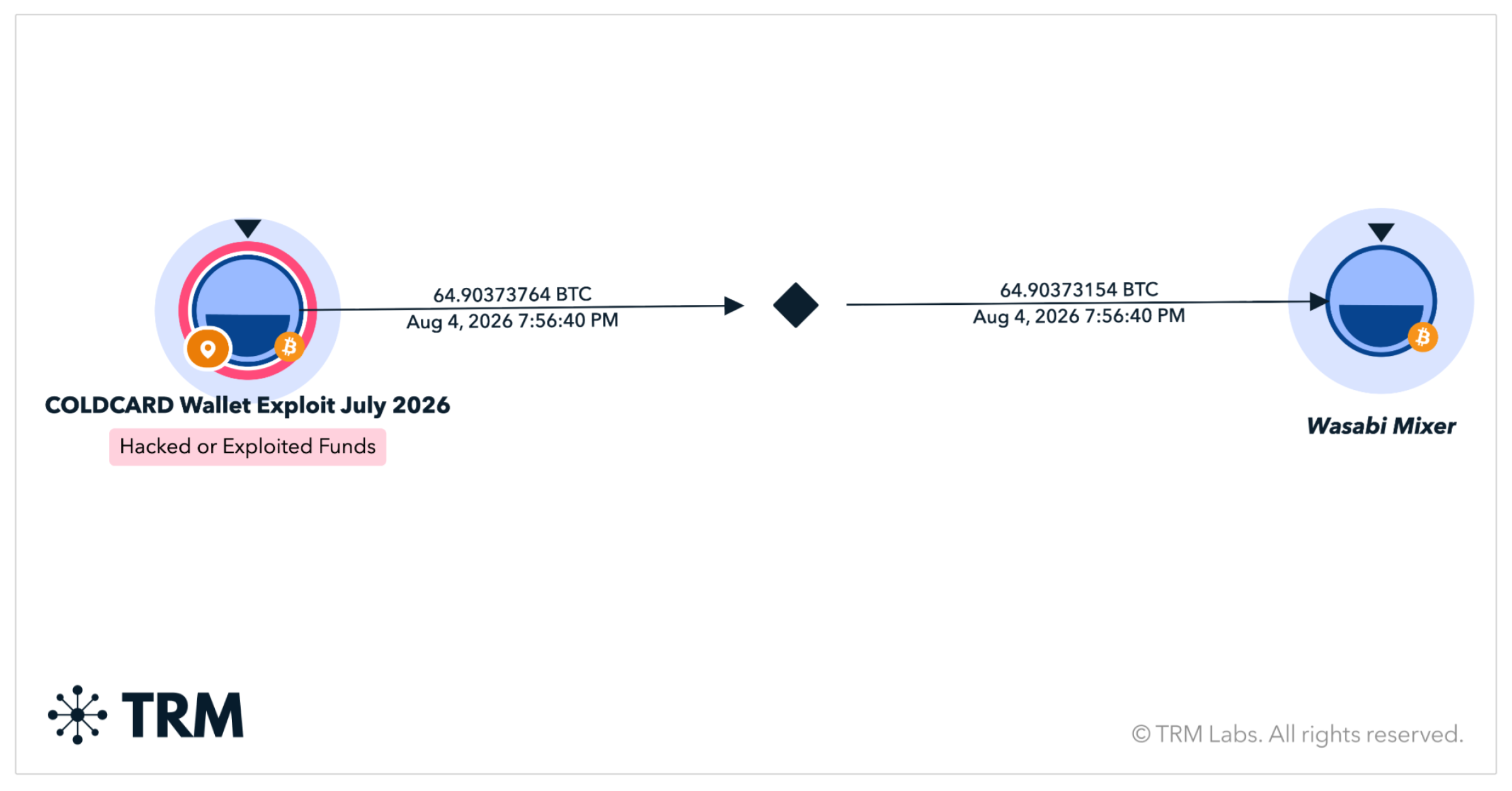
If funds did leave the initial addresses, this was usually limited to just one additional transfer to another address for consolidation. More complex schemes to hide the trail — multi-step transfers, splitting amounts, or coin mixing — are not yet observed. This may indicate that the attacker (or group of attackers) has not yet decided how to more safely cash out such a large sum, which will inevitably attract attention no matter where it is sent.
Such behavior differs markedly from the actions of professional hacker groups that specialize in cryptocurrency theft. For example, well-known North Korean operators usually begin actively laundering stolen funds within the first hours or days after an attack, using a large number of intermediate addresses and various services to obfuscate the transaction chain.
One such message contained an offer to help launder the stolen funds for a 7% fee. It cannot be ruled out that the author of the message was a scammer himself, trying to deceive the hackers, but the very appearance of such offers shows how quickly representatives of the shadow market try to take advantage of high-profile cryptocurrency thefts, advertising their services directly through the blockchain.
What the incident means for self-custody of cryptocurrency
2026 has already been marked by several of the largest DeFi protocol hacks, attacks on centralized cryptocurrency exchanges, and now one of the largest compromises of hardware wallets has been added to them.
This case clearly shows that self-custody of cryptocurrency does not eliminate the risks completely — it merely shifts responsibility for security onto the asset owner. Even the most reliable hardware wallet becomes vulnerable if an error was made back at the private key generation stage. That is why the quality of the firmware and the random number generation mechanism are just as important as the hardware protection of the device itself.
Even open source code and numerous independent audits cannot guarantee absolute security. Device firmware and random data generation algorithms require constant checking and monitoring. An additional layer of protection can be multisignature wallets (multisig), which use several independent hardware devices from different manufacturers and different sources of random number generation. This approach significantly reduces dependence on one particular implementation and makes a successful attack considerably more difficult.
To protect their funds, it is recommended to create a new wallet on the updated version of the device, verify the fingerprint of the new wallet and of one of the receiving addresses, and then first make a small test transfer. Only after confirming that the funds have successfully arrived at the new wallet should the remaining balance be transferred.
