
Between May 7 and August 20, 2026, the United States sanctioned 80 Cuban individuals and entities across nine separate packages.
The Cuban economy has lived under US sanctions for more than 60 years, but for most of that time this meant a broad embargo, supplemented from time to time by individual sanctions against specific people and organisations. Executive Order 14404, signed in May 2026, created a new sanctions programme focused on repression by the Cuban government and on threats to US national security inside Cuba.
Documented sanctions-evasion channels in Cuba
As sanctions have tightened, the ways of moving money and other value into and out of Cuba have shifted towards two documented channels that let sanctioned structures transact with a lower chance of being flagged automatically.
The first channel involves transferring assets and operations to a new legal entity. One example is the Port of Mariel, Cuba's main container port. Shortly before sanctions were imposed on the port, its operator moved the port's assets to a newly created company and kept operating through the new legal entity until OFAC sanctioned that company as well a month later.
The second channel involves trade.
Although many assumed that crypto could become a third sanctions-evasion channel for Cuba, the available data does not yet support this. To date, no crypto address has been included in sanctions measures against vessels, companies or individuals under this executive order. Cuba has licensed a single crypto service provider — Ebioro, a company registered in Lithuania, which received a total of $437K between July 2025 and August 2026. Cuba-related activity on unlicensed exchanges remains small and concentrated among retail users. Meanwhile, the two fiat-based channels described above are already being used actively by sanctioned Cuban structures and create risk for non-US companies that want to avoid inadvertently breaching sanctions.
Sanctions against Cuba escalate sharply in mid-2026
The US administration signed Executive Order 14404 on May 1, 2026. The first sanctions measures followed six days later and have continued without pause ever since.
The order gives the US Secretary of State and the Secretary of the Treasury the authority to sanction foreign persons operating in Cuba's energy sector, its defence industry and related fields, metals and mining, financial services and the security sector. The programme may later be extended to other industries. The order also covers those who provide goods or services in support of the Cuban government or of a blocked person, their officers and directors, and adult members of their families. This combination of provisions creates sanctions exposure for foreign shipowners, operators, charterers, brokers and insurers working with sanctioned Cuban parties, because the logic of the sanctions rests not only on specific company names but also on sectoral ties.
What the EU's 21st sanctions package changed for crypto platforms — in a separate articleNine sanctions packages from May 7 to August 20, 2026
- May 7 (3) — Ania Guillermina Lastres Morera, along with GAESA and Moa Nickel, which were already covered by the 1963 embargo and were re-designated under the new executive order.
- May 18 (14) — the Ministry of the Interior, the National Revolutionary Police and Cuba's Intelligence Directorate, responsible for foreign intelligence, as well as Juan Esteban Lazo Hernández, president of the National Assembly, and ten other senior officials.
- June 4 (10) — Miguel Díaz-Canel Bermúdez, the sitting president of Cuba, along with four of his relatives and close associates, the Ministry of the Revolutionary Armed Forces, the Committees for the Defense of the Revolution and three tourism and mining companies.
- June 11 (1) — CUPET, the state oil company.
- June 23 (6) — Almacenes Universales, RAFIN, Banco Financiero Internacional, GEOMINERA and the José Martí steel mill.
- July 13 (10) — GECOMEX and GEMAR, the state structures responsible for foreign trade and maritime shipping, plus the Ministry of Tourism.
- July 23 (11) — including Coral Marítima and the Mariel container terminal.
- August 6 (13) — entities linked to weapons imports and international military cooperation.
- August 20 (12) — companies linked to construction, nickel and metals trading.
Payment channels close within weeks
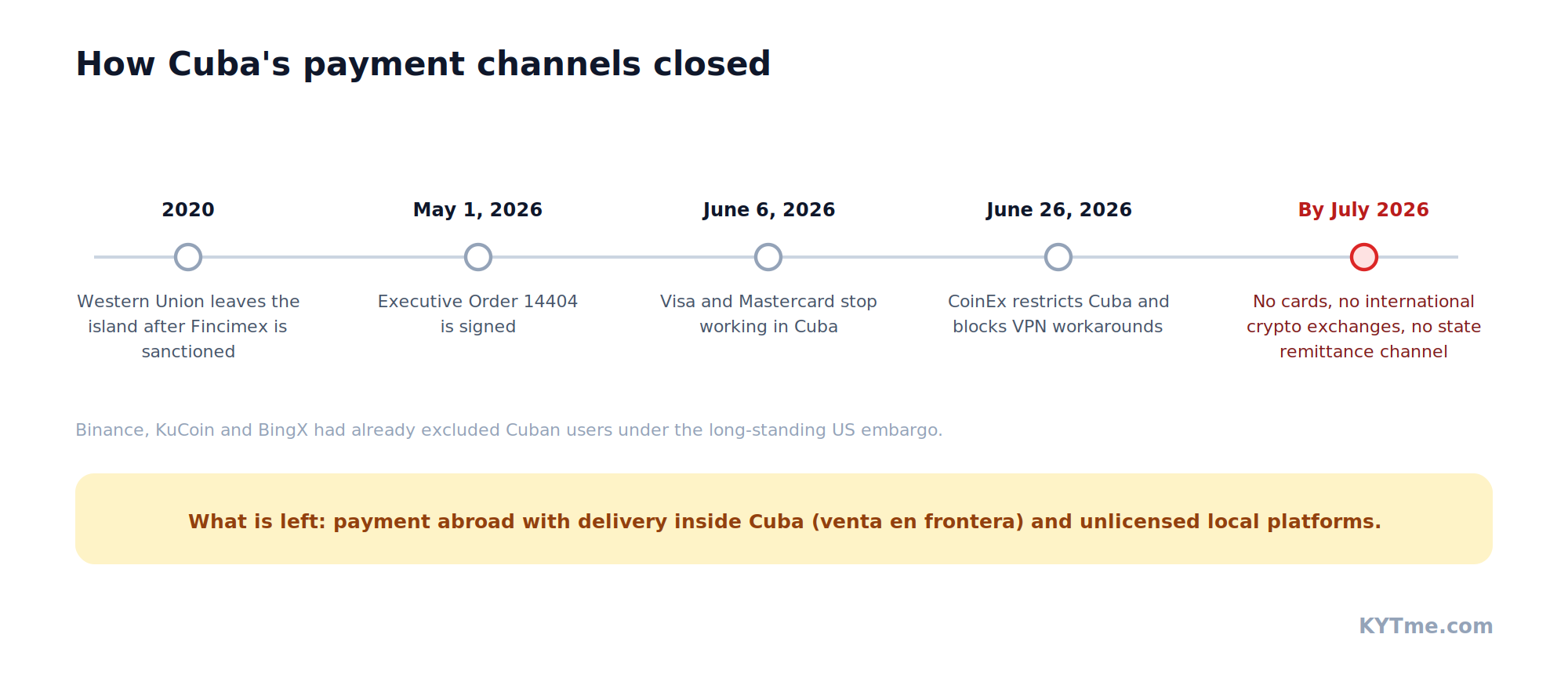
Reuters reported that Cuba stopped working with Visa and Mastercard on June 6, 2026, after a foreign payment operator restricted its activity following the executive order. These payments ran through a foreign bank and Fincimex, the financial arm of GAESA.
Cuba's access to international crypto exchanges was already limited by the long-standing US embargo. Binance, for example, lists Cuba as a prohibited jurisdiction, while KuCoin and BingX exclude Cuban users under their own sanctions-compliance rules.
On June 26, 2026, CoinEx, the largest international exchange used by residents of the country, added Cuba to its list of restricted jurisdictions and said it would block attempts to bypass the restrictions through VPNs.
Creating successor companies for sanctioned businesses
OFAC sanctions apply to specific companies. Once a company is listed, its assets are blocked and cannot interact with US structures. When those assets are transferred to another company, the so-called 50% rule may apply.
From a sanctions-screening perspective, changing the legal entity makes it harder to determine sanctions status — and some Cuban companies appear to have used this feature after sanctions were imposed.
One clear sign of such a scheme is a new company receiving assets from an already sanctioned structure. The signal is even stronger when the two companies share directors, officers or an address. It therefore makes sense to check data on officers and shareholders against people under sanctions. Sanctions-screening tools that extend sanctions exposure on the basis of ownership structure are able to surface some of these connections automatically. A search of corporate registries can also show that an asset transfer took place immediately before sanctions were imposed.
One example of this tactic involves Almacenes Universales S.A., a GAESA subsidiary that controlled container shipping at the Port of Mariel. OFAC sanctioned it on June 23, 2026. That same month Terminal de Contenedores de Mariel (TC Mariel, the original legal entity responsible for running the port) told clients it had sold its assets to a new company, Coral Marítima S.A., which was to run the port through a subsidiary.
This case shows why checking a company's officers and other identifying attributes matters just as much as checking the name of the legal entity itself.
Venta en frontera: Cuban trade paid for outside Cuba
The 2026 sanctions also hit companies tied to Cuba's trade and logistics infrastructure, exposing another way of working around sanctions: venta en frontera, or the border purchase, in which buyers abroad pay in hard currency for goods delivered directly inside Cuba.
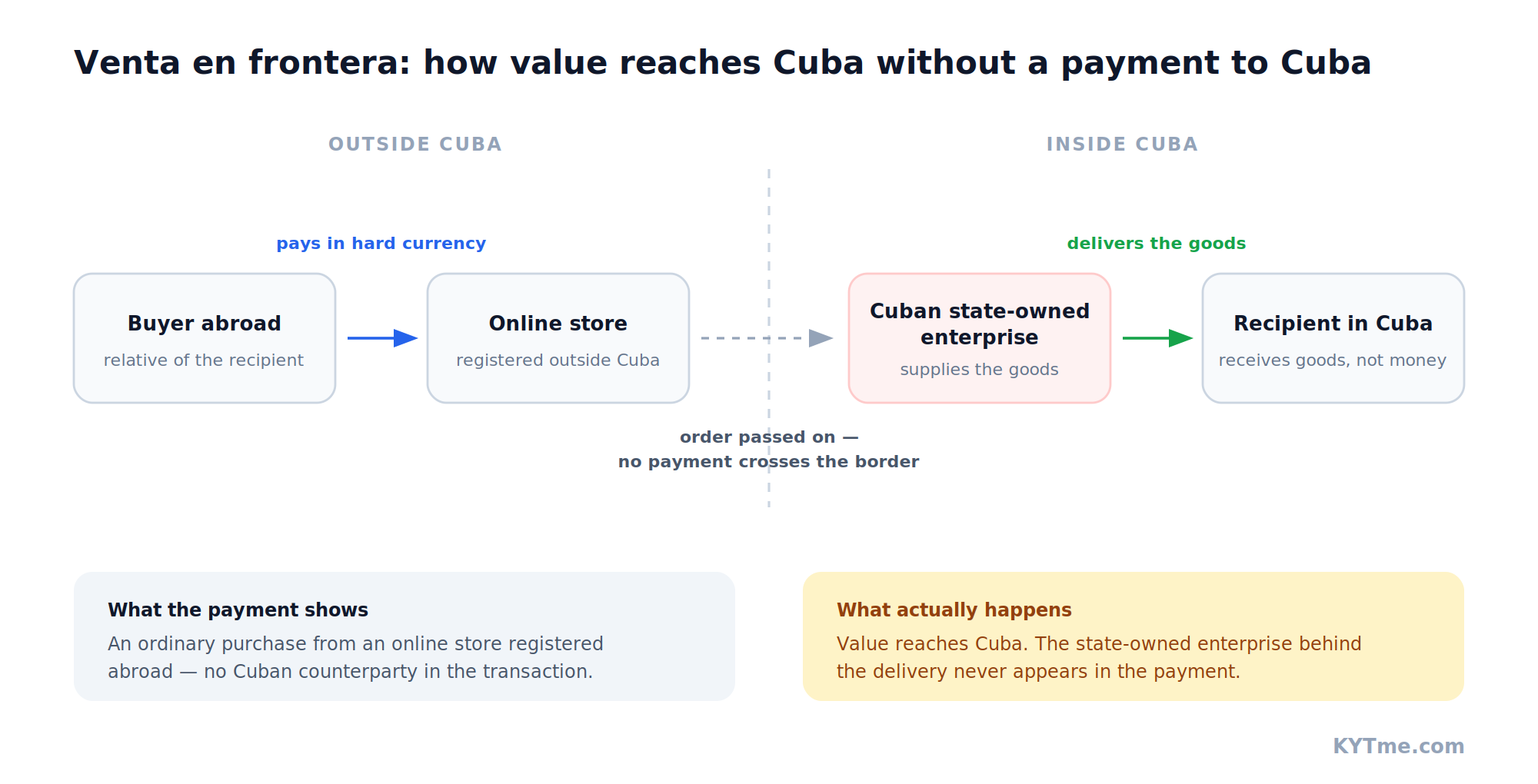
The model predates Executive Order 14404, but its importance is growing as the traditional channels for moving hard currency into Cuba narrow. Western Union left the island in 2020 after its state counterparty Fincimex was sanctioned, and on June 6, 2026, the card networks stopped working. As each of these channels closed, buying goods became one of the few remaining ways to pass value to a person on the island. Cubanet reported that the Cuban state-owned enterprise Alcona used this strategy for cross-border food sales in which the goods were delivered directly inside Cuba.
For sanctions compliance professionals, this model changes where the financial connection becomes visible. A direct money transfer to Cuba can immediately point to a problematic jurisdiction or counterparty. A purchase made abroad with goods delivered inside Cuba, by contrast, can look like an ordinary payment to an online store registered outside Cuba, accompanied by an order and delivery documents.
Online stores serving the Cuban diaspora
Online stores serving Cubans through the border-purchase model have operated this way for many years, and at significant scale. Supermarket23, the largest of them, presents itself as a foreign company. Cubanet traced its link to Alcona and identified at least 11 more sites run by companies connected to Alcona.
The procurement chain through China
One variant of the border-purchase model adds another link: buying the goods in China. The connections described here are based on private intelligence, corporate registration documents and import data.
Gran Azul LLC, a US parcel delivery company, registered around 40 branches in ten states between November 2024 and October 2025, several of them at residential addresses.
According to open import data, in January 2026 Gran Azul received a shipment from Leke Holding Group, a trading company in Quanzhou whose public materials are written entirely in Spanish and aimed at buyers in Latin America.
Leke operates Nihao53, a wholesale platform that presents itself as a link between China and Cuba and requires buyers to hold foreign bank accounts. Its chief executive has said publicly that Nihao53 works with the support of the Cuban government, helping to ease shortages of goods inside the country. Impexport, a Cuban import and export company operating within the state trading system, promotes both platforms.
Public profiles show that employees of these companies previously held positions in Cuban and Venezuelan state structures, including the foreign trade ministry MINCEX, the state food importer Alimport and PDVSA. Some of them simultaneously held positions in related structures in China, Spain and Canada. Although none of these four companies has been added to the sanctions lists, the nature of their activity matches the Cuban border-purchase model used to work around sanctions restrictions.
Is Cuba using crypto to evade sanctions?
Most of the observable crypto activity in Cuba takes place outside state-licensed platforms and appears to consist of small retail-level payments unrelated to large-scale sanctions evasion. The 2026 sanctions measures are aimed primarily at corporate and industrial activity. So despite the loss of payment channels after Executive Order 14404, Cuba's crypto activity does not yet look like part of a state strategy for softening the impact of sanctions.
How the Shelbit exchange worked and why it fell under US sanctions — in a separate articleCuba's licensed crypto platform
Cuba has regulated virtual assets since 2021, when Resolution 215/2021 gave the Central Bank of Cuba the authority to license providers operating in the country. Resolution 89/2022 limited licences to one year, renewable for one more. Today only one provider holds a licence. Ebioro UAB was registered in Vilnius, Lithuania, on January 28, 2022, with declared capital of about €150K, four shareholders and no registered employees. The company's only obvious connection to Cuba is its Cuban licence.
Search results for «proveedor de servicios de activos virtuales» («virtual asset service provider») in the Official Gazette of the Republic of Cuba: two licences issued to EBIORO UAB — Resolution 8/2025 and Resolution 134/2025. Source: Official Gazette of the Republic of Cuba.
Resolution 8/2025 licensed the company in January 2025. When Ebioro applied for a renewal, the Central Bank of Cuba revoked Resolution 8 and issued a new one-year licence under Resolution 134/2025. The new licence took effect on January 28, 2026, and was published in the Official Gazette a month after it came into force.
Share of quarterly volume received by EBIORO's 738 sponsored Stellar addresses compared with Cuban services operating outside the licence. Before the Central Bank's new one-year licence took effect on January 28, 2026, the licensed platform accounted for less than 1% of volume in each quarter. The third quarter of 2026 covers July 1 to August 23, 2026.
Activity outside the licensed sector
Many services without a state licence show significant use by Cubans; below is an example of three such services owned by the same holding company.
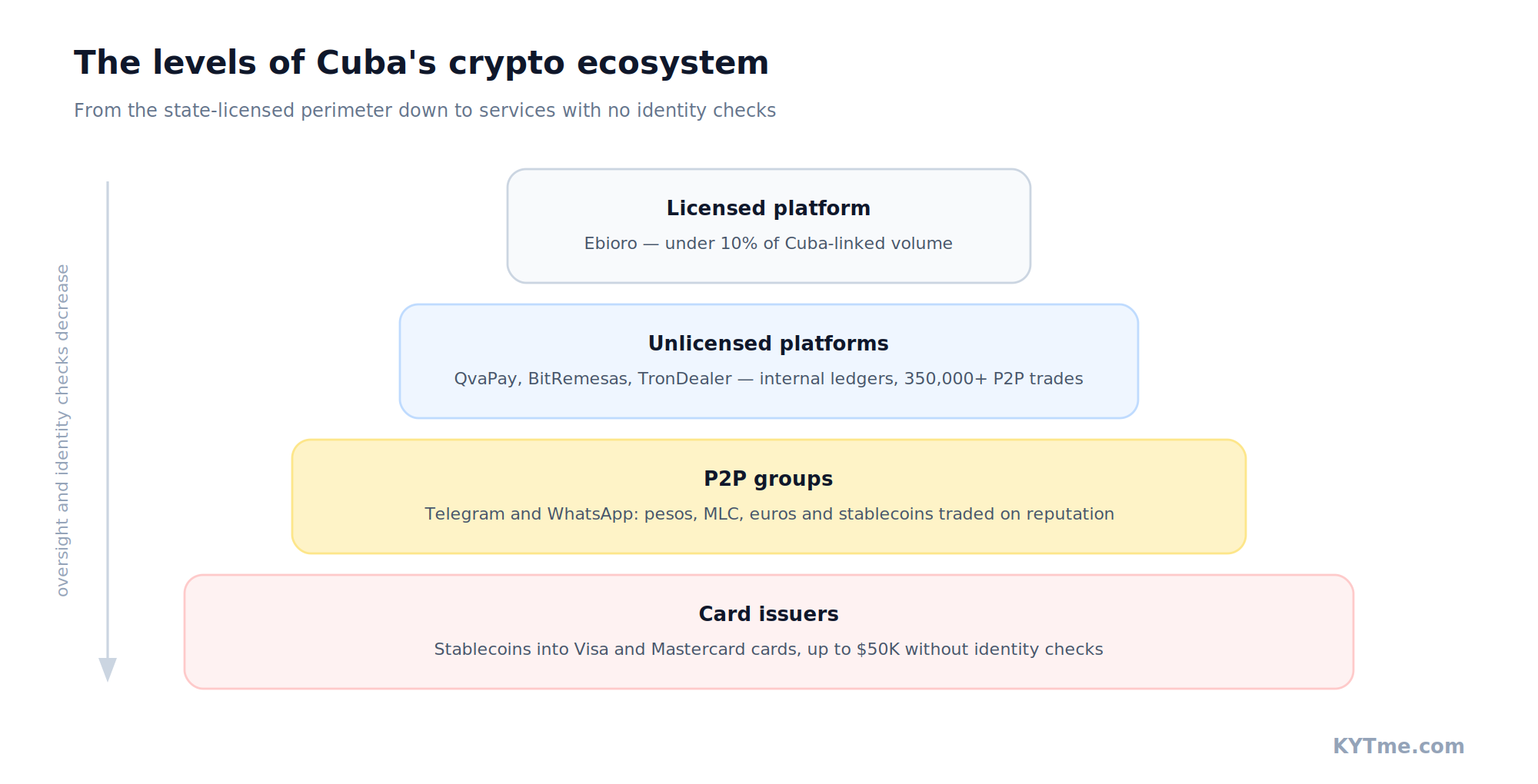
QvaPay is a retail wallet, a P2P marketplace and the best-known Cuban platform in this ecosystem. Trades between its users are settled through an internal ledger and are never recorded directly on a blockchain, although deposits and withdrawals from the platform are recorded on chain.
QvaPay's model is built on QUSD, an internal balance representing the USDT and USDC that users deposit on the platform. Users exchange currencies and crypto assets for this balance using more than 40 payment methods. As of August 2026 the platform reported more than 350,000 cumulative P2P transactions in its published data.
BitRemesas puts the sender's crypto up for purchase by users inside Cuba, so no single transaction ever directly links the sender to the final recipient. BitRemesas and QvaPay share a founder with the payment gateway TronDealer, which also promoted a private token pegged to the Cuban peso, allowing money transfer agents to settle outside the banking system and its daily limit of 80,000 pesos.
From P2P groups to card issuers
Below these structures sit groups on Telegram and WhatsApp where pesos, MLC balances (moneda libremente convertible, freely convertible currency), euros and stablecoins are traded between users on reputation alone.
The difference lies in payment size.
Each line on the chart is indexed to the 2021 level, so the chart shows growth rates rather than absolute dollar volumes.
Sanctions against Cuba keep expanding, and each new package draws further attention to the question of whether crypto is being used to work around the restrictions. So far there is no evidence of that.
What comes next?
Executive Order 14404 has been in force for less than four months and new sanctions measures keep arriving — the ninth package was imposed on August 20. For now, the available data shows that sanctioned Cuban businesses are adapting in two main ways: moving operations to newly created legal entities, and shifting payment for Cuban goods into non-card channels through the border-purchase model. Crypto does not appear to play a significant role in Cuba's strategy for softening sanctions pressure, although that may change as new sanctions are imposed.
For sanctions compliance professionals, the important signals will not always be in the same place. Company names and sanctions lists still matter, but corporate filings, links between owners and officers, trade and shipping data, payment intermediaries and on-chain activity can add context as the structure of this network changes.
