
Russian cases in the context of the global fight against the darknet
Large darknet markets have been shut down many times before, and many of these operations were led by US or European agencies. In October 2013, the US Federal Bureau of Investigation (FBI) shut down the original version of Silk Road and arrested its operator, Ross Ulbricht. In 2015, a court sentenced Ulbricht to life in prison, but on January 21, 2025, he was pardoned.
In July 2017, a coordinated international operation took down AlphaBay, which the US Department of Justice called the largest online marketplace for illegal goods, and Hansa. In April 2022, Germany's Federal Criminal Police Office shut down Hydra. In 2021, that platform accounted for more than 90% of darknet market turnover. In May 2025, Operation RapTor led to 270 arrests and the seizure of more than $200M in cash and digital assets. US and European agencies took part in it, along with partners from ten countries.
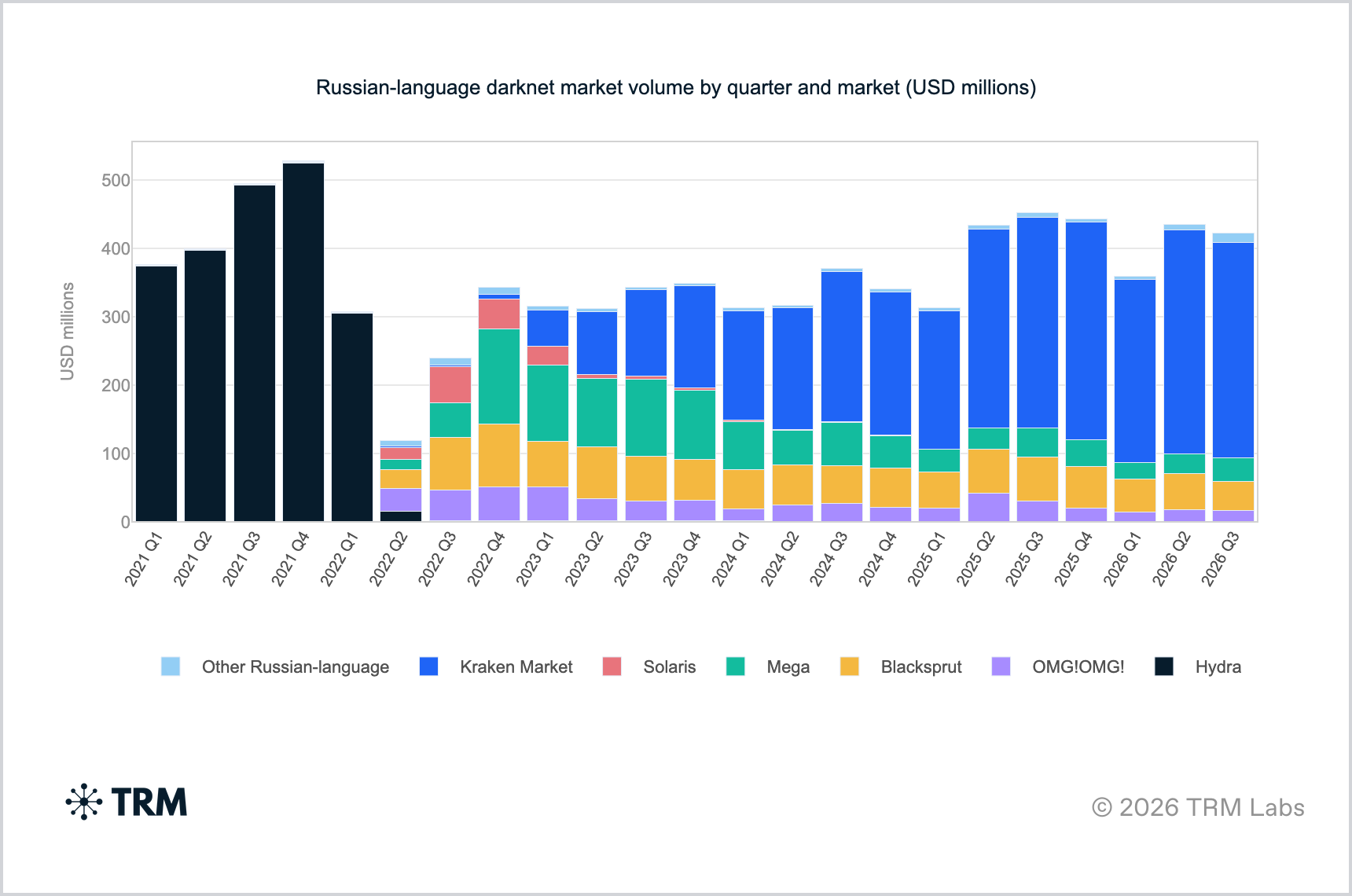
However, soon after Hydra was shut down, sales volumes began to grow: new darknet markets appeared within a few months. According to a study published in April 2025, most such platforms close within two to three years of launch. The Russian-language ecosystem, by contrast, remained relatively untouched by large-scale law enforcement operations after Hydra disappeared.
In 2026, Russian courts began advancing cases against the alleged creators of Hydra and people linked to the WayAway forum. Unlike earlier operations to dismantle major markets, the current cases are being pursued by Russian authorities rather than US or European agencies.
In mid-2026, Russian authorities advanced investigations in two groups of cases. In the Hydra case, Russia's Interior Ministry reported on June 30 that it had completed the investigation into one of the group's alleged leaders, RIA Novosti reported. In July, a court in Perm accepted for consideration a case against two men considered to be the creators of Hydra. In a separate investigation linked to Kraken and WayAway, the Moscow City Court on August 18 extended the detention of four people, the newspaper Kommersant reported. In the same weeks, Russian-language darknet markets kept receiving about $145M a month.
The 2026 cases
The new cases concern the alleged creators of Hydra, as well as the alleged leaders and staff of WayAway. According to a US indictment, around 2015 WayAway, one of two forums, took part in a declared partnership that led to the creation of Hydra.
Some defendants linked to Hydra had been convicted before. On December 2, 2024, a court in the Moscow region sentenced Stanislav Moiseev to life in prison, and 15 other defendants received sentences of eight to 23 years. This was reported by Mediazona and The Record. Interfax and TASS, citing law enforcement sources, called Moiseev the founder or organizer of Hydra, although prosecutors did not mention the platform's name.
In October 2025, a court in Yaroslavl sentenced a man whom Russian media called Hydra's system administrator to 21 years in prison. This was reported by The Moscow Times and SecurityLab.
The Hydra case that developed in 2026 belongs to a later stage of the investigation. Irina Volk of the Interior Ministry said on June 30 that the case against one unnamed alleged leader had been sent to court and runs to 358 volumes.
On July 8, Kommersant reported that the case against Alexei Baikov had been sent to the Kirovsky District Court of Perm. On July 29, the outlet Progorod59 wrote that the court named Baikov one of the co-founders of Hydra and Alexei Kornienko, who is on an international wanted list, as its second creator. Newsko reported that both men had entered into pretrial cooperation agreements with the investigation.
What these cases may mean
It is too early to expect large-scale consequences: since Hydra was shut down, not a single Russian-language darknet market has been dismantled by law enforcement. Russian cases against people linked to Hydra have been under way since at least 2024, and in 2026 the investigations reached a new level. They involve the alleged creators and leaders of Hydra, as well as people linked to WayAway, and are moving to trial.
Public reports on these cases do not mention the seizure of an operating darknet market or its shutdown. Hydra itself was shut down by Western law enforcement in 2022. The people named in the new Hydra cases in 2026 allegedly created a platform that has already ceased operating.
The volume of Russian-language darknet markets since 2022
The law enforcement actions are unfolding against the backdrop of a growing and resilient ecosystem of darknet markets. From January to September 2026, Russian-language markets received more than $1.2 billion of the almost $1.3 billion that went to all darknet markets. That is about 95% of the total, compared with about 90% in 2022, when Hydra was shut down.
The 2026 crypto crime report estimated darknet market inflows for 2025 at $1.7 billion. Russian-language platforms accounted for more than 90% of that amount.
This analysis covers darknet markets only. These are platforms that operate through the Tor network and focus primarily on selling illegal drugs. The study does not include standalone online shops run by individual drug vendors, so the amounts given do not reflect all online drug sales activity.
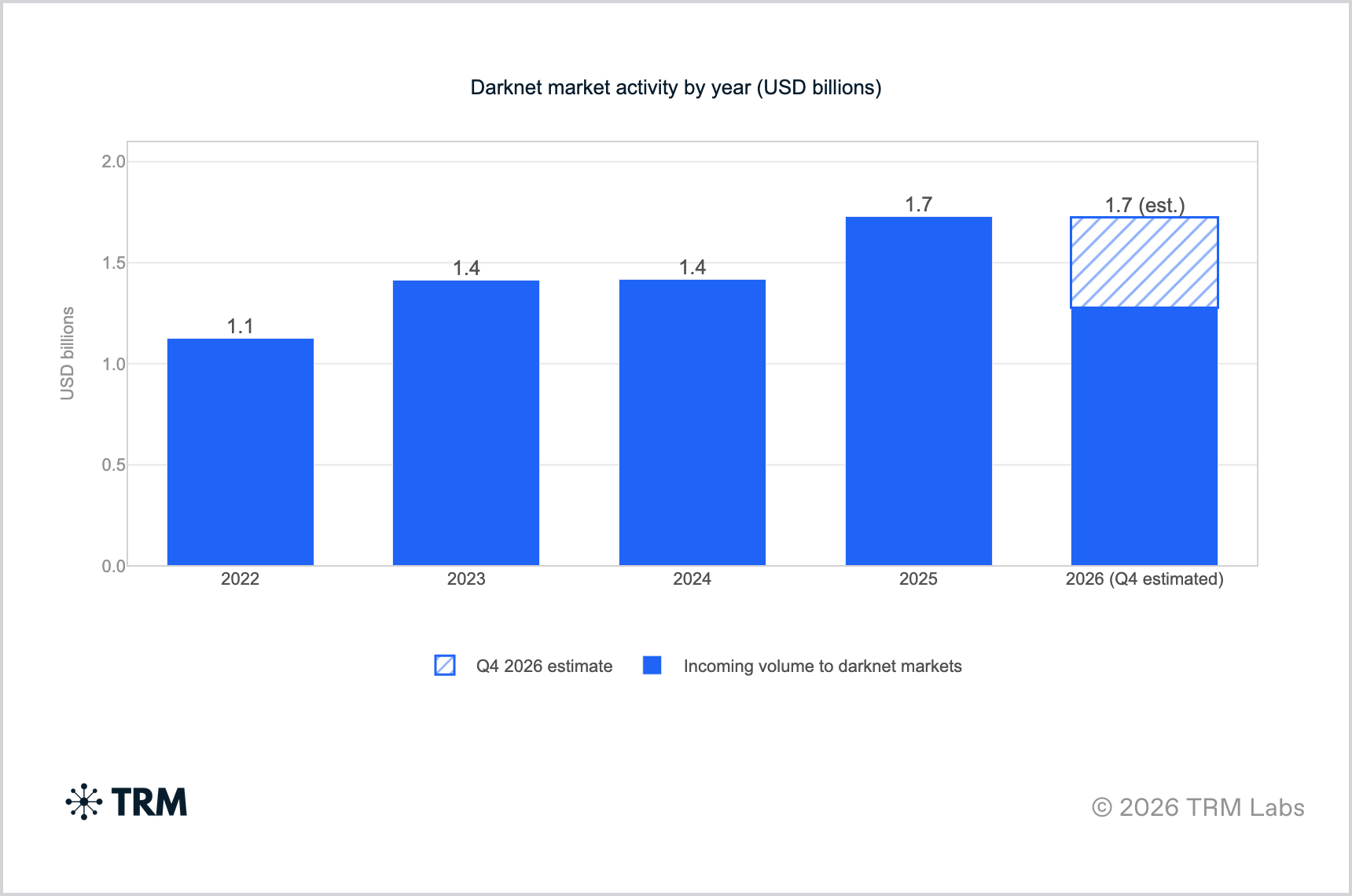
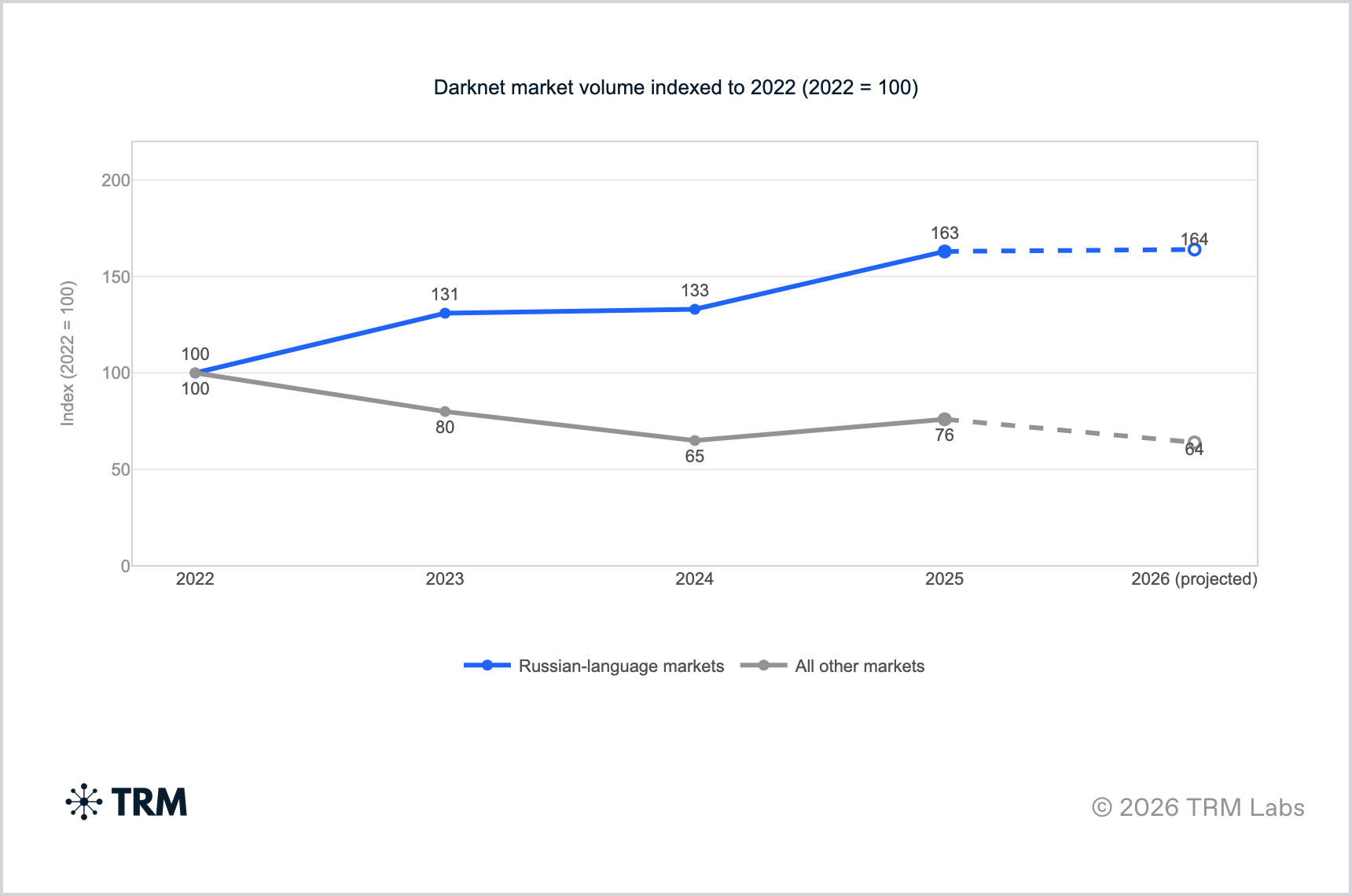
Total darknet market volume grew every year, from $1.1 billion in 2022 to $1.7 billion in 2025. According to the forecast, in 2026 the figure will stay at about $1.7 billion, comparable to the previous year. The volume of Russian-language platforms has also grown every year since 2022, from about $1 billion to more than $1.6 billion in 2025. In 2026, it is expected to slightly exceed last year's level.
Although growth has slowed, the volume of Russian-language markets still rose by 22% in 2025. Growth of about 1% is forecast for 2026. In the first half of 2026, volume was 6% higher than in the same period a year earlier, and in the third quarter it was 7% lower.
One of the reasons for the growth of Russian-language platforms after 2022 was a widespread delivery system known as dead drops.
Research has shown that such delivery can take just a few minutes, while shipping by mail usually takes several days. This model develops faster and is harder to disrupt than traditional postal delivery.
Kraken Market is the largest operating darknet market in both the Russian-language and Western spheres. Today, it accounts for about three quarters of Russian-language platforms' turnover. After Hydra was shut down, vendors and buyers moved to Blacksprut, Mega and OMG!OMG!. This migration allowed the ecosystem to survive and keep growing.
Kraken Market appeared in the same month Hydra was shut down, and the community positioned it as the successor to the old platform. Kraken now takes more than 70% of darknet market volume, which makes it the largest operating platform in both the Russian-language and Western ecosystems.

Kraken Market activity has not changed
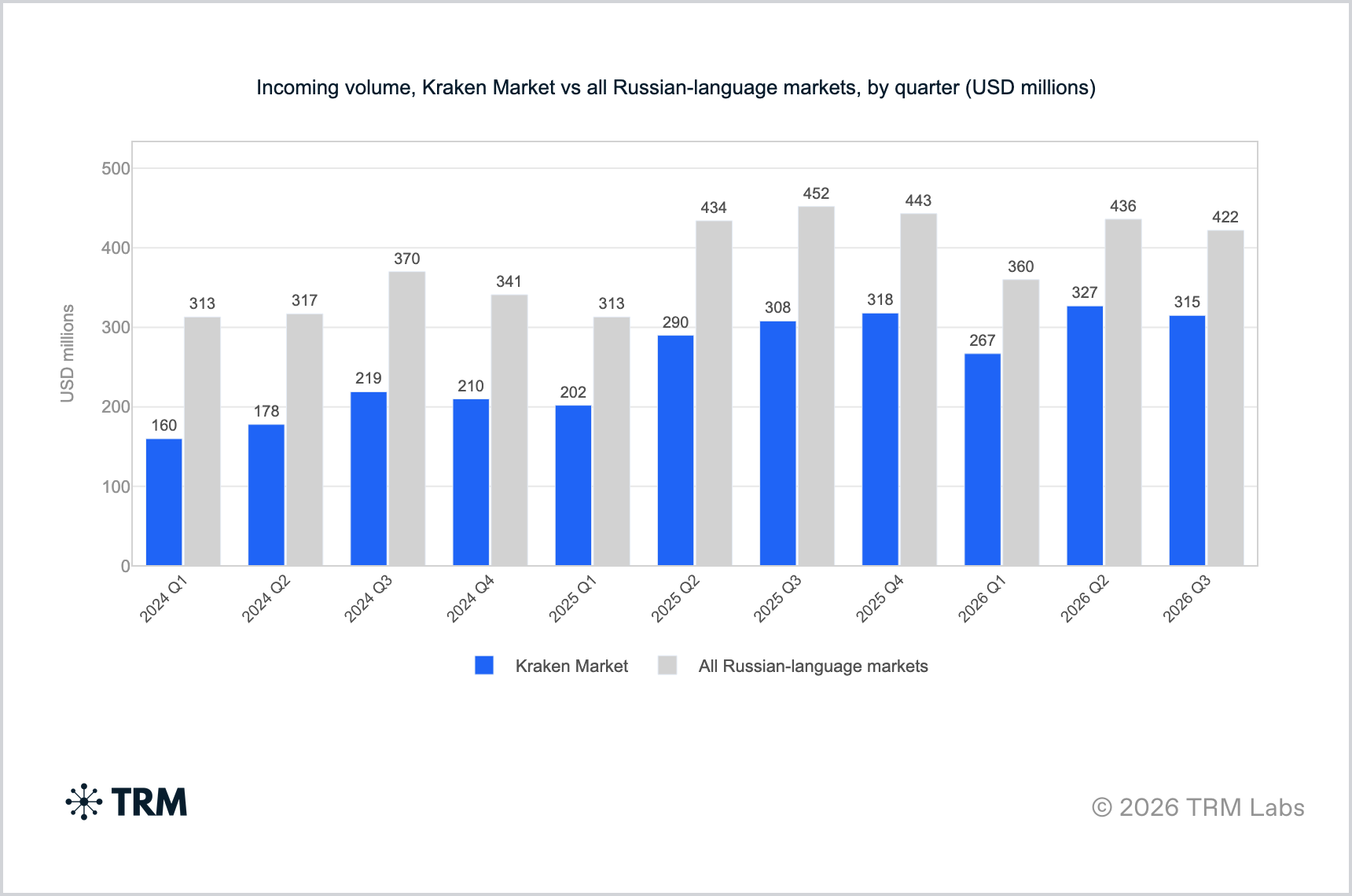
Despite the stepped-up criminal prosecutions in Russia in 2026, Kraken Market's transaction volume did not change in the quarters when the court proceedings took place.
The combined volume of all Russian-language markets also differed from the second-quarter figure by less than 4%: about $420M versus about $440M. Daily data shows the same trend. In August, when the Moscow City Court extended the defendants' detention, Kraken Market's average daily volume was about $3.5M. From September 19 to October 18, it held at about $3.4M a day.
This stability makes sense: so far, not a single operating market has been shut down. The defendants in the Hydra case are the alleged creators of a platform that ceased operating in 2022. The other defendants are linked to the WayAway forum. So Kraken Market and the other major markets keep operating.
What to watch next
Darknet markets first grew rapidly in the West, followed by numerous takedown operations, including the closure of Silk Road in 2013 and AlphaBay and Hansa in 2017. Since then, Russian-language platforms have grown year after year without facing a comparable level of law enforcement attention.
Russian cases against people linked to Hydra have been growing in scale since 2024. The key question now is whether they will lead to intervention in a market that continues to operate. The detention of the defendants in the Kraken and WayAway case has been extended until the end of November, and Kommersant reports that four cases are being sent to court.
