
The U.S. Treasury Department's Office of Foreign Assets Control (OFAC) on Tuesday updated its sanctions list concerning the Central Bank of Iran, adding six new cryptocurrency addresses as identifiers. We break down how U.S. regulatory authorities regularly track sanctioned entities.
The update to the sanctions list tightens the financial blockade of the Central Bank of Iran. According to U.S. authorities, the bank used cryptocurrencies to evade international sanctions, finance the Iranian regime, and transfer funds to regional allies, including the Lebanon-based group Hezbollah, which the U.S. has designated a terrorist organization.
The Central Bank of Iran's cryptocurrency activity came under even closer scrutiny following the outbreak of the armed conflict with Iran. Last month, OFAC had already imposed sanctions on major Iranian cryptocurrency exchanges that were allegedly used by the Central Bank to convert funds into stablecoins and subsequently withdraw them.
Why Iran chooses stablecoins
Research into Iran's cryptocurrency activity shows that the country's authorities have a clear preference for stablecoins.
This choice is understandable. Stablecoins are pegged to the value of traditional currencies, primarily the U.S. dollar, and therefore have a relatively stable price, high liquidity, and are accepted by market participants across almost the entire world. These qualities make them a convenient instrument both for legitimate users and for those seeking to circumvent international restrictions.
However, the use of stablecoins also carries a serious risk for those who violate the sanctions regime. Unlike most conventional cryptocurrencies, stablecoin issuers can, at the request of law enforcement authorities, freeze the funds held at specific addresses.
A stablecoin freeze means that the wallet's owner can no longer transfer, spend, or in any way use the digital assets held in it.
Where the funds came from: a liquidity provider and payment processing from Asia
This data makes it possible to trace the origin of the financial flows and demonstrates how the funds moved through international cryptocurrency infrastructure before reaching the addresses linked to the Central Bank of Iran.
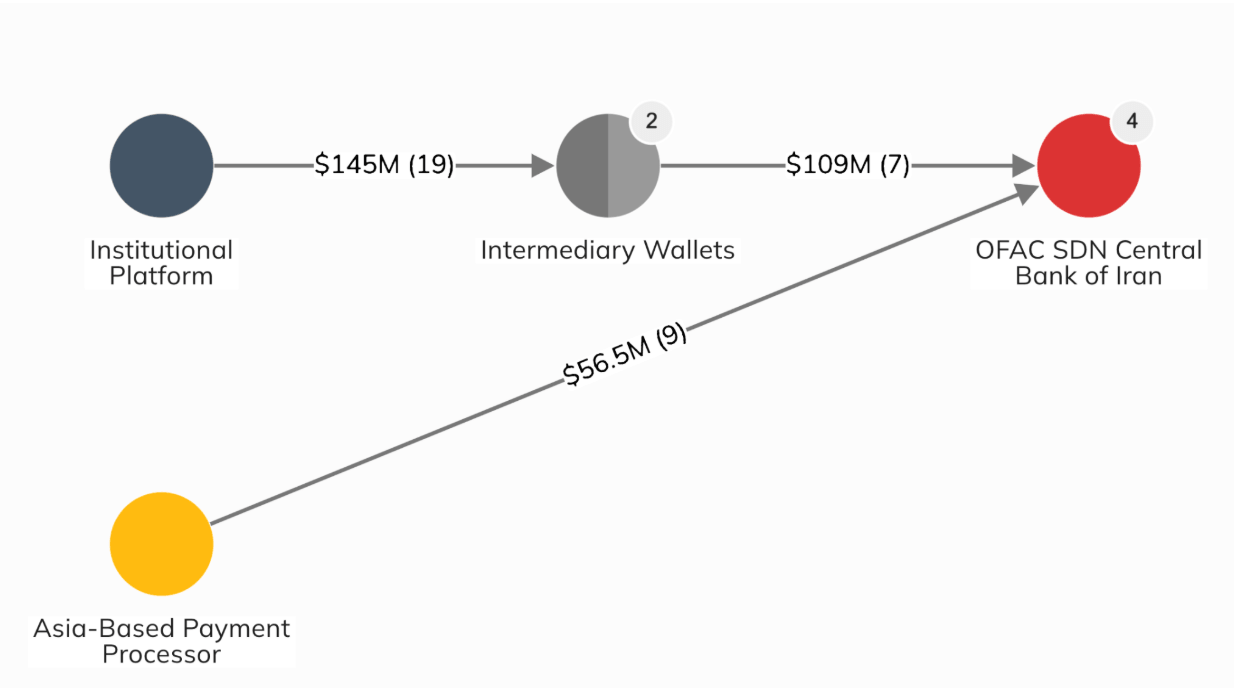
6 Central Bank of Iran addresses under OFAC sanctions
