
On November 6, 2026, the US Treasury Department's Office of Foreign Assets Control (OFAC) sanctioned eight Canadian financial services companies under US Executive Order 13902. According to US authorities, these organizations operated in the digital asset sector of the Iranian economy.
OFAC added to the sanctions list six addresses on the TRON network linked to four of the eight companies.
According to OFAC, many of these companies carried out operations with sanctioned Iranian crypto exchanges and addresses linked to the Islamic Revolutionary Guard Corps (IRGC). In addition, several companies worked with Canadian drug trafficker Ryan Wedding, who is also under OFAC sanctions, and helped launder proceeds from drug trafficking.
On November 6, 2026, as part of Operation Economic Outcast, OFAC sanctioned eight Canadian financial services companies engaged in money transfers and currency exchange. According to the agency, these organizations exchanged Iranian rials and other currencies for digital assets. Many of them carried out operations with sanctioned Iranian crypto exchanges and addresses linked to the Islamic Revolutionary Guard Corps (IRGC). Several companies also sent or received funds from addresses linked to terrorism, and some worked with drug trafficker Ryan Wedding, helping launder proceeds from drug sales.
One network, two clients: how Ryan Wedding and the IRGC used shared channels to move money
According to OFAC, the eight companies exchanged Iranian rials and other currencies for digital assets. They also carried out operations with sanctioned Iranian crypto exchanges and addresses linked to the Islamic Revolutionary Guard Corps (IRGC).
OFAC also said that several companies on the list worked with Ryan Wedding – a Canadian drug trafficker whom the agency sanctioned on November 19, 2025. He was detained in January 2026. According to OFAC, Wedding used financial services companies in the Vancouver and Toronto areas to launder proceeds from drug trafficking. Couriers transported large amounts of cash, which were then exchanged for digital assets.
The sanctioned companies
OFAC sanctioned the following organizations:
- Diverse Trade Inc (operating as Million Exchange), Ontario;
- 1380079 BC Limited (operating as Amin Exchange), British Columbia;
- Top PC Technician Inc – a subsidiary of 1380079 BC Limited that also operates as Amin Exchange, Ontario;
- NIA Nations Currency Ltd, British Columbia;
- 2397639 Ontario Ltd (operating as Farah Exchange), Ontario;
- CCC Inc, Ontario;
- B Galaxy Inc (operating as Cryptoyal), Ontario;
- Darvish Exchange, Ontario.
CCC Inc and B Galaxy Inc are two companies registered in Ontario and operating at the same address.
Blockchain addresses published by OFAC
In the entries of the SDN sanctions list (Specially Designated Nationals – the list of specially designated individuals and entities), OFAC listed six addresses on the TRON network linked to four of the eight companies. No digital asset addresses were published for the other four organizations.
| Counterparty | Network | Address |
|---|---|---|
| Amin Exchange | TRON | TLyRLCNwBhaXkYak1bTFUYTj72crbgN5Vy |
| Amin Exchange | TRON | THauYJJEaFGLpEknoKnYmXmT5TCeQGKjDE |
| Amin Exchange | TRON | TJT3JZKJWVHVkKRKSmWmg5UYHhAqBM7mfP |
| Farah Exchange | TRON | TW5NEaaoPHXC1rt5PaYgG474gQ49oiZ2F5 |
| CCC Inc | TRON | TCreRMzGspdHNEkqkasejS6xTzqXNkYJJZ |
| Million Exchange | TRON | TJHZswisiMgjioAVpmpMSWXCeQGCPjcTMK |

What the blockchain investigation revealed
Million Exchange laundered drug trafficking proceeds for Ryan Wedding by buying digital assets with cash obtained from drug sales. According to the transaction analysis, the Million Exchange address on the sanctions list received $120.7M and sent $121.8M between January 2025 and February 2026.
Most outgoing transfers from this address went through a single intermediary wallet. From July 2025 to January 2026, it received $48.8M from the Million Exchange address and then distributed $54.1M among 121 addresses. The last transfer from this wallet was made on January 26, 2026.
Monthly incoming funds in US dollars to the Million Exchange address listed by OFAC in the sanctions list, from January 2025 to April 2026. Ryan Wedding was detained on January 22, 2026. The following month, the volume of incoming funds to this address fell to its lowest level in more than a year.
The sanctioned companies sent funds to each other and dealt with Iranian exchanges sanctioned by OFAC earlier in 2026
On-chain activity shows that the newly sanctioned companies actively transferred funds to each other and also interacted with Iranian organizations that US authorities had sanctioned earlier. From June 2025 to August 2026, Amin Exchange, Million Exchange and NIA Nations transferred at least $1.9M to each other. At the same time, they carried out operations worth about $678,000 with organizations that were already under OFAC sanctions. In total, the volume of recorded transfers between these participants and related organizations exceeded $2.5M.
- The Amin Exchange addresses listed by OFAC sent $942,628 to the Million Exchange address between October 1 and December 1, 2025.
- From June 30 to August 25, 2026, NIA Nations transferred $968,342 to Amin Exchange in 21 transactions.
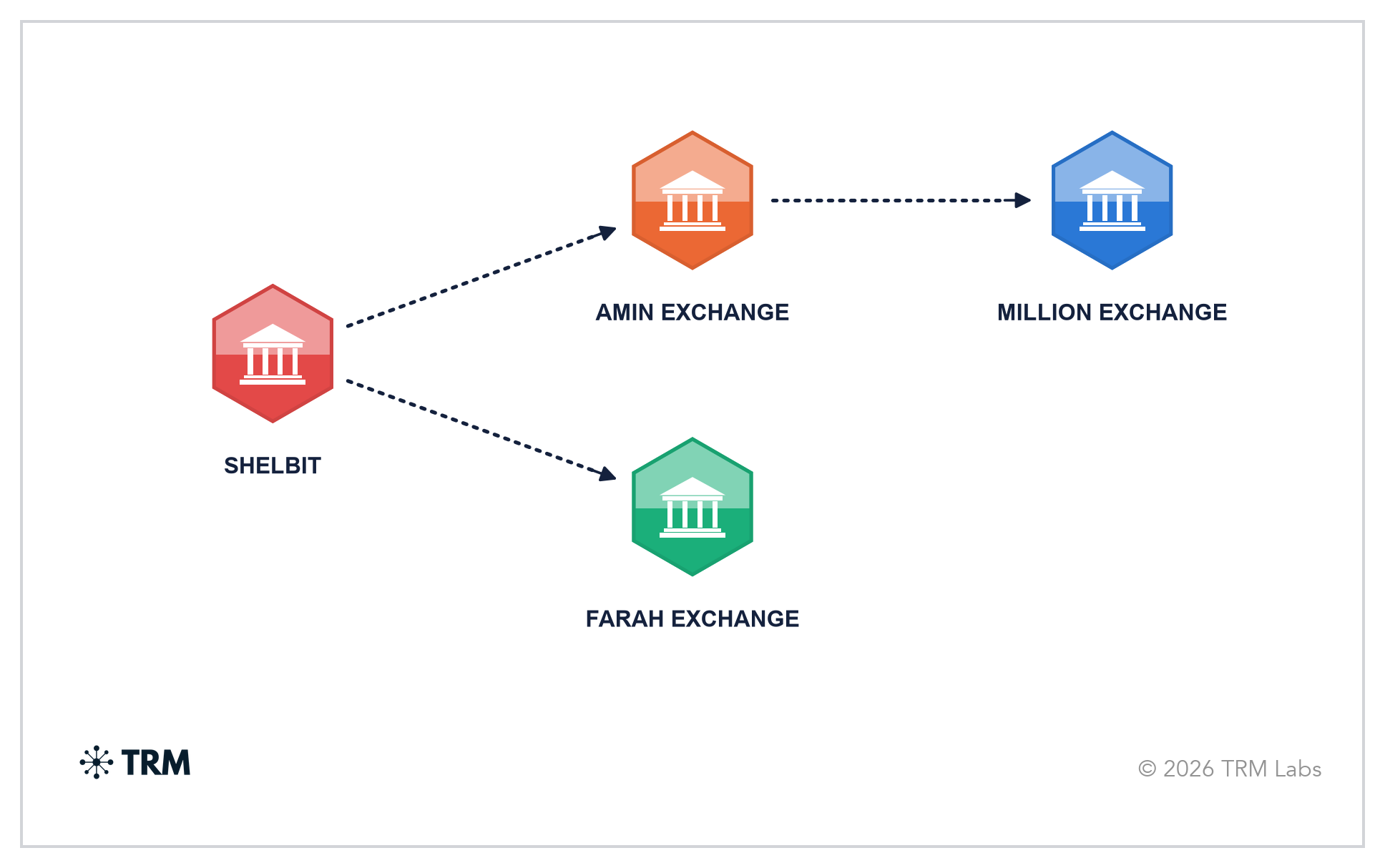
- On July 17, 2025, a single Shelbit address sent funds to Amin Exchange and Farah Exchange less than an hour apart.
In addition, the following operations were identified:
- Between July and September 2025, Shelbit transferred $311,250 to the Amin Exchange addresses listed by OFAC in the sanctions list. In July 2025, the Farah Exchange address, also on the sanctions list, received $76,439 from Shelbit, and in January 2026 it sent $149,816 to this organization.
- In September 2025, the Farah Exchange address received $29,689 from Wallex. During 2025, NIA Nations and Million Exchange carried out smaller operations with Nobitex, Wallex, Bitpin and Aban Tether.
- Million Exchange received $100,765 from an address that OFAC listed in the sanctions entry of Iranian national Keyvan Fayyaz Gareh Blagh, and also sent $9,995 to this address. On August 24, 2026, OFAC added him to the sanctions list under a program targeting cybercrime.
All of the transfers listed were made before Shelbit was sanctioned. Shelbit transferred funds to Amin Exchange and Farah Exchange between July and September 2025. Amin Exchange then sent funds to Million Exchange between October and December 2025. Transfers on the TRON network, July – December 2025.
IRGC-linked counterparties and other sanctioned organizations
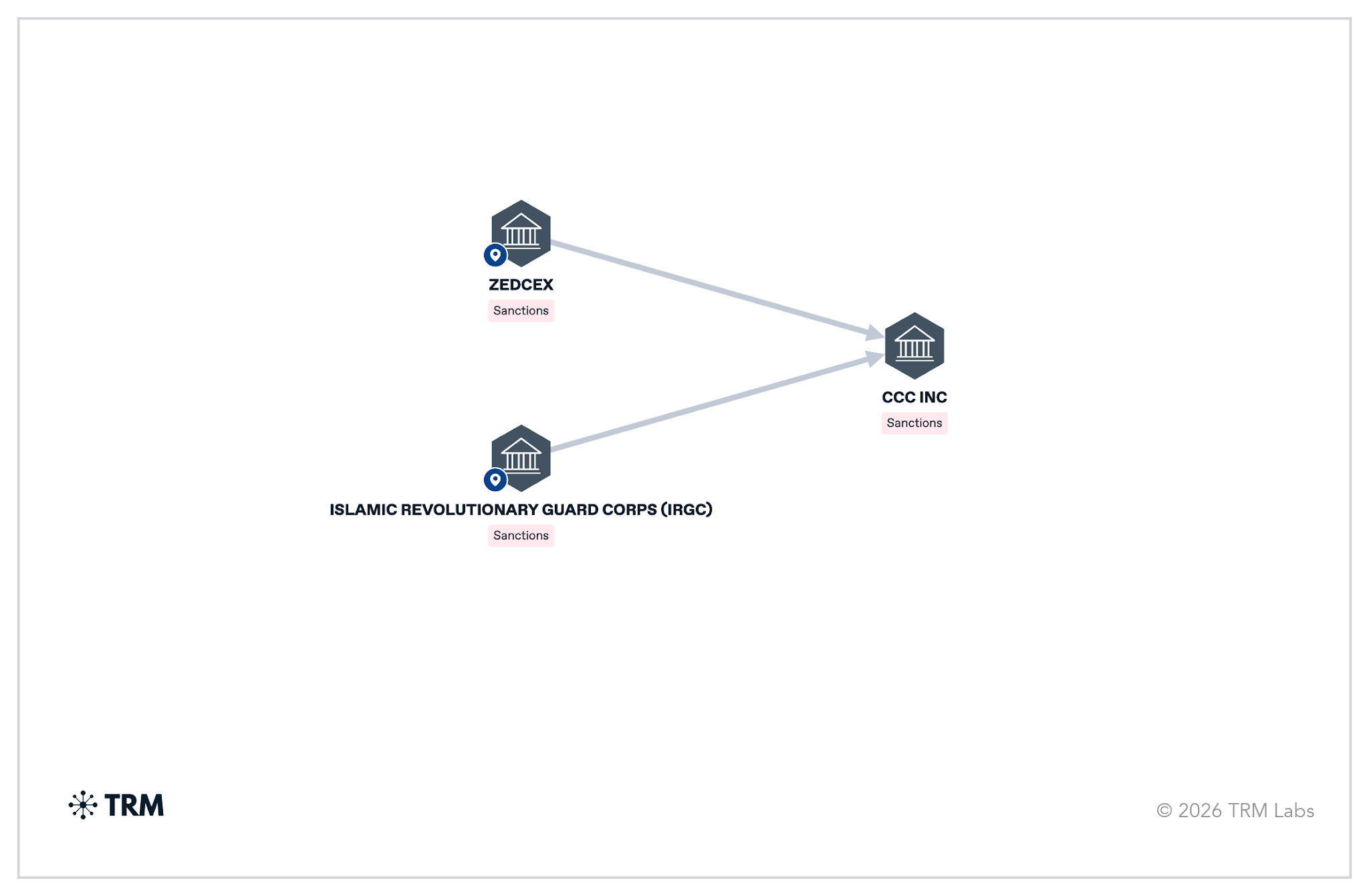
The transaction analysis shows that CCC Inc received at least $300,000 from two IRGC-linked sources – directly from addresses belonging to the Islamic Revolutionary Guard Corps and from Zedcex. The latter is a UK-registered crypto exchange that OFAC sanctioned in January 2026 for providing material support to the IRGC.
NIA Nations kept operating
Addresses linked to NIA Nations moved about $20.6M in each direction from January 2025 to early November 2026 – that is, they both received and sent about $20.6M. The average volume of operations was about $1M per month. The company kept operating even a few days before the sanctions were imposed.
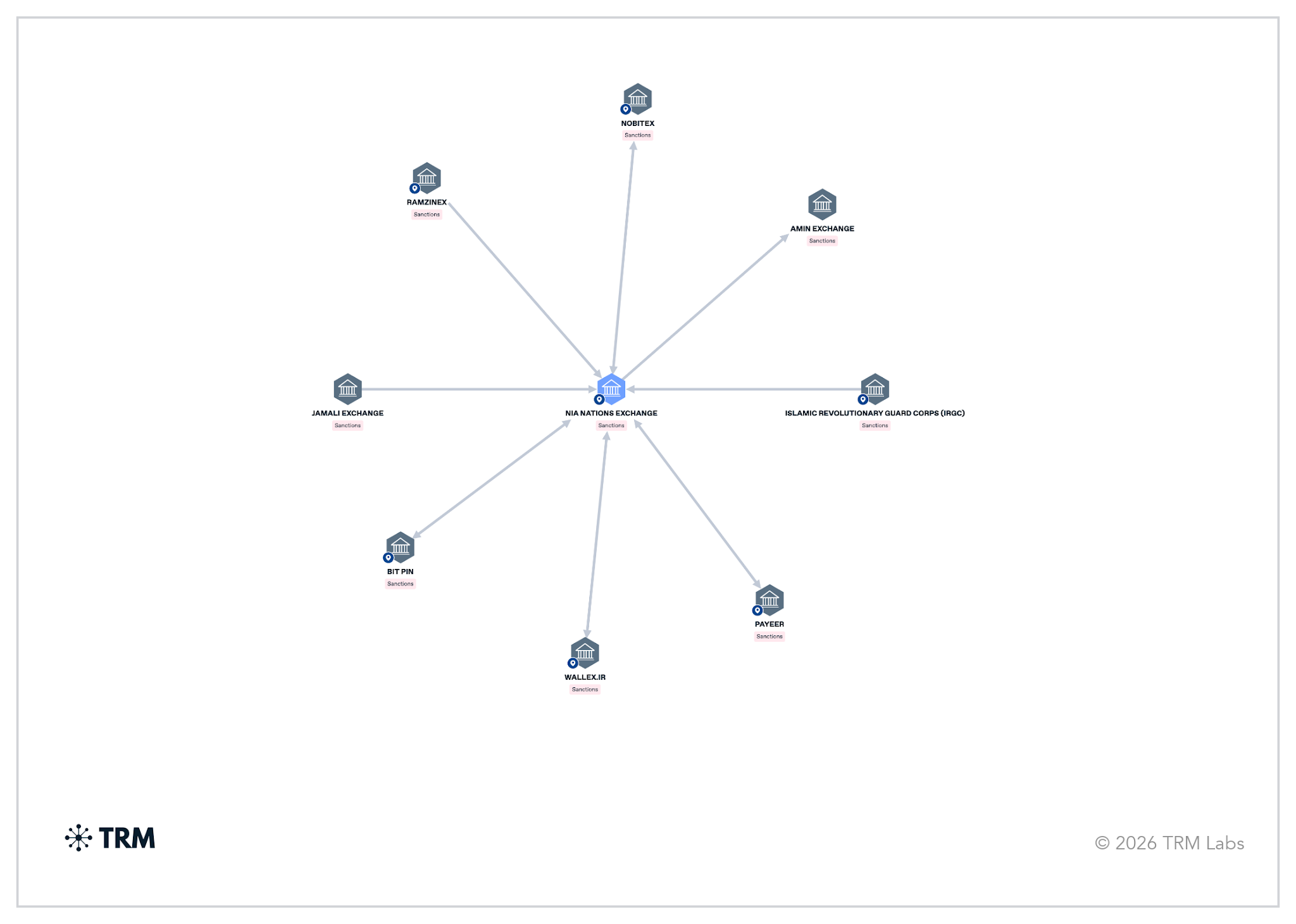
According to the transaction analysis, NIA Nations carried out operations with sanctioned Iranian crypto exchanges, including Nobitex, Ramzinex, Amin Exchange, Jamali Exchange, Bitpin, Wallex.ir and Payeer, as well as with addresses linked to the Islamic Revolutionary Guard Corps.
How these sanctions fit into Operation Economic Outcast
The current decision continues two previous rounds of US sanctions targeting the Iranian digital asset sector. On June 2, 2026, OFAC sanctioned the Iranian crypto exchanges Nobitex, Wallex, Bitpin and Ramzinex. Then, on August 7, 2026, Aban Tether Exchange and SHPS Shelbit (Shelbit) came under restrictions.
In the November round, US authorities shifted their focus from exchanges operating directly in Iran to companies in Canada. According to OFAC, these organizations exchanged Iranian rials and other currencies for digital assets, thereby helping carry out financial operations linked to Iranian entities.
What compliance specialists should do
- Screen counterparties and deposit addresses for matches with the six addresses published by OFAC, as well as with the related organizations listed above. Such screening should become part of the sanctions risk identification procedure.м
- Check company names and all their known alternative names listed in the SDN sanctions entries. These include: Amin Exchange Vancouver, Sarafi Amin, Amin Exchange Toronto, Aminex Toronto, Farah Exchange, Cryptoyal, C Exchange, Ccurrency Exchange, Sarafi C, Parsis Exchange, Salam Exchange, Sarafi Capital, Million Exchange, Million Money Exchange, Millionex, Kanata MD Inc and Canada Exchange. According to OFAC, several companies changed their names.
- Assess the risks of dealing with Canadian financial services companies that exchange cash or Iranian rials for digital assets.
- Keep in mind that the SDN sanctions entries contain a warning about the risk of secondary sanctions under Section 2 of US Executive Order 13902. OFAC also points to the guidance in FAQ 1250 and FAQ 1257 on sanctions risks related to Iranian crypto exchanges.
