
The ruble-pegged stablecoin A7A5 was created as an instrument that could not be taken out of the game. This crypto asset, pegged to the Russian ruble, was issued in Kyrgyzstan, backed by the assets of a sanctioned Russian state bank, and intended to allow Russian companies to make international settlements while bypassing existing restrictions.
The story of A7A5 shows how coordinated sanctions by the United States, the United Kingdom, and the European Union, combined with blockchain analysis technologies, were able to almost completely paralyze the operation of a cryptocurrency that could not simply be switched off by technical means.
Created to circumvent sanctions
The project was developed by the Russian company A7 LLC, which specializes in international payments for businesses seeking to circumvent Western sanctions.
The token's formal issuer is Old Vector LLC, a company registered in Kyrgyzstan. Under the declared model, every token issued is backed by ruble deposits on a one-to-one basis. These funds are presumed to be held at Promsvyazbank.
Why the bet was placed on a ruble-pegged stablecoin
After Russian banks were cut off from the Western financial system in 2022, importers and exporters increasingly began using cryptocurrency for international settlements.
For several years, the main instrument remained USDT — the world's largest stablecoin, pegged to the U.S. dollar. It has high liquidity, is accepted by almost all crypto exchanges and brokers, and makes it possible to carry out large international payments. This is precisely why USDT long remained the main tool for circumventing sanctions restrictions.
However, it has a serious drawback. USDT's issuing company is able to freeze the tokens in any cryptocurrency wallet, and it has repeatedly done so at the request of U.S. authorities. In March 2025, the U.S. Secret Service seized USDT reserves belonging to the Russian crypto exchange Garantex.
It was then that A7A5 offered an alternative scheme. Funds could be held in a ruble-pegged token that is not controlled by any Western company, and the exchange into USDT would take place only immediately before an international operation was carried out.
In effect, A7A5 served as a kind of "safe haven," allowing Russian companies to make use of the global liquidity of USDT while minimizing the risk of their funds being frozen.
The collapse in figures: $102 billion in turnover and a 96% drop
For its first year, the scheme really did work. A7A5 became the world's largest stablecoin not pegged to the U.S. dollar. Over that time, more than $102 billion passed through it in roughly 251,000 transactions. But the situation then changed dramatically.
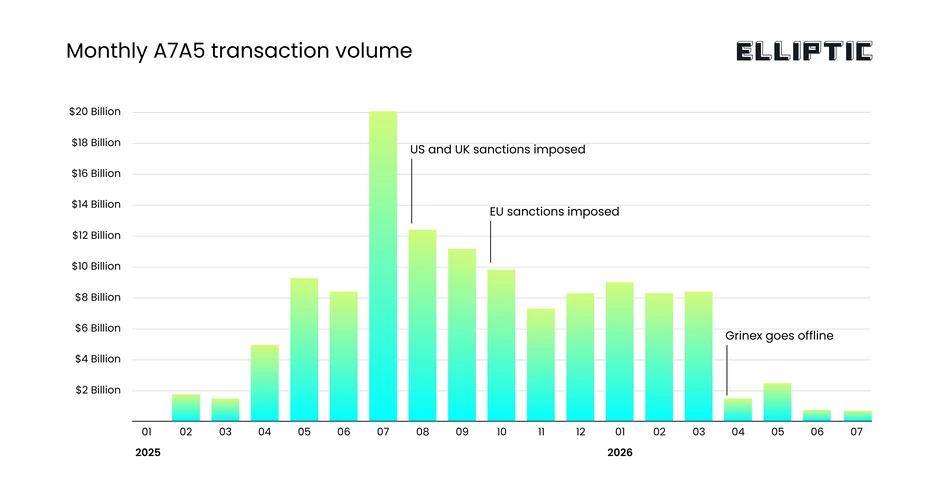
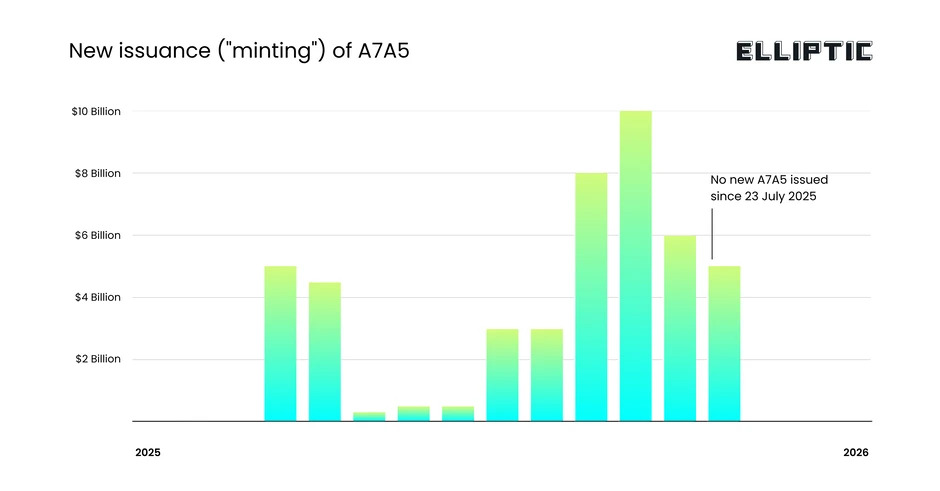
Another indicator also points to declining interest in A7A5. After July 2025, no new tokens were issued at all. By comparison, over the same period the volume of USDT issued grew by around 14%, equivalent to nearly $22 billion.
Most likely, such a sharp reduction in activity is explained by a combination of three factors:
- international sanctions;
- changes in Russian regulation of the cryptocurrency market;
- the loss of access to the main trading venues.
Sanctions made the token "toxic"
In the second half of 2025, A7A5 and all the infrastructure connected to it were successively placed under sanctions by the United States, the United Kingdom, and the European Union. From a technical standpoint, this changed almost nothing. A7A5's smart contracts still continue to operate on the Ethereum and Tron blockchains, and no Western state can simply switch them off.
In practice, however, the sanctions changed almost everything. The main blow fell not on the token itself, but on the venues where it could be exchanged for other cryptocurrencies, above all USDT. Every operation on the blockchain is public and remains in the network's history forever.
For this reason, companies engaged in blockchain analysis can track the movement of funds connected to organizations under sanctions. The world's largest crypto exchanges use such screening systems to analyze every incoming deposit.
By the start of 2026, warnings were already circulating within the community not to use any wallets connected to the A7A5 ecosystem, including the Grinex and Meer exchanges. The reason was that even an indirect connection to this infrastructure could lead to an account being blocked on major international trading venues.
The consequences of the sanctions also affected decentralized trading venues. In November 2025, Uniswap, the largest decentralized exchange, added A7A5 to its list of unsupported tokens and removed it from its official website.
Although the smart contracts continued to function, access to the token became severely limited, and liquidity on decentralized exchanges practically disappeared.
Russia itself shut down the main channel for buying the token
The second serious blow to the project came from within Russia itself. The Bank of Russia had long opposed the widespread use of cryptocurrencies within the country, and in the second half of 2025 it began gradually restricting the main way ordinary users acquired A7A5 — bank cards.
The project's official website repeatedly posted notices about the temporary suspension of token purchases using cards of the national payment system "Mir" issued by Promsvyazbank.
Instead, the support service recommended using the services of brokers or arranging deals through promissory notes.
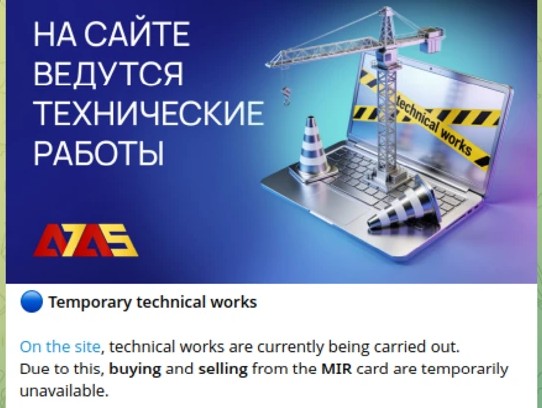
Almost immediately after this channel was cut off, the volumes of operations with A7A5 began to shrink rapidly. If the sanctions had blocked the ability to exchange A7A5 for other assets relatively freely, the April restrictions effectively deprived the project of any inflow of new rubles.
The "hack" of Grinex finally stripped the token of its liquidity
By the end of 2025, virtually all trading in A7A5 was concentrated on the Grinex exchange, which was considered the successor to the Russian crypto exchange Garantex and was likewise linked to Russian sanctions infrastructure.
Grinex representatives claimed the attack had been organized at the state level and was highly sophisticated.
However, some members of the cryptocurrency community suggested that this might not have been a hacking attack at all, but a so-called exit scam — a situation in which the owners of a venue themselves cease operations and disappear along with their clients' funds.
Whatever the true cause of what happened, the result was the same. The only venue that had genuinely significant A7A5 liquidity ceased normal operation, and along with it, users lost access to their funds.
What the story of A7A5 teaches
The A7A5 project has not entirely disappeared. Its smart contracts continue to operate, and transactions are still being made, albeit in significantly smaller volumes.
The story of A7A5 allows several important conclusions to be drawn. Sanctions against stablecoins can be effective even when the token itself cannot be switched off.
Sanctions work even when a token cannot be switched off
They still allow users to transfer tokens between wallets and to receive the interest payments provided for by the system. In practice, however, the market in which this token can be used has all but disappeared.
The reason is that the key entry and exit points — crypto exchanges, decentralized exchange interfaces, and services for converting fiat money into cryptocurrency — are required to comply with sanctions requirements.
The concentration of liquidity on a few venues makes the system vulnerable
Because A7A5 could not be freely traded on major international crypto exchanges, almost all of its liquidity became concentrated within a small network of sanctioned trading venues, the main participant of which was the Grinex exchange.
The April 2026 security incident, regardless of whether it was a genuine hack or fraud on the part of the exchange's owners, revealed the weak point of such a model.
As soon as it stopped functioning normally, serious problems immediately arose for the entire project. Sanctions are most effective when different countries act together. The sanctions against A7A5's infrastructure were imposed simultaneously by the United States, the United Kingdom, and the European Union.
Sanctions are most effective when several countries coordinate
Cryptocurrencies easily cross national borders. If only one country imposes restrictions, market participants often simply move their activities to another jurisdiction. But when the actions of several states are coordinated with one another, the opportunities for circumventing sanctions become significantly fewer.
It is precisely such a coordinated policy that deprives the participants of such schemes of the ability to quickly relocate their activities to new venues.
Indirect connections to sanctioned assets are what matter most
Their risk was indirect. They encountered USDT and other cryptocurrencies that had previously been acquired using A7A5 and only reached their platforms several transfer steps later. It was precisely the ability to detect such indirect connections that made the sanctions truly effective.
This simultaneously sets a new standard for sanctions compliance. If a blockchain analysis system is not capable of reliably identifying such indirect connections to sanctions infrastructure in real time, it no longer meets modern sanctions-control requirements.
What role blockchain analysis played in the fight against A7
Sanctions lists alone are not enough. A sanction is merely the name of an organization or company on an official list. In reality, it is blockchain analysis technologies that turn such entries into frozen assets, blocked deposits, and closed user accounts.
Because all operations on the blockchain are open, specialists can track the cryptocurrency addresses and financial flows connected to organizations under sanctions.
Even if funds pass through several exchanges and intermediate wallets designed to conceal their origin, such routes can be reconstructed.
This is precisely why crypto exchanges and fintech companies screen incoming funds for such connections. Thanks to this, it becomes possible to detect an indirect connection to sanctions infrastructure that would have remained unnoticed without blockchain analysis.
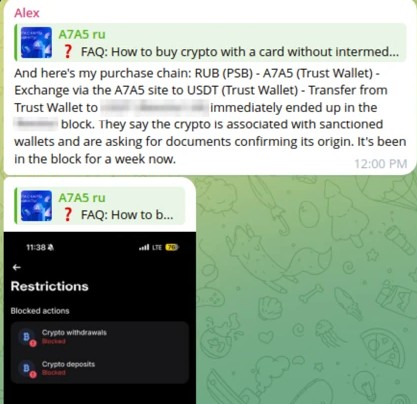
It is the operation of such systems that explains the numerous complaints from A7A5 users who reported the freezing of their USDT after it arrived at international crypto exchanges. Such blocks were not accidental — they were the result of the routine operation of sanctions-control mechanisms.
The deterrent effect proved no less important than the blocks themselves
Interestingly, the impact of such technologies manifested itself not only in blocks that had already taken place. Even before most users encountered the freezing of their funds, warnings began to spread actively within the community not to use A7A5 when dealing with major international exchanges. In other words, the system began to serve a preventive function.
The main takeaway: technical invulnerability does not protect against sanctions
The story of A7A5 shows that issuing a ruble-pegged stablecoin in a third country cannot in itself provide a reliable mechanism for circumventing sanctions. The practical value of such a token depends entirely on the existence of liquid venues willing to exchange it for dollar-denominated assets.
Recently, the Russian parliament passed a sweeping law regulating the digital-asset market. The document places the activities of crypto exchanges, brokers, and custodial services under the supervision of the Bank of Russia.
Notably, while retaining the ban on using cryptocurrencies to pay for goods and services within the country, the law expressly permits the use of digital assets in foreign-trade settlements. Most of its provisions will take effect on September 1, 2026.
Thus, the failure of the A7A5 project has not forced the Russian authorities to abandon the idea of using cryptocurrencies in international trade. On the contrary, efforts are now being made to create a more organized, state-controlled infrastructure to replace the previous system.
Sanctions and blockchain analysis were able to seriously weaken A7A5. However, this does not mean a final victory. As new tools and schemes for circumventing restrictions emerge, international regulators and financial institutions will have to remain in a constant state of readiness for new challenges.
