
The blockchain records every transaction, but it never reveals where the person who made it is located. However, by analyzing the daily rhythm of on-chain activity, one can match stablecoin users to the world's time zones — and it turns out that the ten largest stablecoins live by completely different clocks.
Why geography is hard to determine on the blockchain — and how it's estimated
Location is one of the hardest characteristics to determine on the blockchain. It shows well which assets moved and when it happened, but the blockchain data itself contains no IP address, country of residence or username. That is why many published estimates of where a given token is used are based on off-chain surveys or on fairly indirect assumptions.
There is also another approach, based directly on what the blockchain really is able to show: on the time of activity. If you collect all the transactions of a particular coin and distribute them across the time of day, a certain rhythm emerges. During the night hours, activity declines for the bulk of users, and during working hours it rises. Such a daily rhythm makes it possible to match a coin's users to a particular UTC time zone.
Here it is important to note two limitations right away. Such an analysis determines precisely the time zone, not the state border: it shows the hours by which a coin's users live, but doesn't reveal exactly which country they are in. In addition, a single time profile cannot determine whether a user is to the north or south of another group of users. However, because the world's time zones are distributed quite unevenly — for example, India uses UTC+5:30, Iran UTC+3:30, and the whole of China lives on a single UTC+8 time — the time zone itself can provide a surprisingly precise reference point. That is exactly why the analysis is carried out in 30-minute increments, which allow such features to be taken into account.
The methodology of such an analysis is rigorous and has been validated, but it is not disclosed in detail in this material. Only activity resembling human behavior is used for the analysis: obvious bots and identified institutional participants are excluded, after which the remaining activity is analyzed.
Testing the method on cases with a known answer
The most reliable way to test a geography-detection method is to use stablecoins whose users initially have an obvious geographic tie.
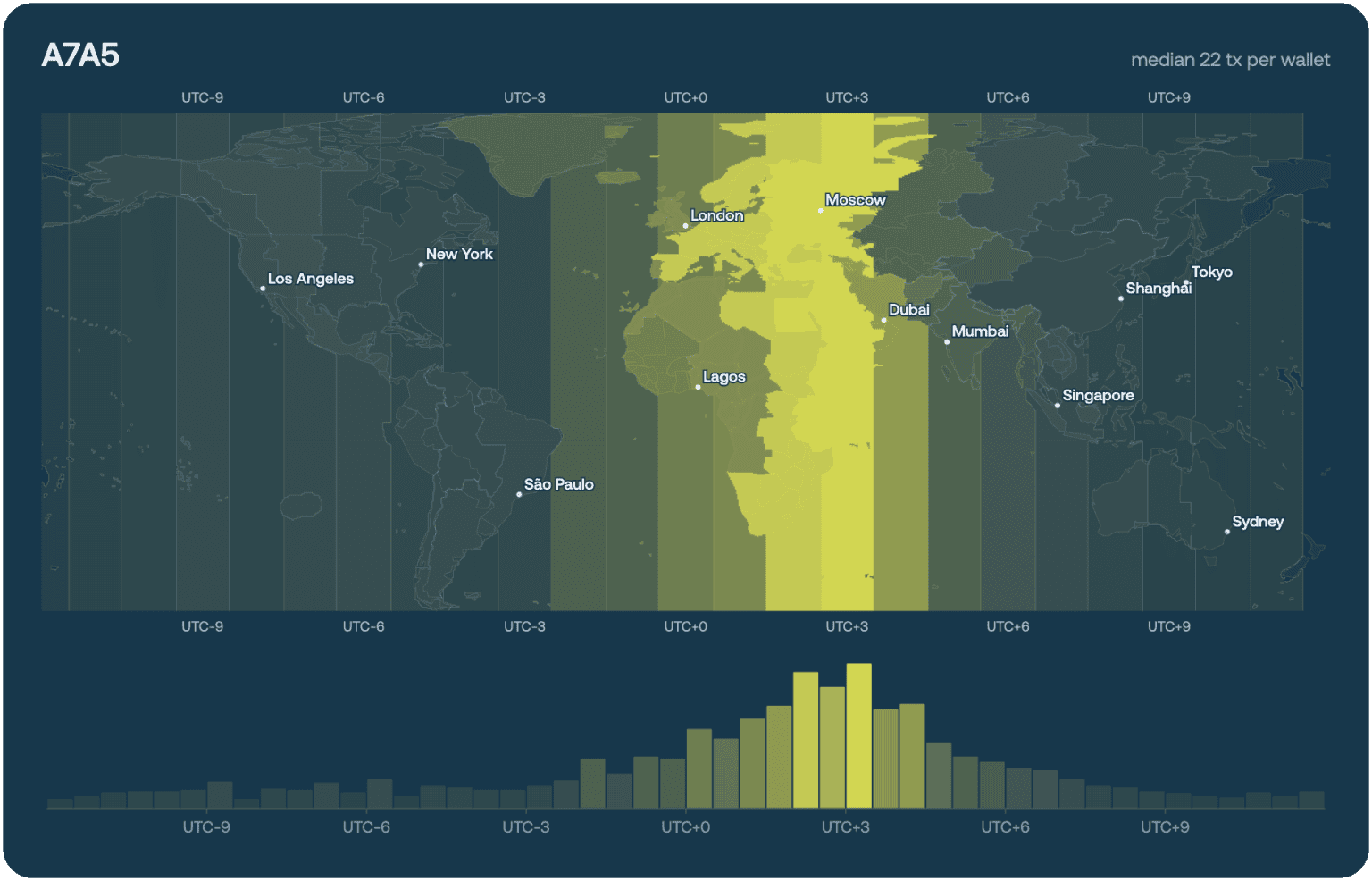
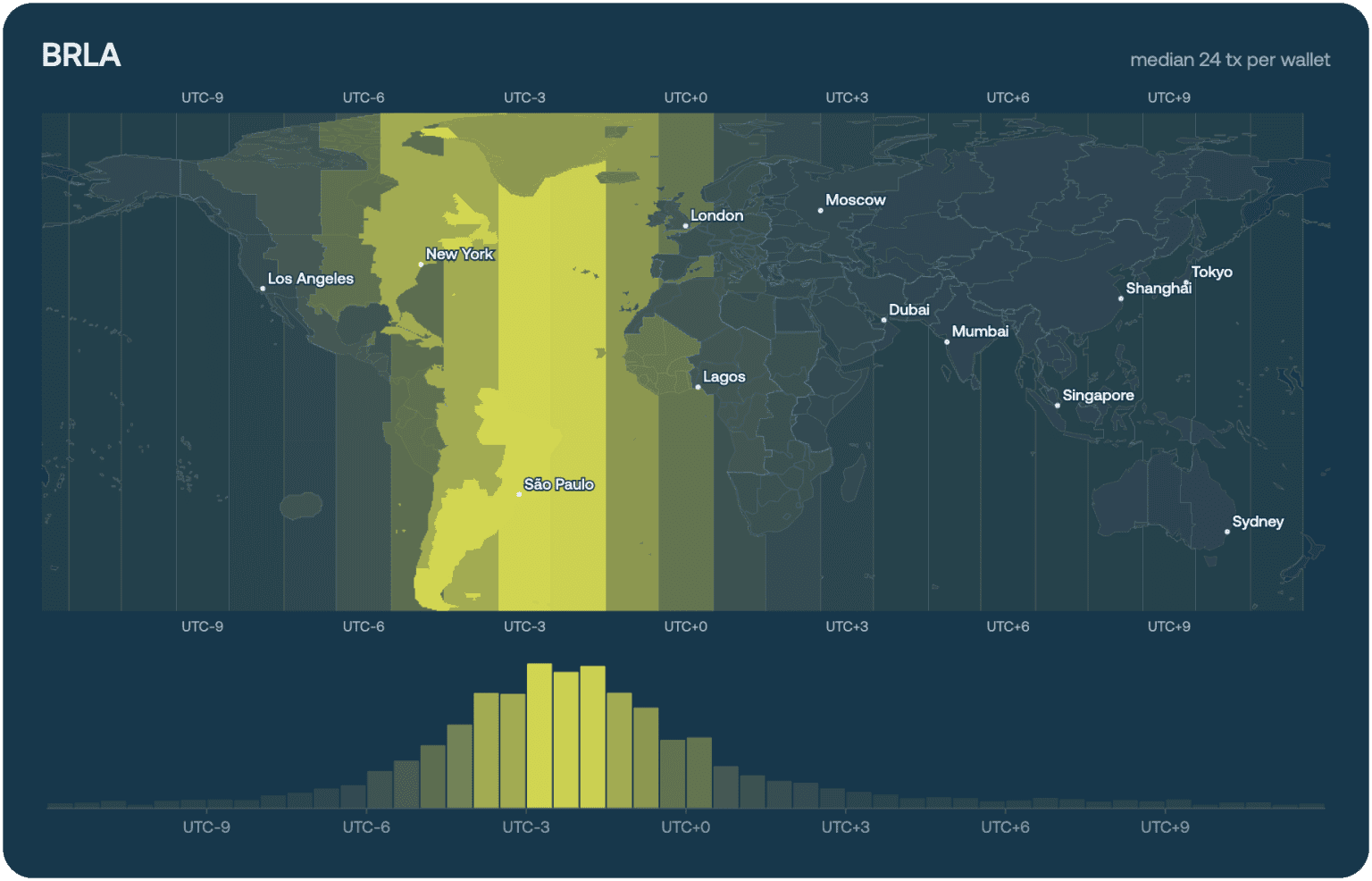
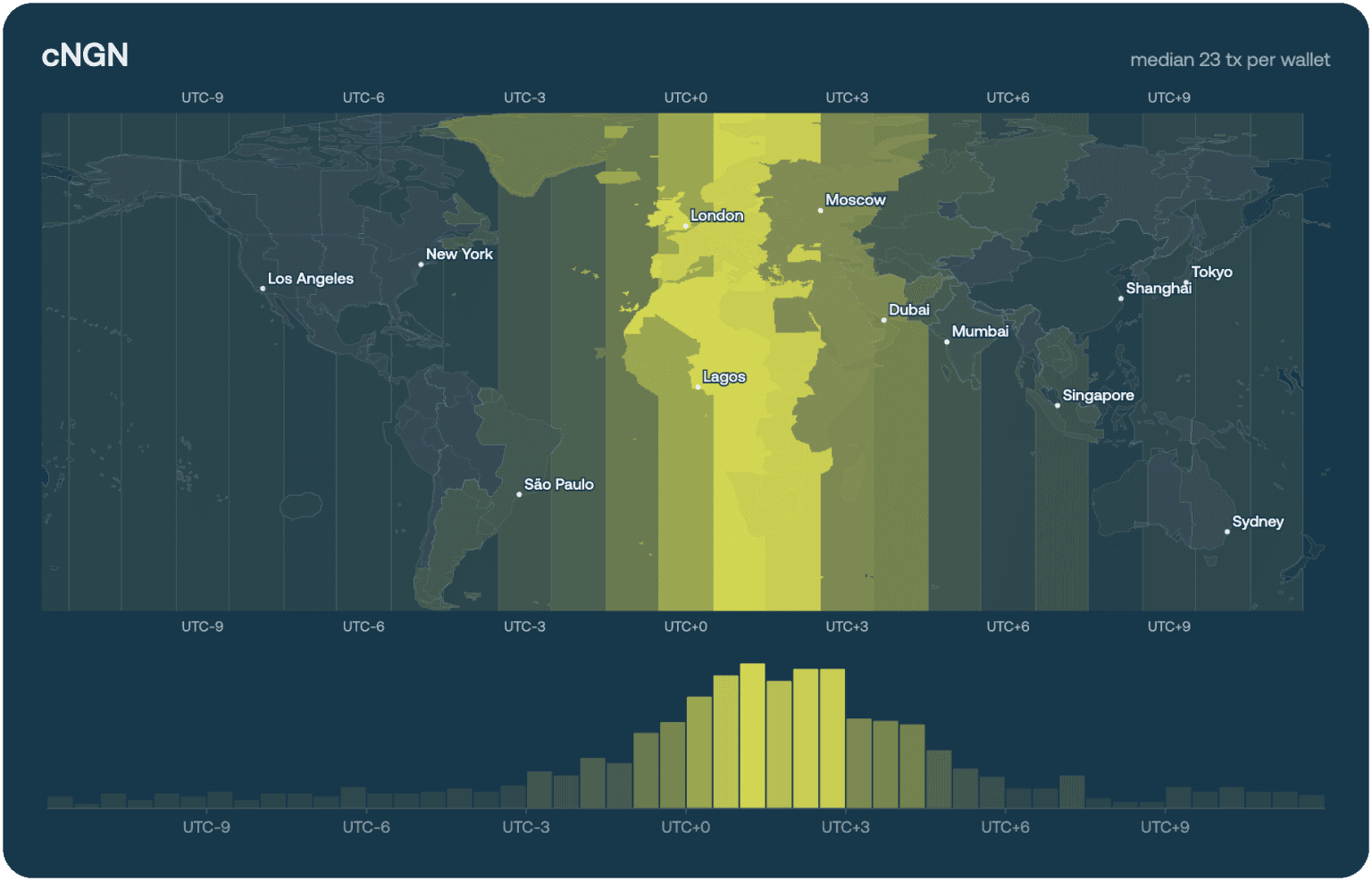
There are three stablecoins created for specific markets: a coin pegged to the ruble, a Brazilian real coin and a Nigerian naira coin. If the time-zone analysis really works, it should determine the corresponding time for each of them. That is exactly what happens.
- A7A5 reaches peak activity at UTC+3 — the Moscow time zone, corresponding to the usual working rhythm of users from Russia and Eastern Europe.
- BRLA concentrates around UTC-3 — the time zone of Brazil, where more than half of this coin's human wallets are located.
- cNGN becomes active in line with UTC+1 — the time of Lagos and of the West African working day. The regional range, that is, the spread of time zones whose activity rises around the main peak, turns out to be fairly wide. However, the combination of the time profile itself with the tie to Lagos makes it possible to determine the main region.
Each of these results is based on an analysis of the corresponding blockchain's activity over a full year.
The ten largest stablecoins and the time zones they live by
Now the same approach is applied to the ten largest stablecoins. If they are grouped not by the share of users in a particular region but by the shape of the daily activity rhythm, they split into three main types.
Coins with a single clear time zone
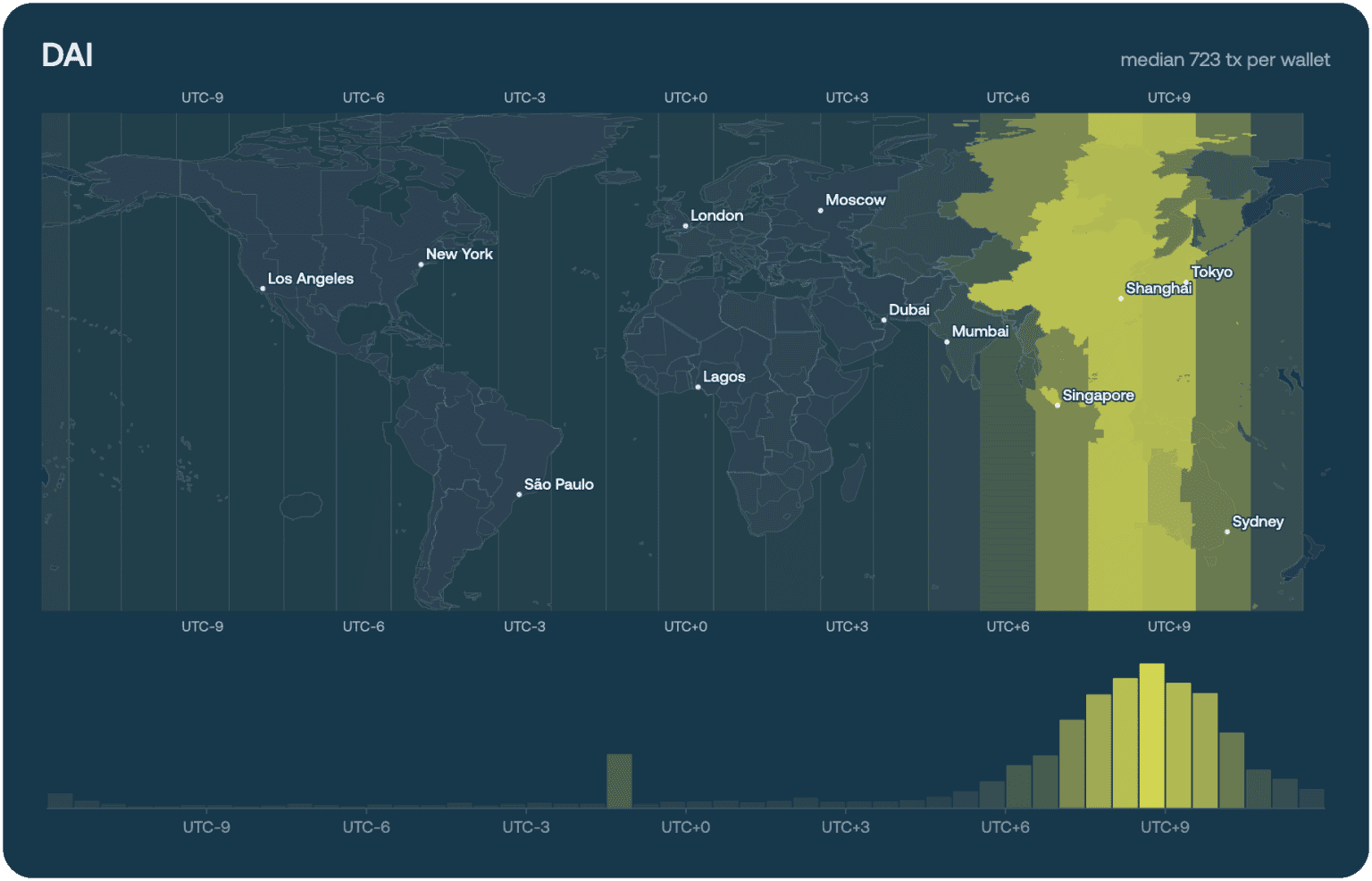
For these four stablecoins, a single time zone clearly dominates throughout the day. This means that the bulk of the activity is formed by one large group of users, and a pronounced single zone of concentration appears on the map.
- DAI shows the most pronounced profile among all the coins examined: a single clear peak falls on UTC+8 — the time zone shared by mainland China, Singapore and Hong Kong. More than three quarters of DAI's human wallets fall precisely within this time zone.
- USD1 is located slightly further east — its activity corresponds to the working and trading day in the UTC+8–UTC+9 range.
- PYUSD presents an almost mirror image on the other side of the globe, concentrating in the UTC-4–UTC-5 range, which corresponds to the US East Coast and other regions of the Americas.
- EURC shows a clear peak at UTC+2 — the time zone of continental Europe during the daylight saving period.
Thus, the four coins show four different main time profiles.
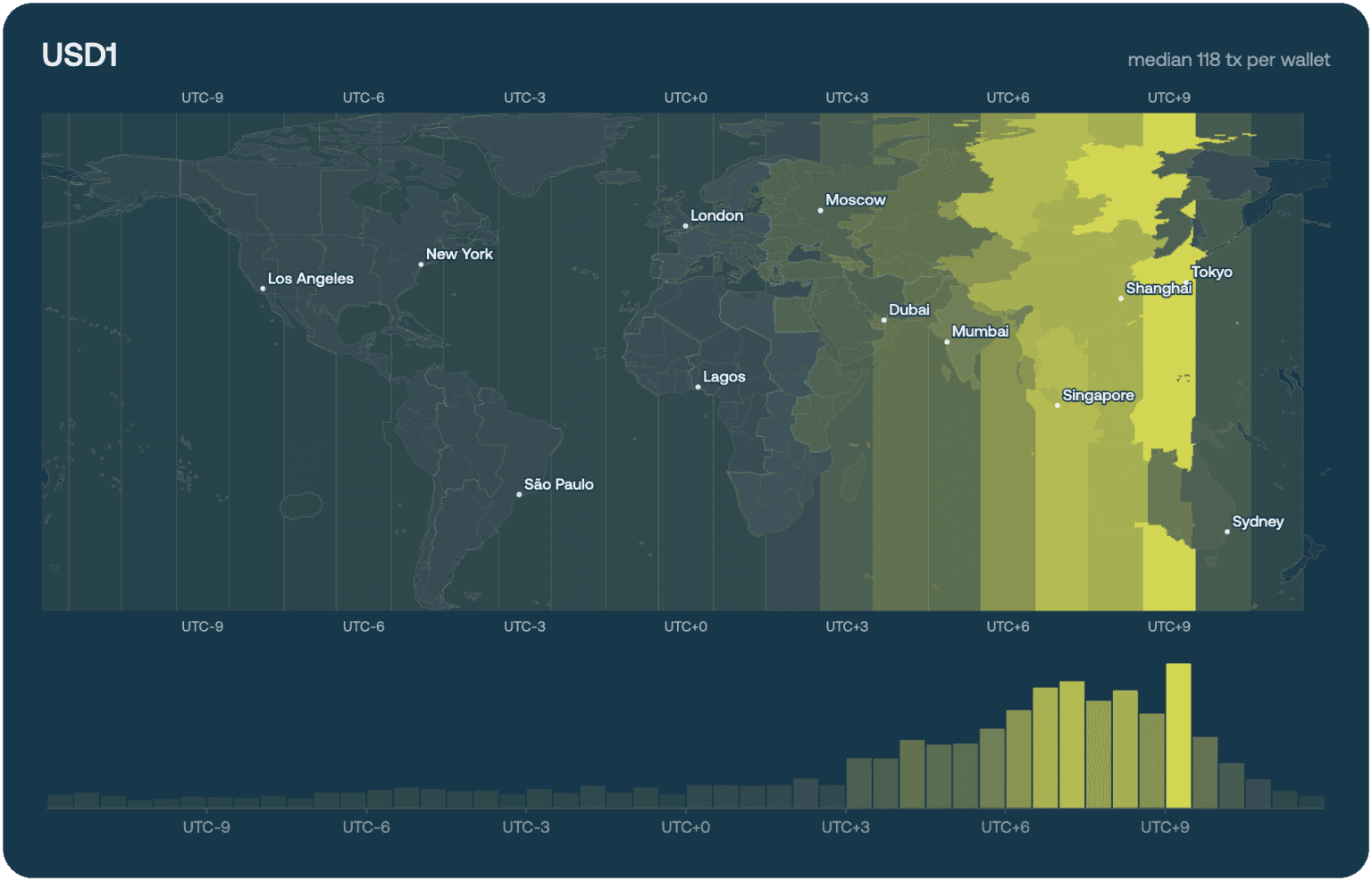
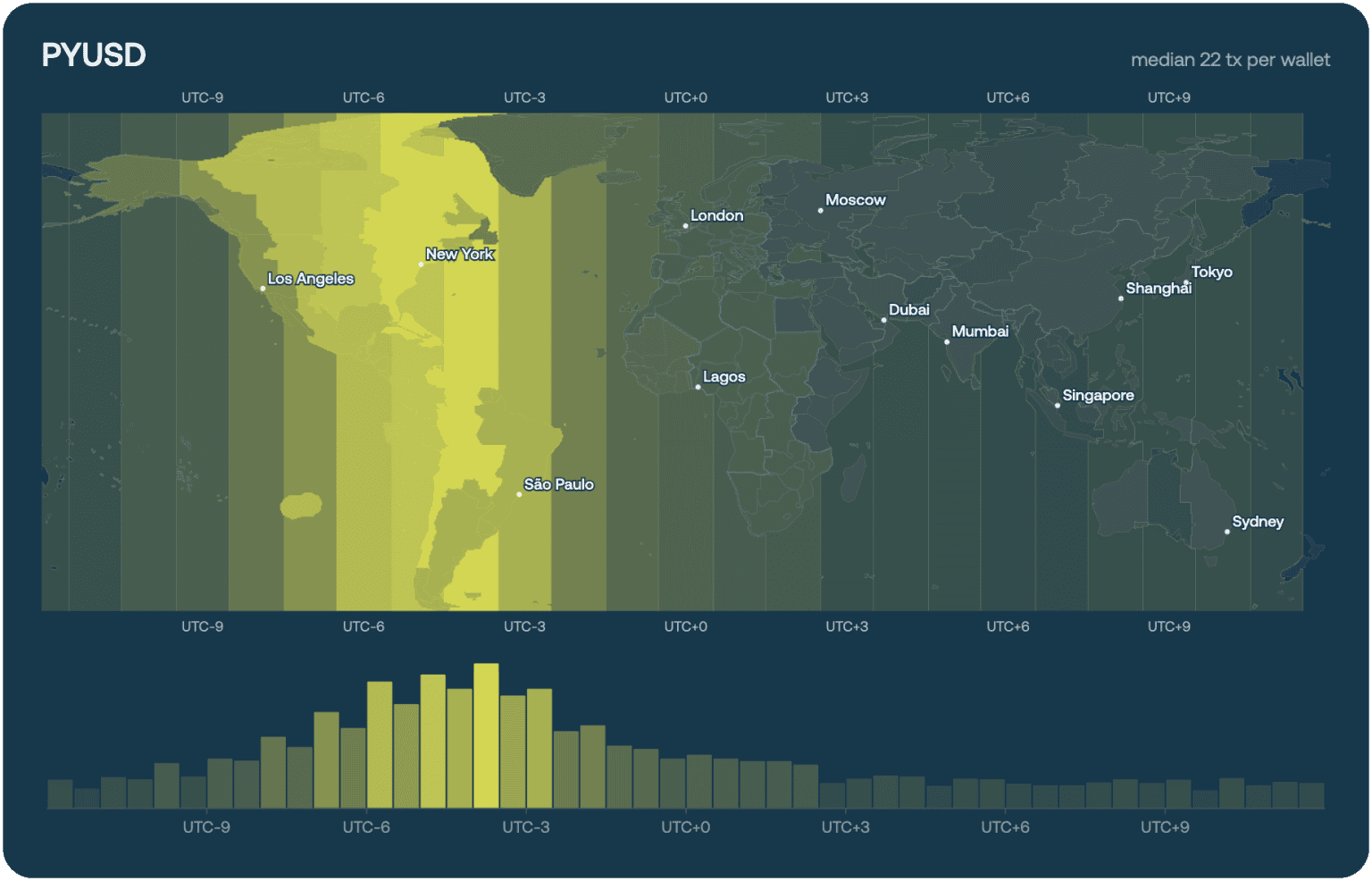
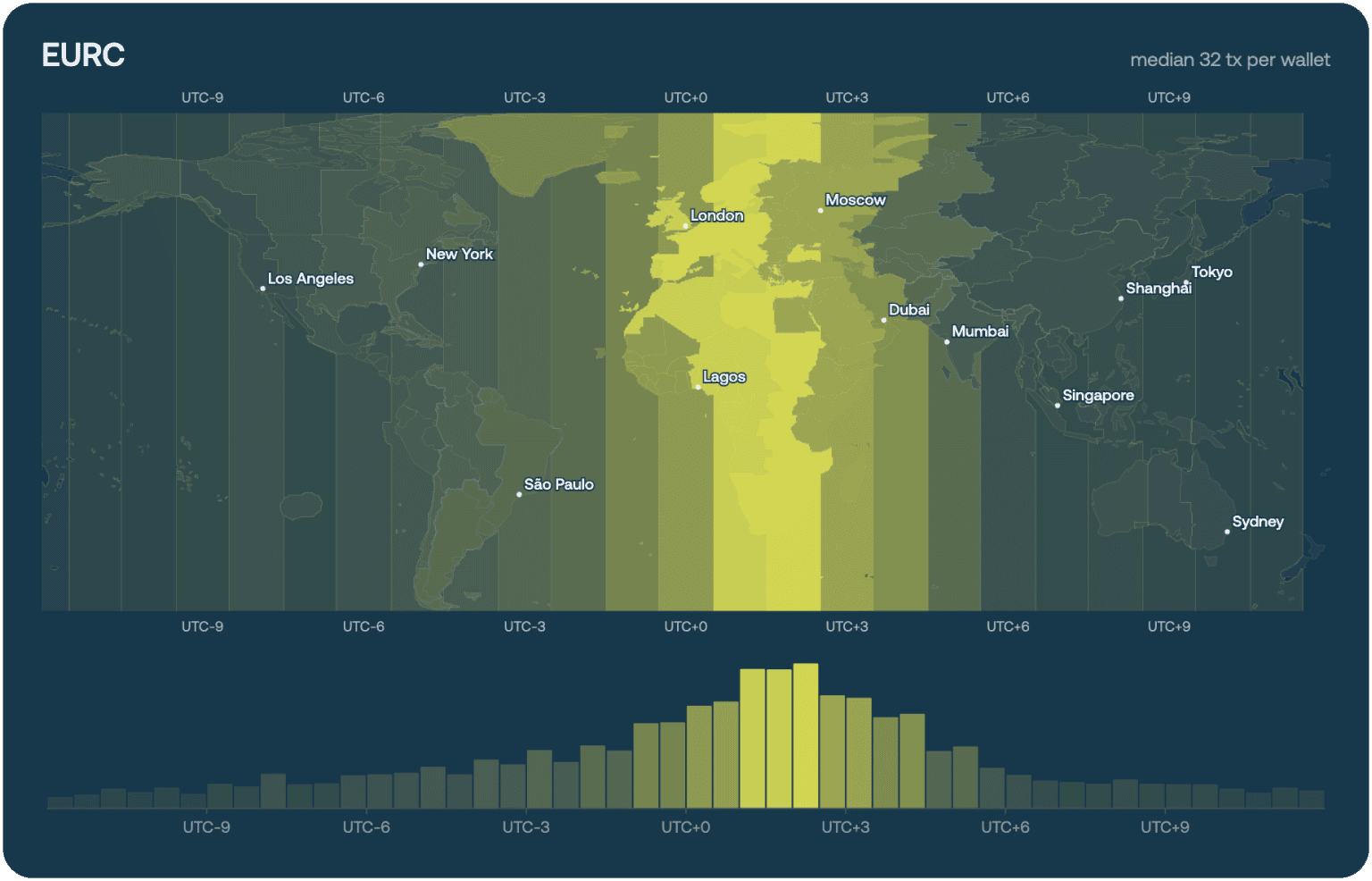
Coins with a single main time zone
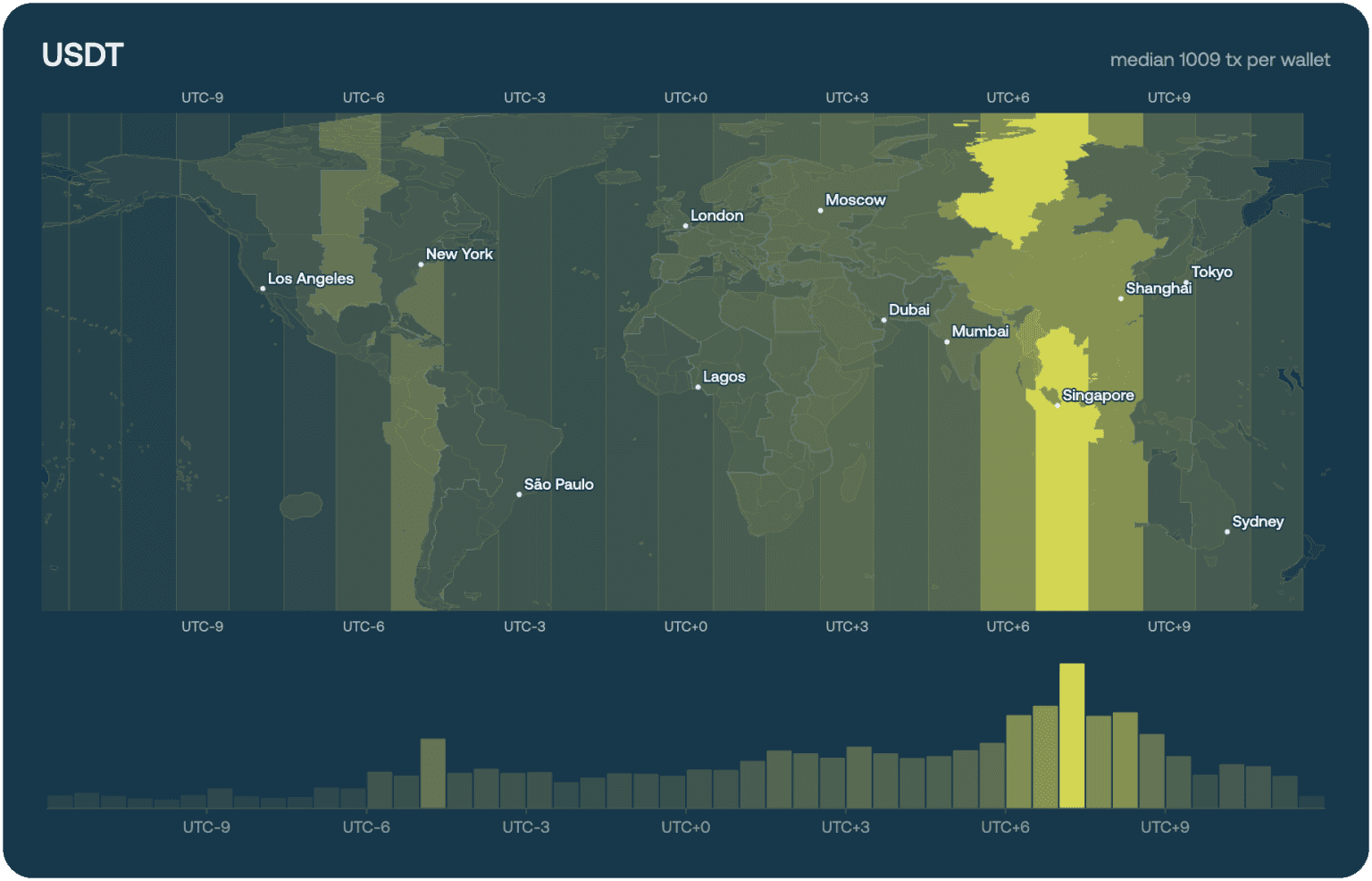
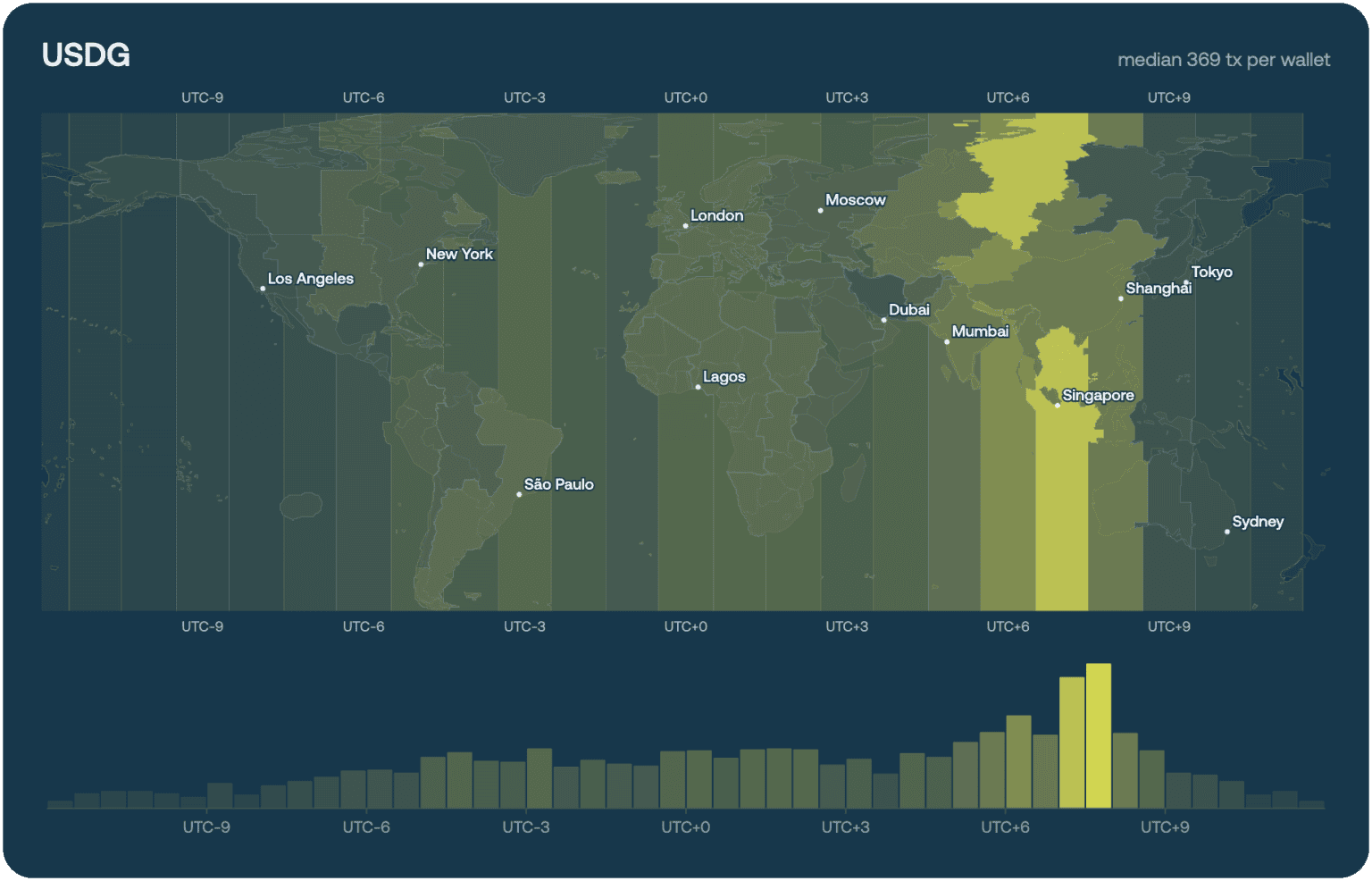
For these two stablecoins there is a clearly defined center of activity, but at the same time a wide range around it is present. In other words, one region forms the bulk of the activity, yet the coin is genuinely used by users all over the world.
- USDT, the largest stablecoin, is used almost everywhere. Nevertheless, the distribution of its activity forms a wide range from the Persian Gulf countries through South Asia to East Asia, with the maximum concentration falling at roughly UTC+7.
- USDG looks more even in terms of distribution across regions, but beneath this picture there is also a rightward shift, with the center of activity in the Asia-Pacific region, roughly in the UTC+7–UTC+8 range.
Coins living across all time zones
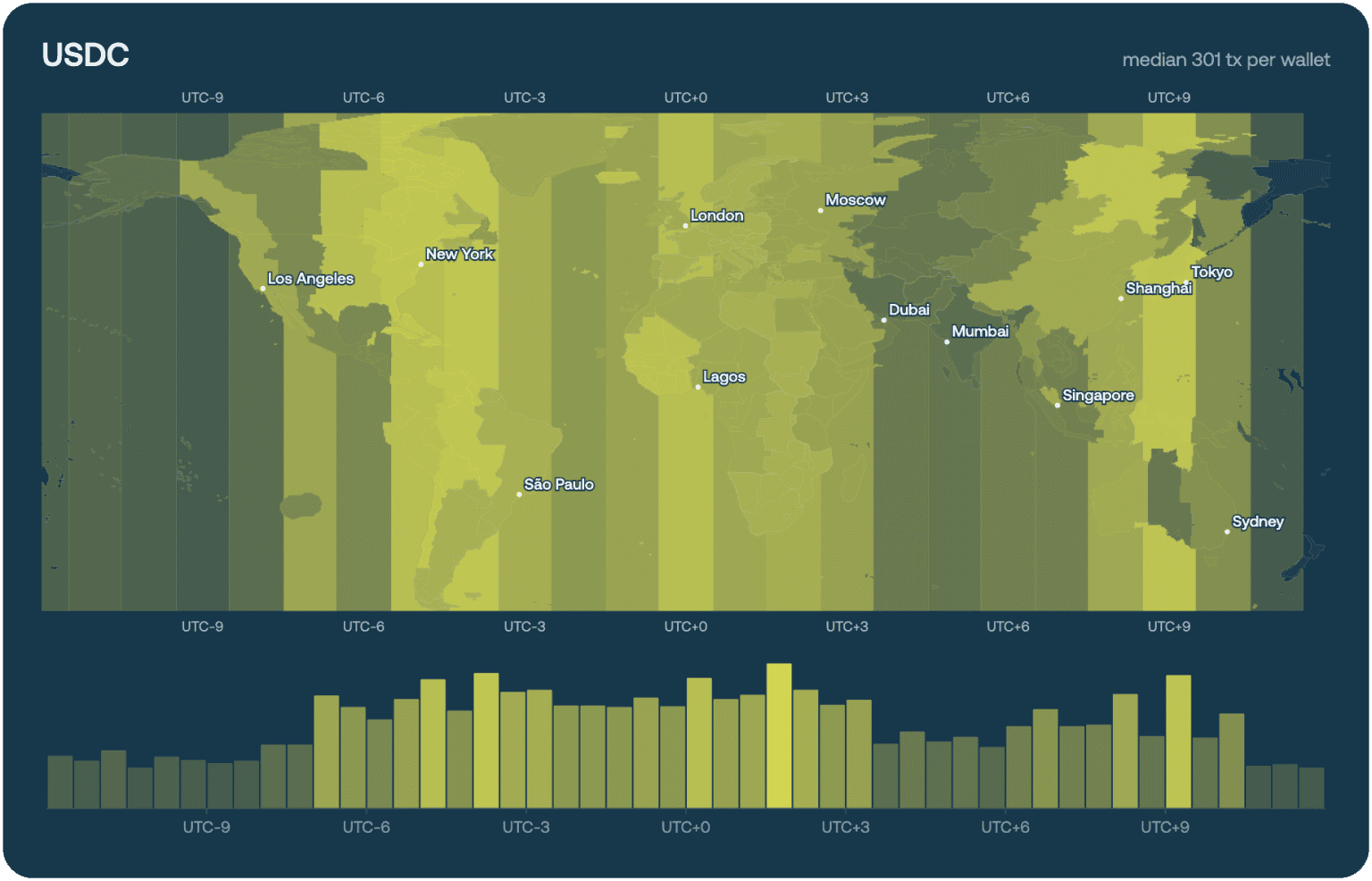
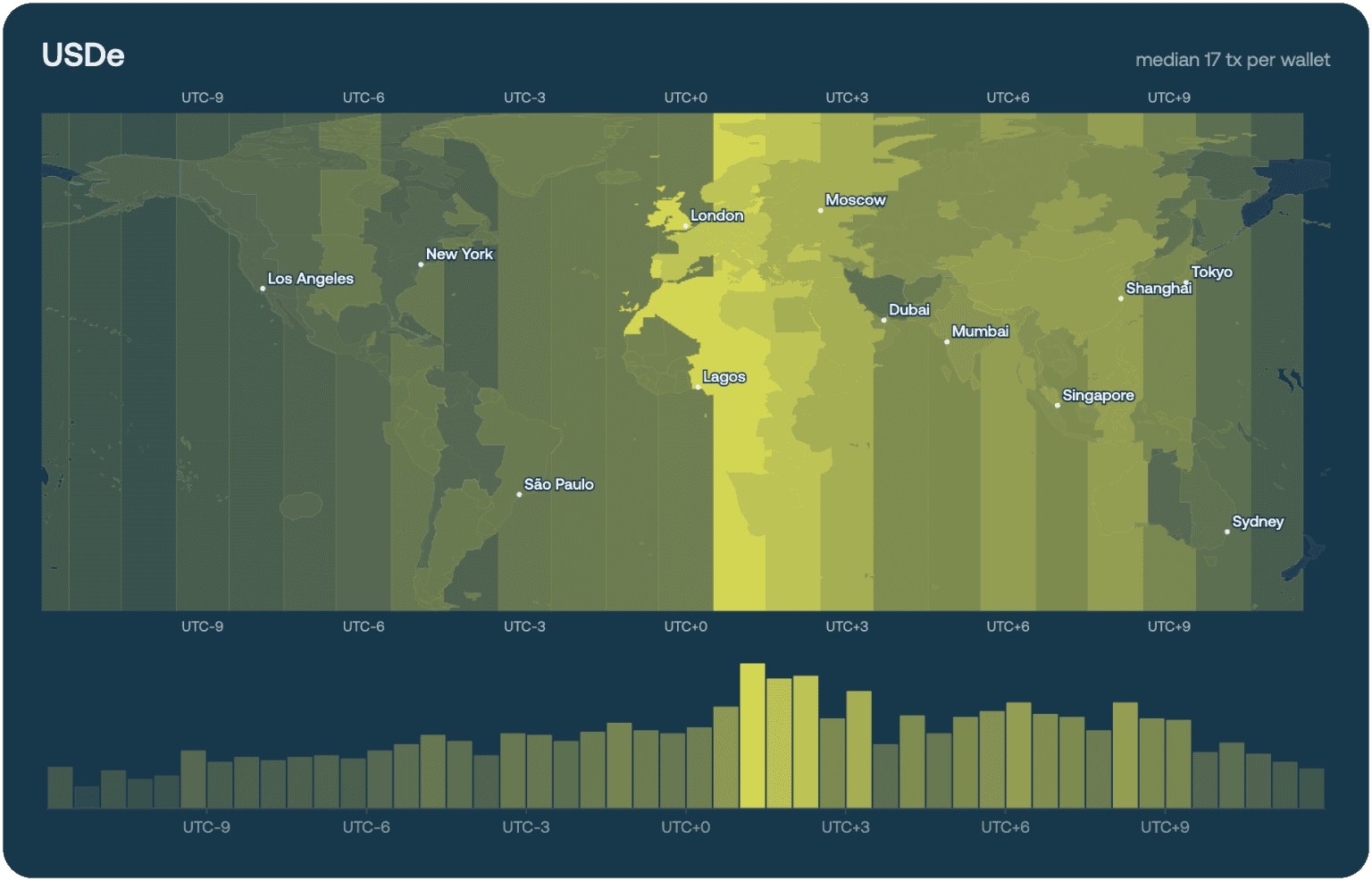
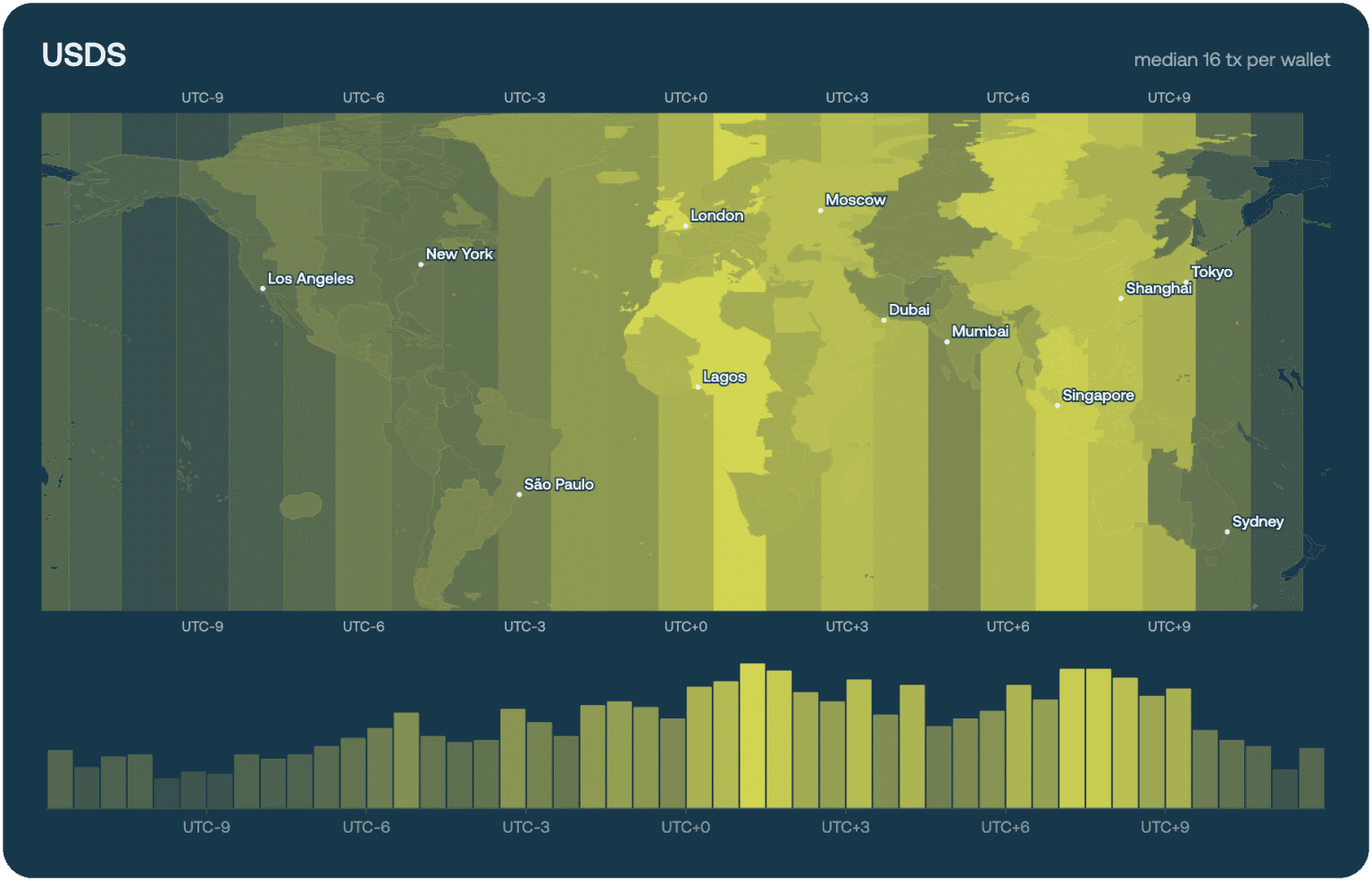
For these stablecoins, the activity profile is distributed across almost the entire day, and the map lights up from edge to edge. No single time zone becomes dominant.
- USDC shows the most even profile among all the coins examined. A slight shift toward the American time zones actually represents only a small increase in activity on top of a generally even round-the-clock distribution. That is exactly why USDC turns out to be the closest to a truly global stablecoin.
- USDe, USDS and RLUSD show a similar distribution: their relatively small activity, matching the rhythm of human behavior, is spread across all time zones and doesn't form a pronounced center.
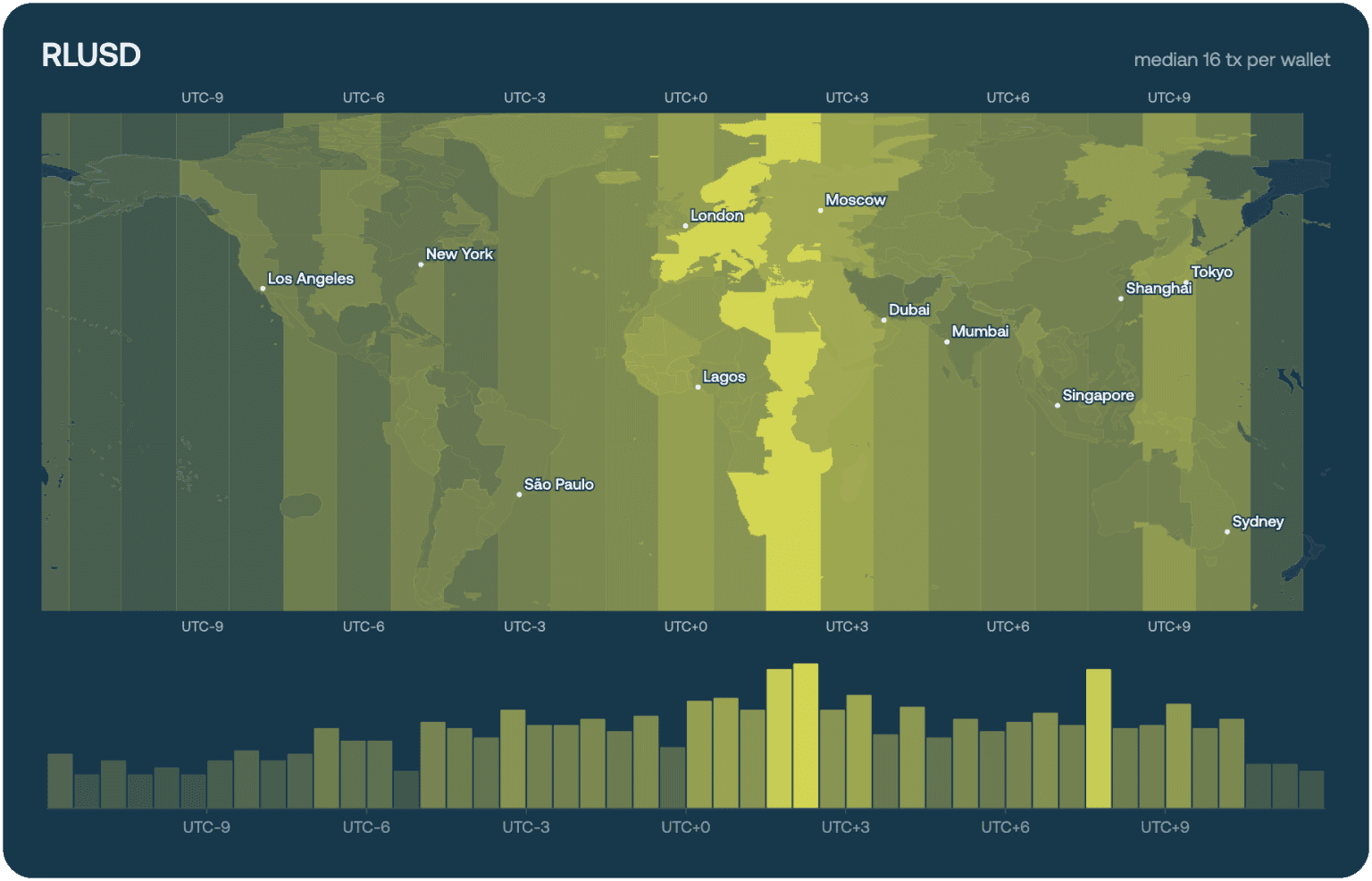
Methodology and scope of the study
Regions are determined on the basis of the time of on-chain activity and matched to UTC time zones in 30-minute increments, fixed during the summer period. That is why European time is represented in the results as CEST, and American time as EDT. The resulting time zone is determined to an accuracy of roughly ±1 hour and describes precisely the time profile, not a specific country. A bright area on the map may cover all territories that use the corresponding time zone: for example, UTC+3 corresponds to both Moscow and some regions of East Africa.
For each coin, the most active wallets with a human-like rhythm are analyzed; bots and identified institutional participants are excluded. For the largest stablecoins a recent two-week observation period is used, for the rest roughly four months, and the three region-focused stablecoins are studied over a full year directly on their own blockchains.
