
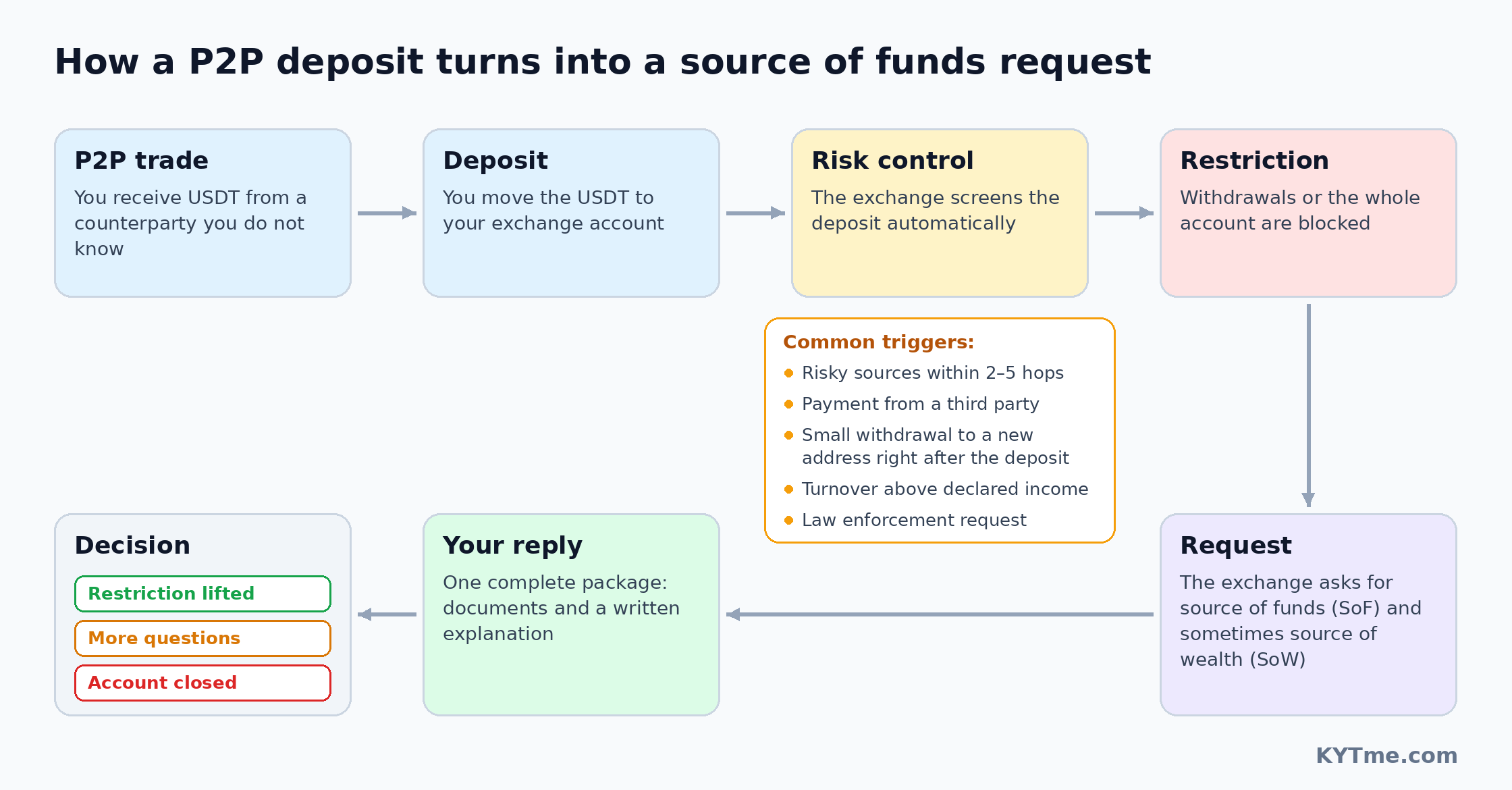
You sold or bought USDT on P2P, moved the coins to an exchange, and a few hours later withdrawals stopped working. The app shows a notice that your account is restricted, and your inbox has an email asking you to confirm where your funds came from. This is not a permanent ban and not an accusation. It is a compliance review, and it follows a clear logic: the exchange saw a risk signal in your deposit and wants you to explain it. Below we look at what that signal usually means, which documents to collect, how to write your explanation and what to expect in terms of timing.
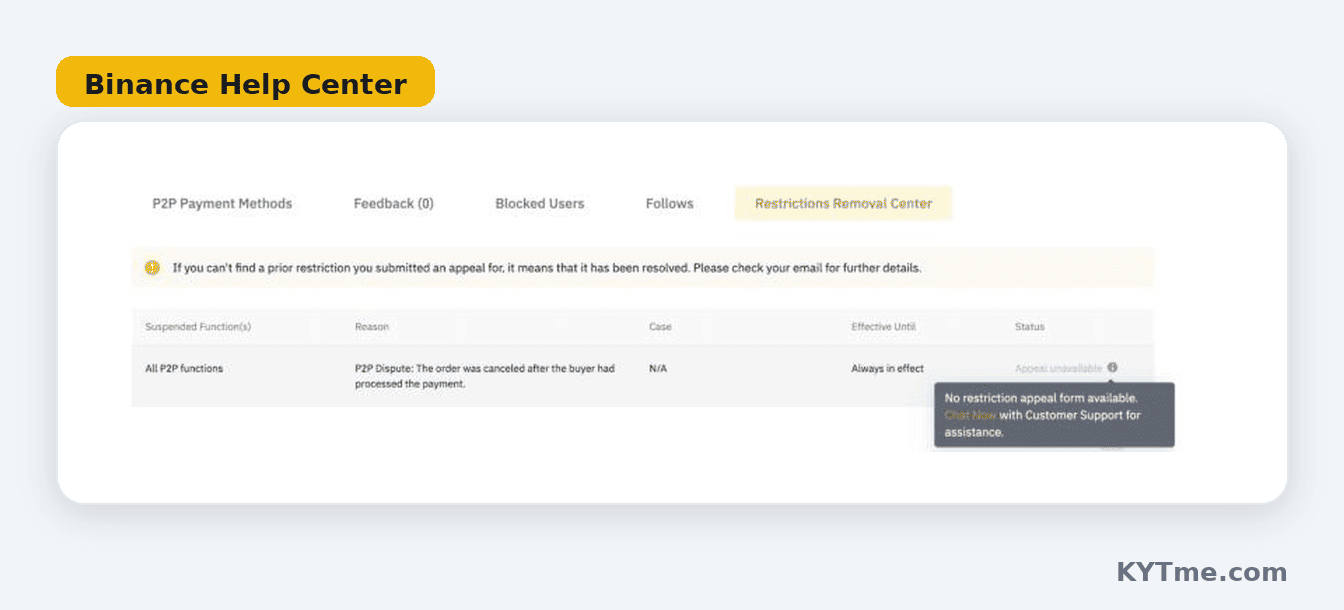
Why the exchange restricted your account after a P2P trade
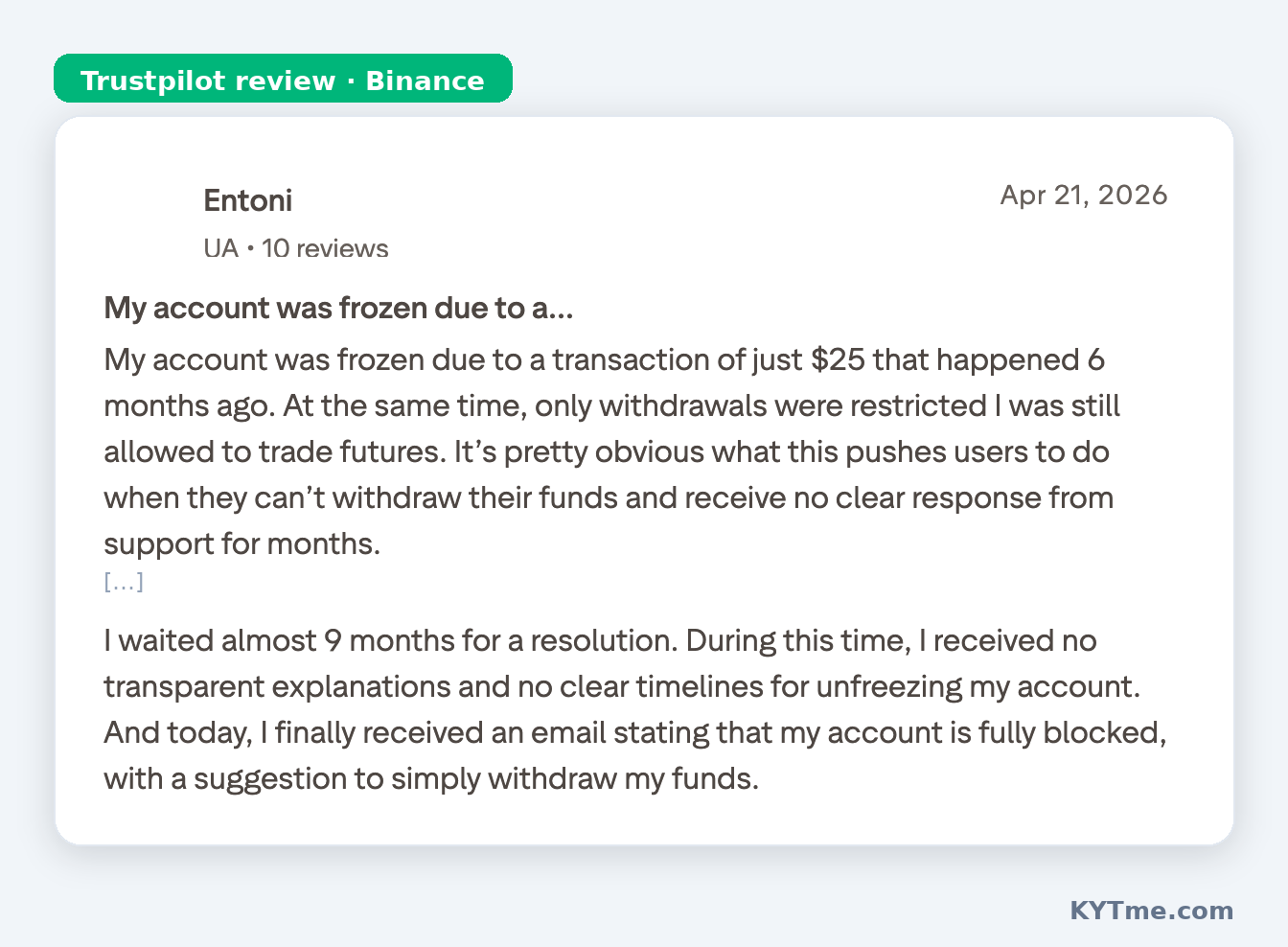
Exchanges screen every incoming transfer automatically. The system looks not only at the address the coins came from, but also at its history. If a sanctioned address, a scam cluster, a darknet market or a mixer appears within a few hops of the sender, the deposit gets a risk flag. According to an analysis of Bybit's rules, the exchange takes into account links across two to five intermediate addresses, so direct contact with a "dirty" wallet is not necessary. In complaints from Turkish Binance users, the reason is even shorter – withdrawals were stopped with the note "High address is flagged". The trigger can also be tiny and old: a Binance user writes that his withdrawals were blocked because of a transfer of just $25 made six months earlier, and that he waited almost nine months for a decision.
In P2P, a deposit like this is easy to receive. The seller does not know the buyer, and the buyer could have received the USDT from anyone – including someone cashing out stolen funds. We have written in detail about how such coins reach ordinary people.
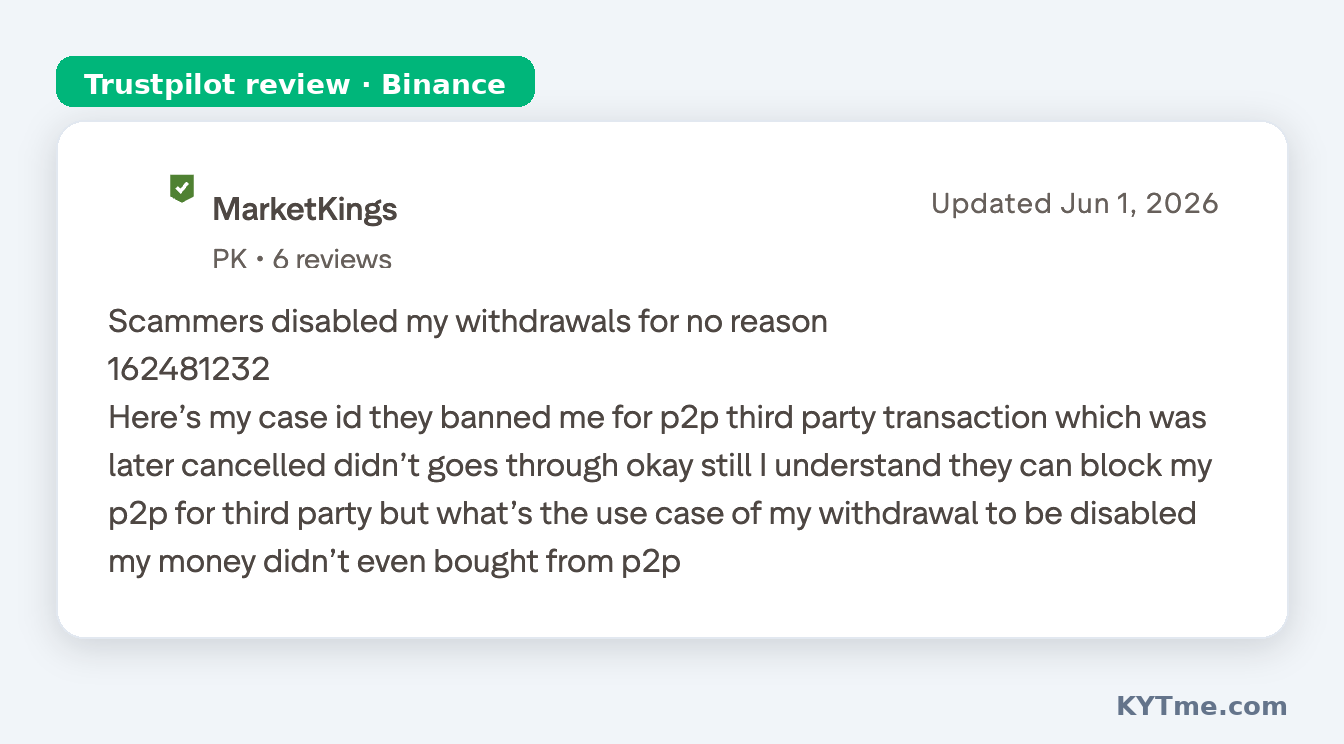
The second common trigger is a payment from a third party. If the money for the USDT came from someone other than the person who opened the order, that breaks the rules of almost any P2P platform. Binance states plainly that transfers from another person's account violate its P2P policy. A Binance user said that after a P2P order with a third-party payment, the exchange disabled not only his P2P access but also his withdrawals – even though the trade itself was cancelled and never went through.
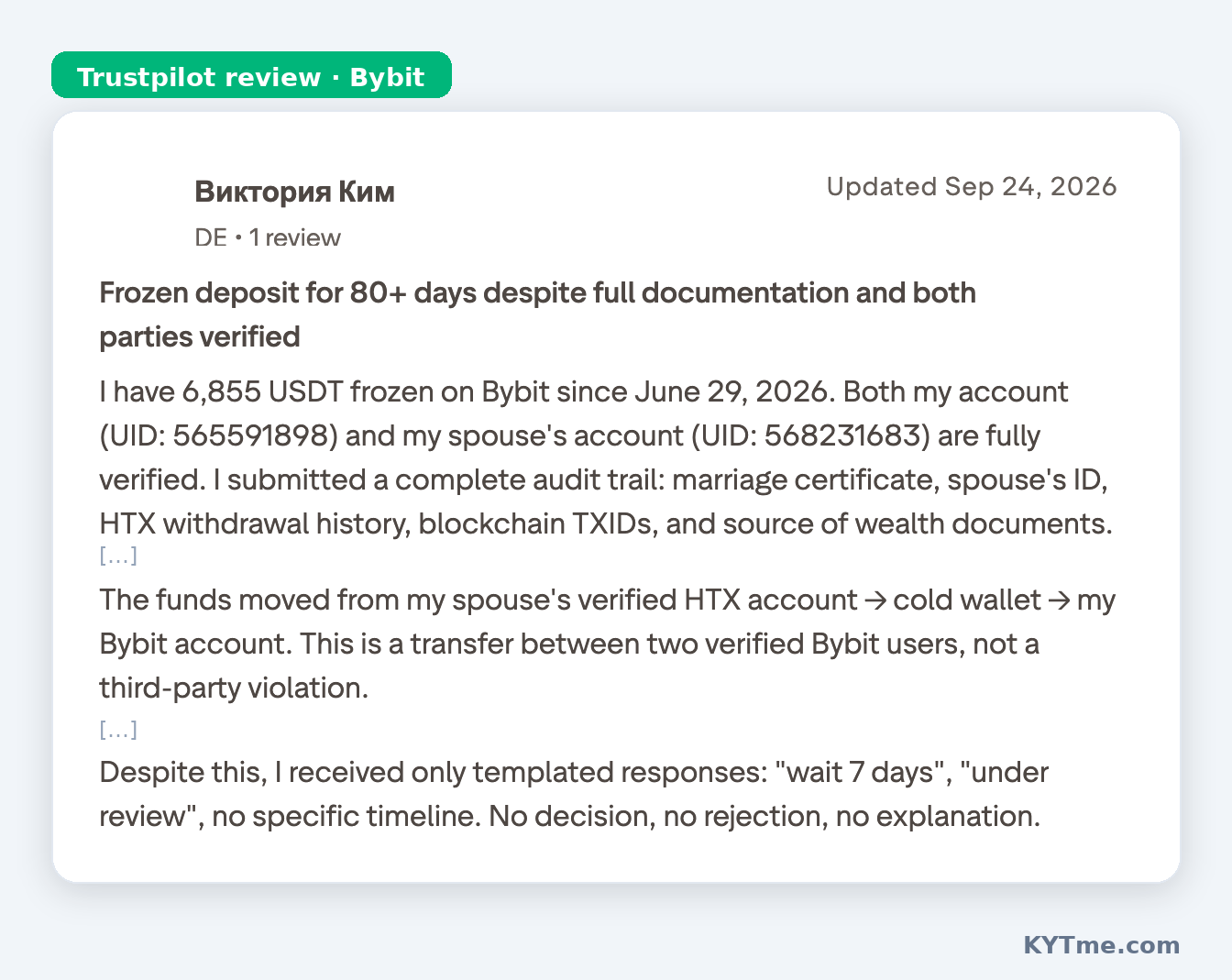
Transfers from family members can raise suspicion too. A Bybit user writes that 6,855 USDT have been frozen since 29 June 2026: the coins came from her husband's verified HTX account via a cold wallet. She sent a marriage certificate, her husband's ID, his HTX withdrawal history, the TXIDs and source of wealth documents, but after more than 80 days she was still receiving only template replies.
The third trigger has to do with account behavior. Lawyers who handle such cases name one of the most common triggers on Bybit as a small withdrawal to a new address right after a deposit. To the system, this looks like transit: the money came in and immediately moved on. MEXC describes a similar signal in its rules:
Rapid inflow/outflow of funds, large-value or high-frequency transactions without legitimate economic purpose, – MEXC's risk control guideline says.
The fourth trigger is turnover that does not match income. In the summer of 2026, Binance began sending users in Venezuela requests titled "Fuente de Fondos y Riqueza – Información Salarial". They went to users whose trading volume was well above their declared income. Freelancers and small traders who are paid informally were hit the hardest.
The fifth trigger is a law enforcement request. In April 2026, the accounts of Binance traders in Kenya were restricted at the request of the police, and users received a single line: "Your account has been restricted at the request of law enforcement". In such cases the exchange does not make the decision on its own, and the user's documents change little until the request is withdrawn.
Source of funds and source of wealth: what the exchange wants from you
Exchanges ask for two different kinds of proof, and they are easy to confuse. Binance defines them as follows:
If the review was triggered by a single deposit, SoF is usually enough: show that you bought these coins with your own money and where that money came from. If your account turnover is large for your declared income, the exchange will also ask for SoW: salary, business, sale of property, inheritance, investments. For a P2P trader, the question is almost always twofold: where did the fiat used to buy the crypto come from, and why did the counterparty turn out to be risky?
How long the review takes: stated and real timelines
Almost no exchange publishes a maximum review time. Below is what exchanges say themselves and what user complaints from 2025–2026 show.
| Exchange | What the process is called | What they ask for | Stated time | In real cases |
|---|---|---|---|---|
| Binance | RFI, SoW and SoF verification, withdrawal appeal | income for 3 months, statements, video with TXID | not published | 35–115+ days |
| Bybit | EDD (enhanced due diligence) | SoF and SoW documents, proof of wallet ownership | not published | 9–152+ days |
| OKX | risk control, enhanced verification | ID, address, income | 24 hours to 1–3 days | 2–200 days |
| MEXC | Account Risk Review | advanced KYC, statements, TXID | 30-day observation, restriction up to 180 days | from 2 weeks to a year or more |
| HTX | security questionnaire (AML) | questionnaire and documents | about 5 business days | more than a year |
| KuCoin | User Forbidden | on request via support | not published | months |
| Bitget | withdrawal restricted | KYC | 24 hours | more than a year |
| BtcTurk | account restriction and document request | income declaration, address | not published | 3 days to 4.5 months |
| Paribu | review of the economic purpose of transactions | occupation and income | 10 business days | about 10 days |
Sources: exchange help centers and complaints on Trustpilot and Şikayetvar. The table shows the main point: the stated time describes the fast track, when the documents are accepted on the first try. If compliance asks new questions or waits for a decision from another party, the count goes into months.
Real cases: how reviews end
Cases where the user sent a complete package right away are resolved the fastest. The owner of an OKX TR account holding about 400,000 TL in assets said that the account was frozen on a Thursday for a source of funds review. He sent all the documents, and access was restored four to five days later.
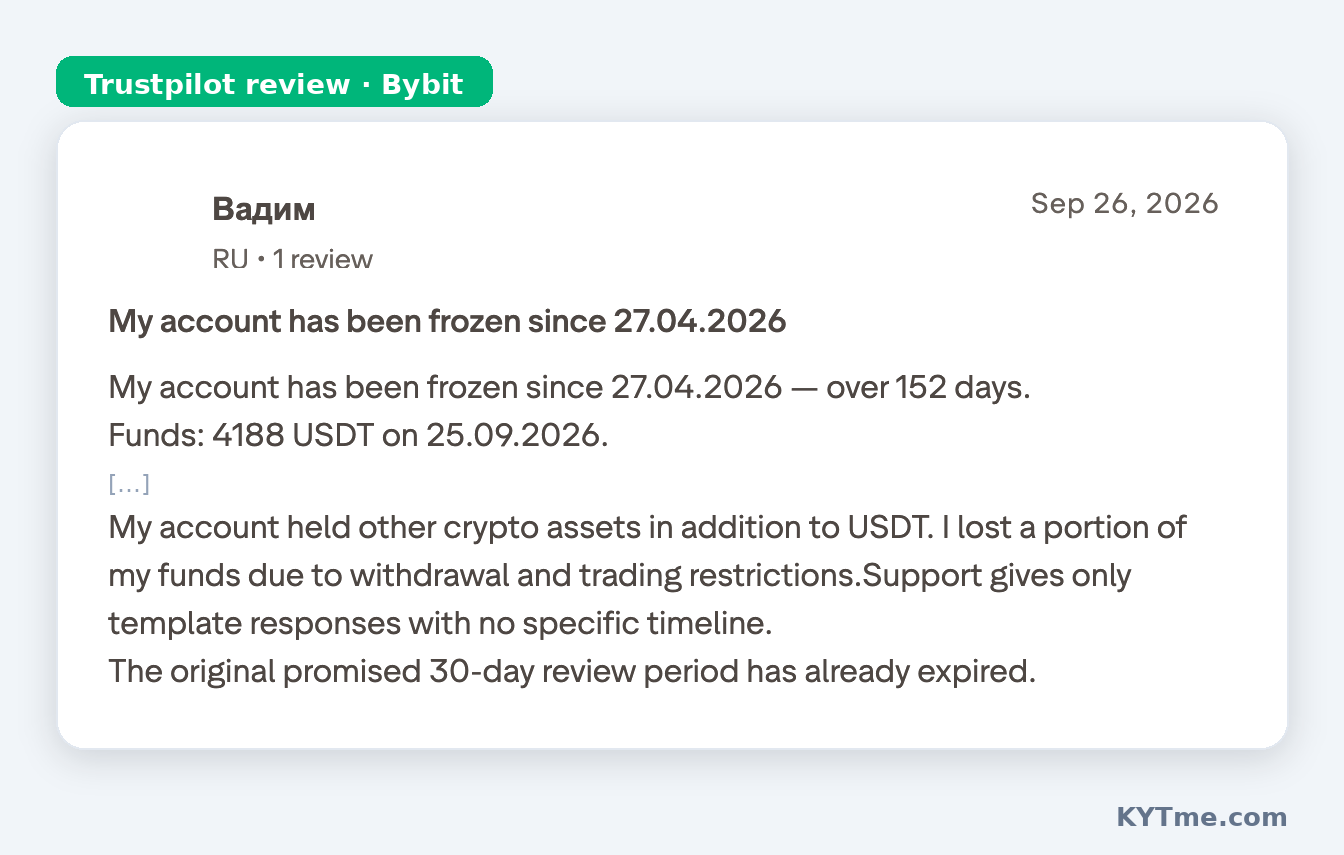
If compliance is not satisfied with the answer or waits for other departments, the review drags on. A Bybit customer writes that his account with 4,188 USDT has been frozen since 27 April 2026 – more than 152 days. The promised 30-day review period passed long ago, support replies with templates, and he eventually filed a complaint with the regulator.
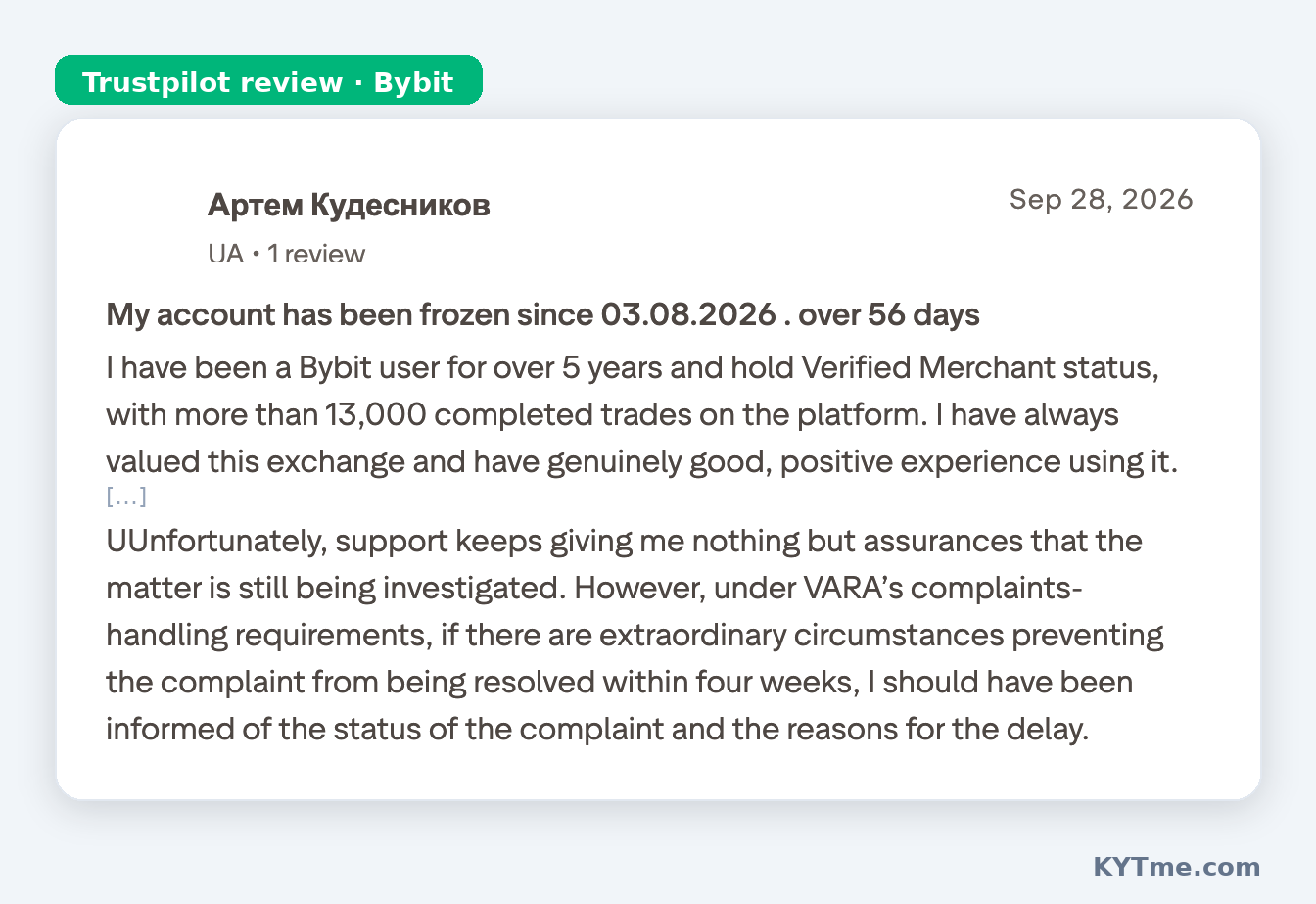
Experience and reputation do not protect you either. A verified Bybit P2P merchant with five years on the platform and more than 13,000 trades said that his account has been frozen since 3 August 2026. After 56 days, support was still only telling him that the matter was being investigated.
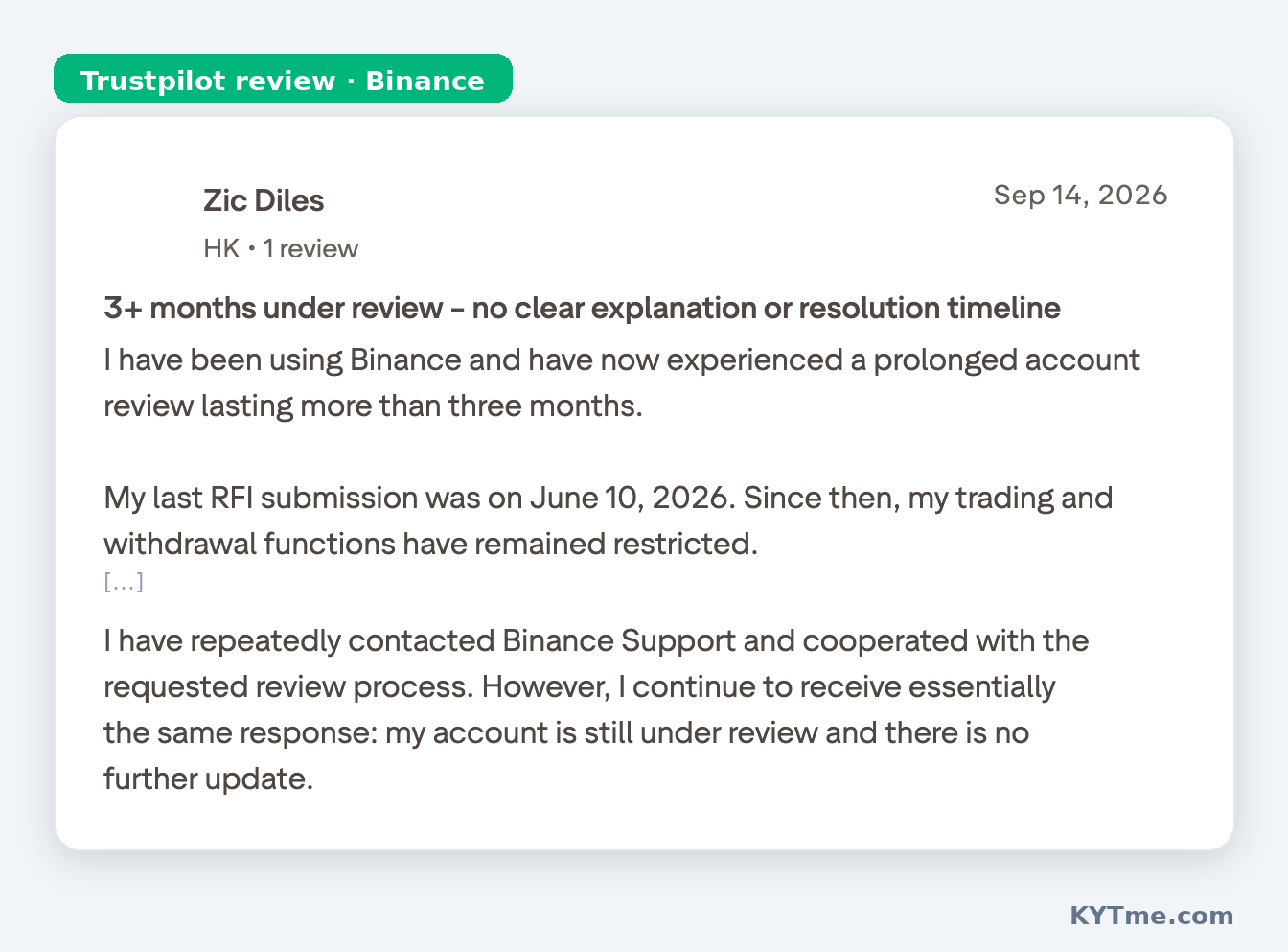
Sometimes answering the request does not end the story. A Binance customer reported that he submitted his last package for a request for information (RFI) on 10 June 2026, yet in September his trading and withdrawals were still blocked. To every message, support replied that the review was ongoing.
The longest cases are those where a police request stands behind the review. At the end of 2021, Binance restricted the accounts of more than 100 traders from Colombia following a request from the Dutch police. The P2P sellers had received coins from "risky addresses", and some had balances of 1.88 BTC and $70,000 in USDT. The traders sent bank statements, tax returns and proof of income, but four months later only 16 of them were unblocked – after the story became public. In Kenya in 2026, traders complained that their accounts had been closed for more than two months with no charges and no court order.
There are also cases with no clear reason at all. A Bitget user writes that his account has been frozen for more than a year after profitable futures trading. Cases like these show that documents do not always settle things quickly, but without documents you have no chance at all.
Which documents to collect
The lists from Binance, Bybit, OKX and MEXC overlap by about 80%. For a P2P trader, the package looks like this:
- ID and proof of address – if the exchange asks for them again.
- Proof of income for the last three months: payslips, a tax return, client contracts for freelancers.
- A bank statement showing the fiat side of your trades: who paid you and when, or whom you paid. Binance requires a three-month statement with the account holder's name visible.
- Screenshots of P2P orders with order numbers, amounts, the counterparty's name and time. In a Binance P2P appeal, you can list up to 10 order numbers and attach up to 20 files.
- An export of the chat with the counterparty from the P2P platform.
- TXIDs of incoming and outgoing transfers and a video. Binance asks you to record the process live rather than as a screen recording: logging in to your account, the transaction history, then the external platform with the same TXID, all in one video.
- A dated report on the screening of the sender's address. To be clear: no exchange lists a third-party AML report as an accepted document in its rules. But lawyers include such a report in the package as supporting evidence: it shows that you checked the counterparty and what was known about them on the date of the trade.
How to write your explanation for compliance
A compliance officer reads dozens of letters like this every day. They need to understand within a minute who you are, what happened and what supports it. Write it step by step – one paragraph for each point.
- 1. Introduce yourself.Your name exactly as in KYC, your occupation and since when you have been trading on P2P. If you are a merchant, state your status and number of trades.
- 2. Describe the transaction that led to the restriction.The deposit date, network, amount, TXID, P2P order number, the counterparty's name and the payment method. The more precise the details, the fewer follow-up questions you will get.
- 3. Explain where the fiat came from.What money you used to buy the crypto: salary, business income, the sale of another asset. Refer to a specific attached document – for example, "bank statement, page 2".
- 4. Show why you did not know about the counterparty's risk.You traded through the platform's escrow and could not see where the buyer's money came from. If you checked the address before the trade, attach the report and give its date.
- 5. State your request.Lift the restriction on the whole account or on a specific amount, restore access to withdrawals. List the attached files.
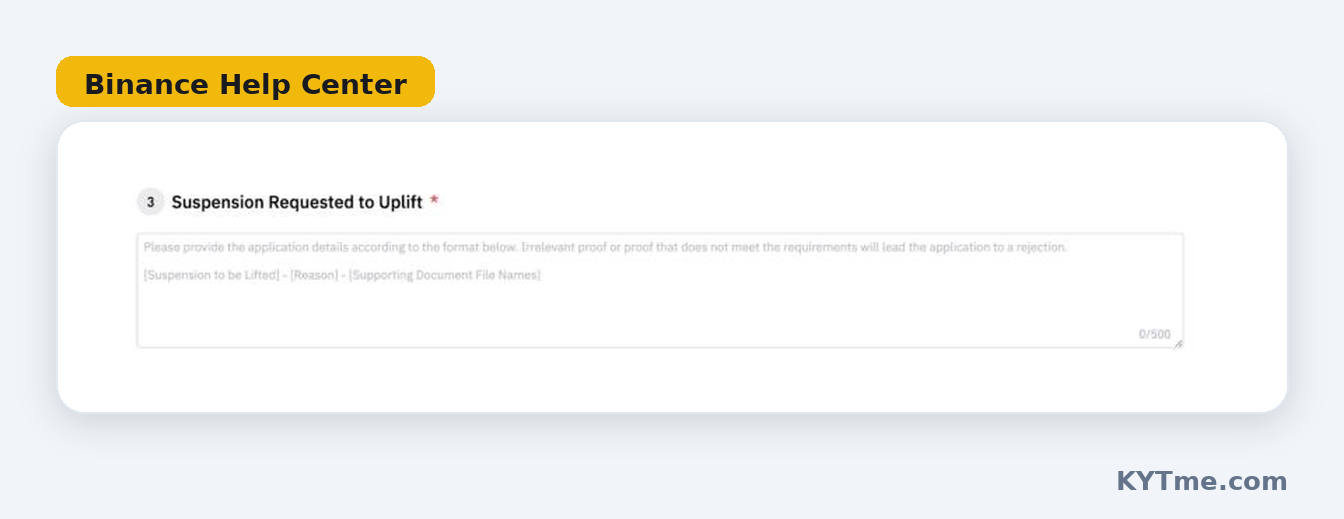
If the exchange has an appeal form, follow its format. Binance, for example, asks you to state in the description field which restriction to lift, the reason and the names of the attached files.
Keep the tone calm and businesslike. Threats, sarcasm and demands to "return my money immediately" do not speed up the review.
If the exchange does not respond: where to turn
First, use all of the exchange's official channels: the appeal in the app, the restrictions removal section, support chat. Write down the case number and every date. If there is no answer for weeks, the next step depends on your country.
In Turkey, bank blocks by MASAK under Law No. 5549 are limited to seven business days of administrative suspension, after which the case goes to the prosecutor. If the exchange simply will not release your money, you can take the dispute to the consumer arbitration committee (Tüketici Hakem Heyeti) for amounts up to 186,000 TL, and to the consumer court for larger amounts.
In Brazil, after the ouvidoria – the exchange's internal ombudsman – you can turn to the Central Bank. In Argentina, crypto service providers must report unjustified transactions to the UIF within 24 hours, so a question about the source of funds can also come from the regulator. In India, if a fraud complaint stands behind the restriction, the route goes through the NCRP portal and the 1930 helpline. In Kenya, such requests are initiated by the DCI, and in Nigeria by the EFCC. According to Binance itself, between June 2020 and February 2024 it received 626 requests from Nigerian law enforcement and responded on average within 37.4 hours.
The last lever is a public complaint on Trustpilot, Şikayetvar, Reclame Aqui or X. In the case of the Colombian traders, some accounts were unblocked precisely after the story became public. But this works when you already have a complete package of documents, not instead of it.
What not to do during the review
A separate word about fake "AML bots". Scammers know that someone with a frozen account is nervous, and they offer to "check your USDT" or "confirm your funds are clean" on their own website. A real AML check needs only a public address or TXID. It never asks you to connect a wallet, sign a transaction or enter a seed phrase.
How to avoid a review next time
You cannot rule out a review completely: each exchange has its own thresholds, and it may ask for documents simply because of your trading volume. But you can remove most of the triggers before the trade.
Before a trade with an unknown counterparty, you can check their address on KYTme: one service brings together three AML providers – Crystal Intelligence, BitOK and VALEGA Chain Analytics. Your first check is free, after that checks start from $0.30.
Check the sender before the trade
Visit siteFAQ
Stated times range from 24 hours to 10 business days; at MEXC, observation lasts up to 30 days and restrictions up to 180. In real cases, the review takes from 2 days to several months. Cases where the user sent a complete package of documents right away are resolved the fastest.
This article is for information only and is not legal advice. Laws and exchange rules change – check with a lawyer in your country about your specific situation.
