
On April 23, 2026, Tether froze two wallets on TRON holding $344M in a single day. Nobody stopped the blockchain, there was no vote – the coins simply stopped moving. The next day, OFAC added both wallets to its sanctions list under its entry for the Central Bank of Iran. This story is the best illustration of what a new study by Bitquery has found. The analysts counted every freeze they could find on-chain over ten years and concluded that money in crypto today is stopped not by blockchains but by the companies that issue stablecoins. Below is what the count shows and what it means for anyone who holds USDT.
How $344M was frozen in a single day
The two April wallets are the largest single freezes Bitquery found: $213M and $131M. Tether said it acted together with OFAC and US law enforcement. We covered the details of the second freeze in our article on how Iran lost USDT again.
The scale of these two freezes stands out against the rest. The next largest is $100M on Ethereum in January 2022, and the top ten includes four more TRON wallets frozen in 2026 alone. The year has been a record overall: by October 16, issuers had frozen $2.4 billion, more than in any previous year.
The irony is that Bitcoin was created precisely to remove this kind of control. Its white paper describes electronic cash sent straight from one person to another, with no bank in the middle. Stablecoins work differently. They are dollar tokens issued by companies, and those companies kept the right to stop them.
How a stablecoin freeze works
Freezing USDT takes a single transaction. Every stablecoin is a smart contract that keeps its own record of who holds how many tokens. The contract has a built-in blacklist: once Tether adds a wallet to it, the USDT in that wallet can no longer be sent. From there, the issuer has two options. It can lift the block, or it can destroy the frozen balance and issue the same amount to someone else from its Treasury. Paxos has the same mechanisms, and Circle can freeze and unfreeze USDC. The blockchain keeps running as usual throughout.
Tether Treasury – the wallet from which Tether issues new USDT. When the company destroys frozen coins and issues the same amount again, the new tokens come out of this wallet.
A blockchain can stop money too, but it takes far more participants. On networks such as Sui or BNB Chain, validators can agree to freeze an address, halt the network or roll it back to undo a hack. But a majority has to go along with the decision. There is also a softer option that needs no agreement: whoever builds a block can simply leave a transaction out of it. The transaction then waits for the next block, built by someone else.
Who really stops the money
The difference between these two methods decided the outcome of the count. For every dollar a blockchain stopped, issuers stopped more than eight. Of every $100 frozen or moved on-chain since 2016, $89 was stopped by stablecoin issuers and only $11 by the networks themselves.
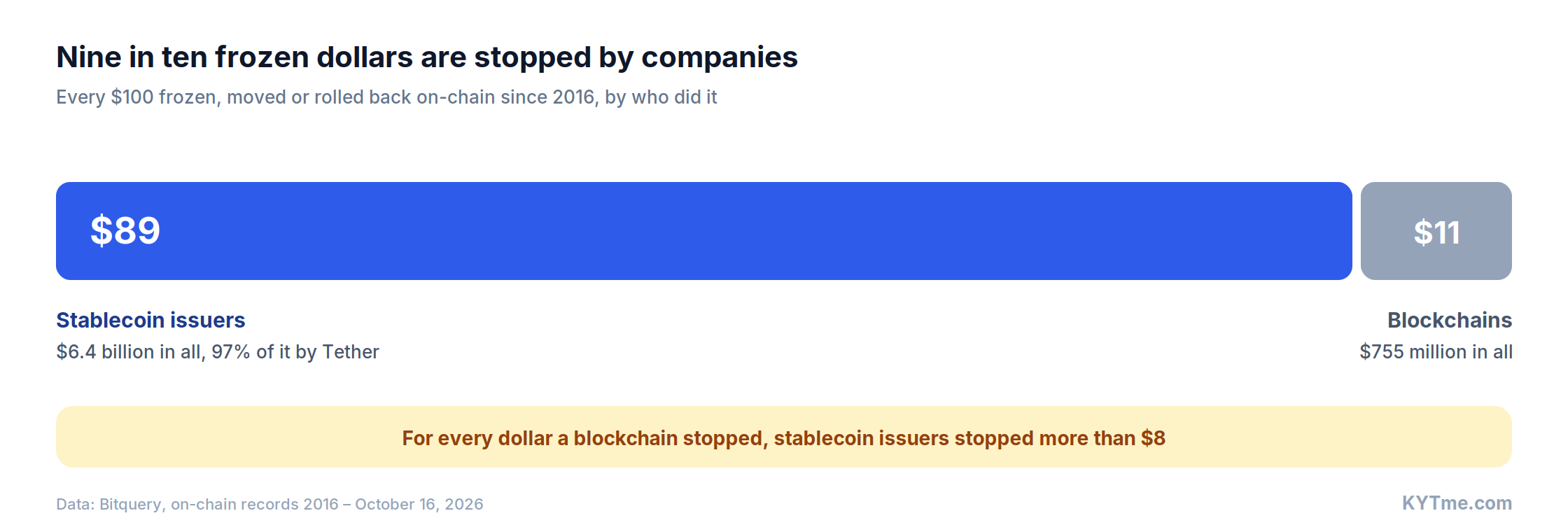
Within those $89, almost everything comes down to one company. Tether froze 97% of the issuer total, most of it on TRON: USDT on that network accounts for 64% of all issuer freezes, and USDT on Ethereum for another $2.1 billion. Circle, the second-largest issuer, froze $149M in USDC on Ethereum, and many of its blocks on newer networks such as Base and Arbitrum simply copy its Ethereum list: those wallets hold almost nothing there. Blockchains behave differently. Issuers increased their freezes almost every year, while the networks stepped in in bursts, usually after major hacks.
Why money gets frozen: 77% has no reason
Tether and Circle rarely explain why they froze a wallet. Bitquery tried to find the reasons itself: it matched every freeze against the OFAC sanctions list as it stood that day, against published police and court cases, and then against its own address labels. For 77% of frozen dollars, no reason could be found.
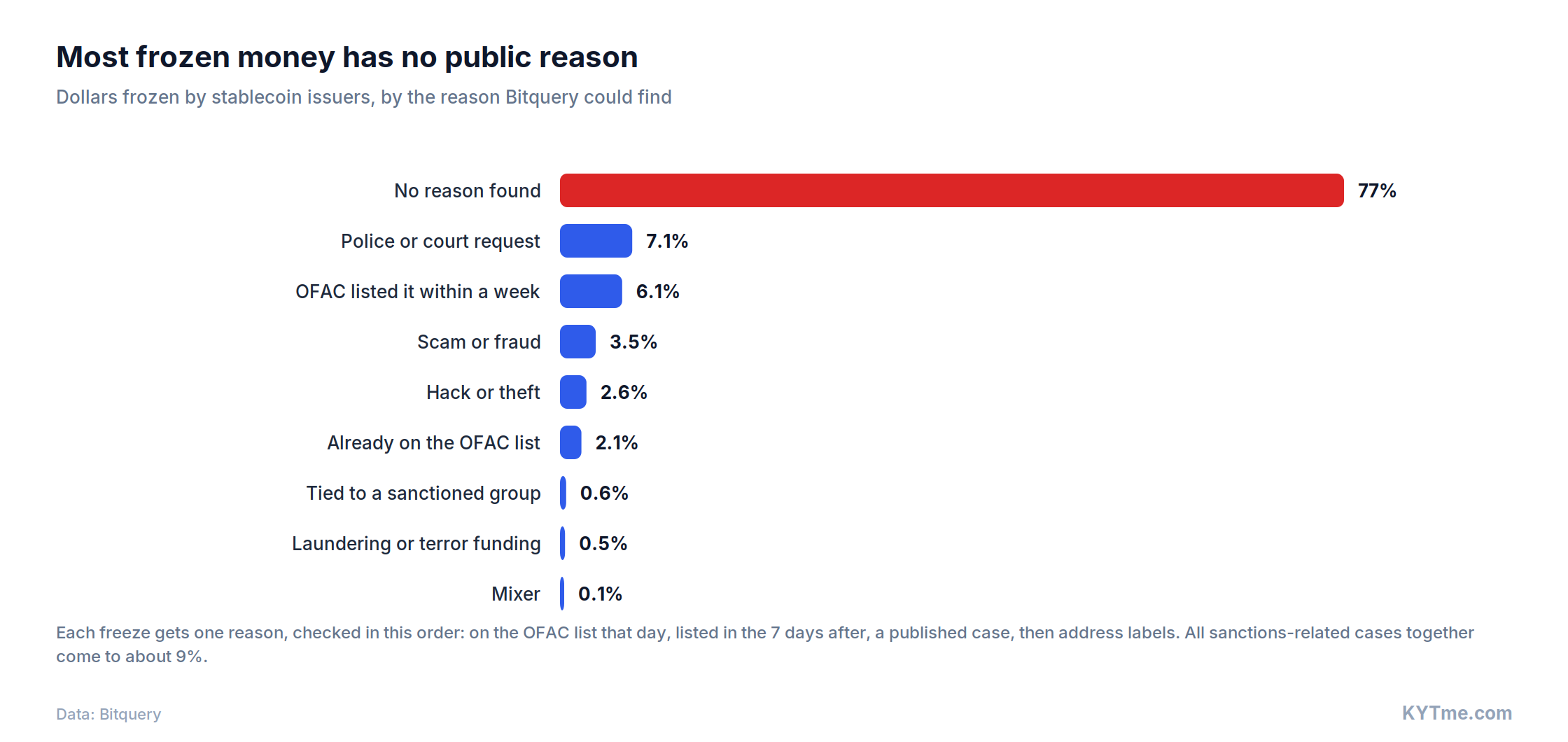
Sanctions explain only a small part. Wallets that were already on the OFAC list when frozen make up 16% of all freezes but only 2.1% of the money – most of them were empty by then. The bulk of the sanctions-related money comes from cases like the April one, where OFAC added the wallets to its list after the freeze. In total, about 9% of frozen dollars is linked to sanctions, another 7.1% to police or court requests, 3.5% to fraud and 2.6% to hacks and theft.
When OFAC does list a wallet, Tether now reacts quickly. Since 2024, 76% of its freezes of sanctioned wallets came within seven days of the listing, and the median delay is zero – Tether usually blocks such a wallet the same day. Before December 2023, the picture was entirely different: back then, sanctioned addresses were blocked more than a year late.
Address labels point the same way. Only 17% of frozen wallets carry a crime or sanctions label, while 77% carry no information about their owner at all. A few hundred belong to ordinary businesses, such as exchange deposit wallets. And some freezes are not final: 11% were later lifted, after a median of 96 days. In late March and early April 2026, Circle and Tether blocked 529 wallets, and by late May they had lifted all of those blocks.
Freezes almost always come late
A freeze helps only if the money is still there. Bitquery checked how much of the USDT a wallet had received had already left by the time of its first freeze. The result is sobering: even wallets frozen within a week of receiving their first USDT had already sent out 41% of it on Ethereum and 75% on TRON. The longer the delay, the less is left: after six months, 99% is gone on TRON.
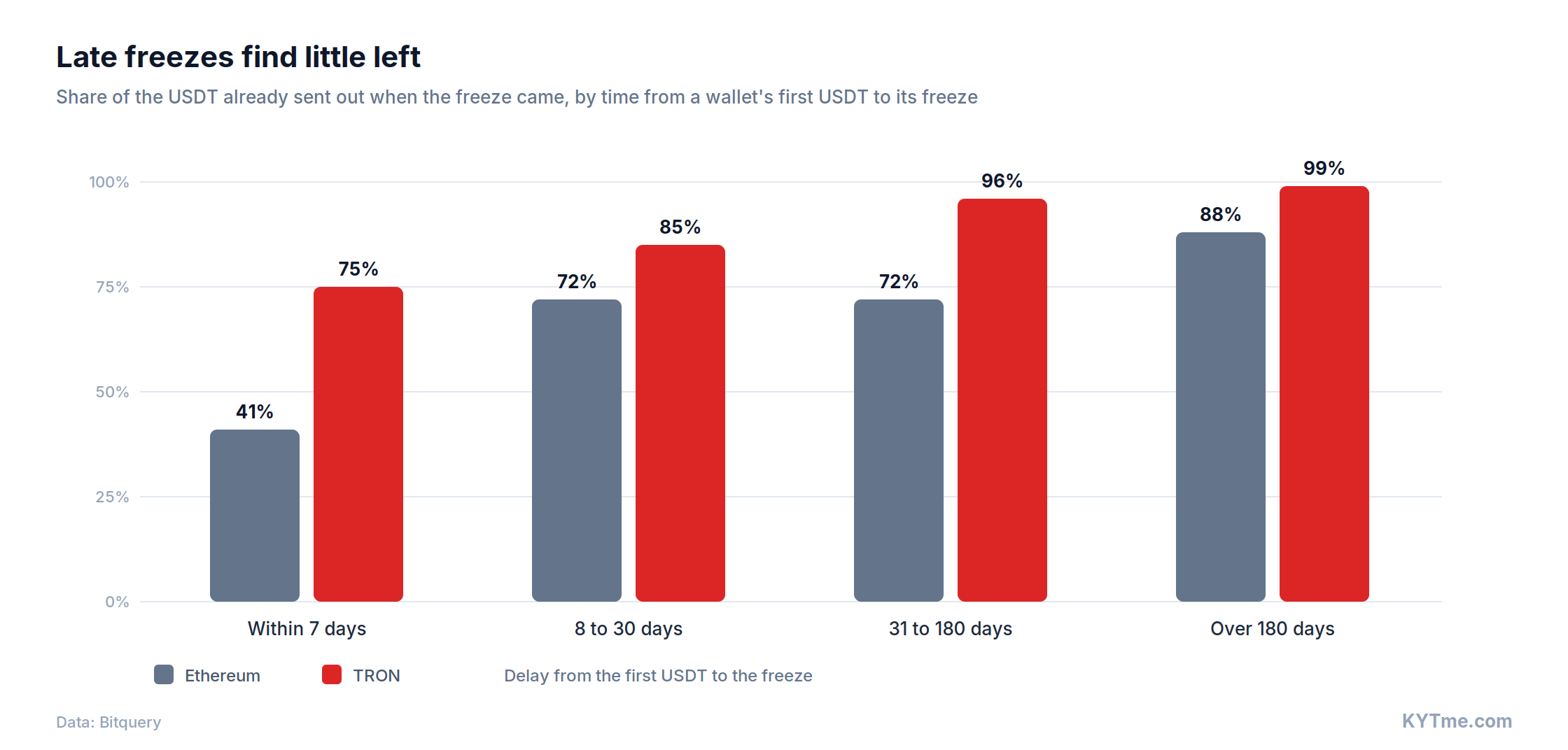
Money leaks out even when the freeze comes on the same day or the day after: by then, 37% has left on Ethereum and 54% on TRON. And such fast freezes are rare. Only 23% of wallets are caught in their first week, and on TRON that share has been falling since 2023.
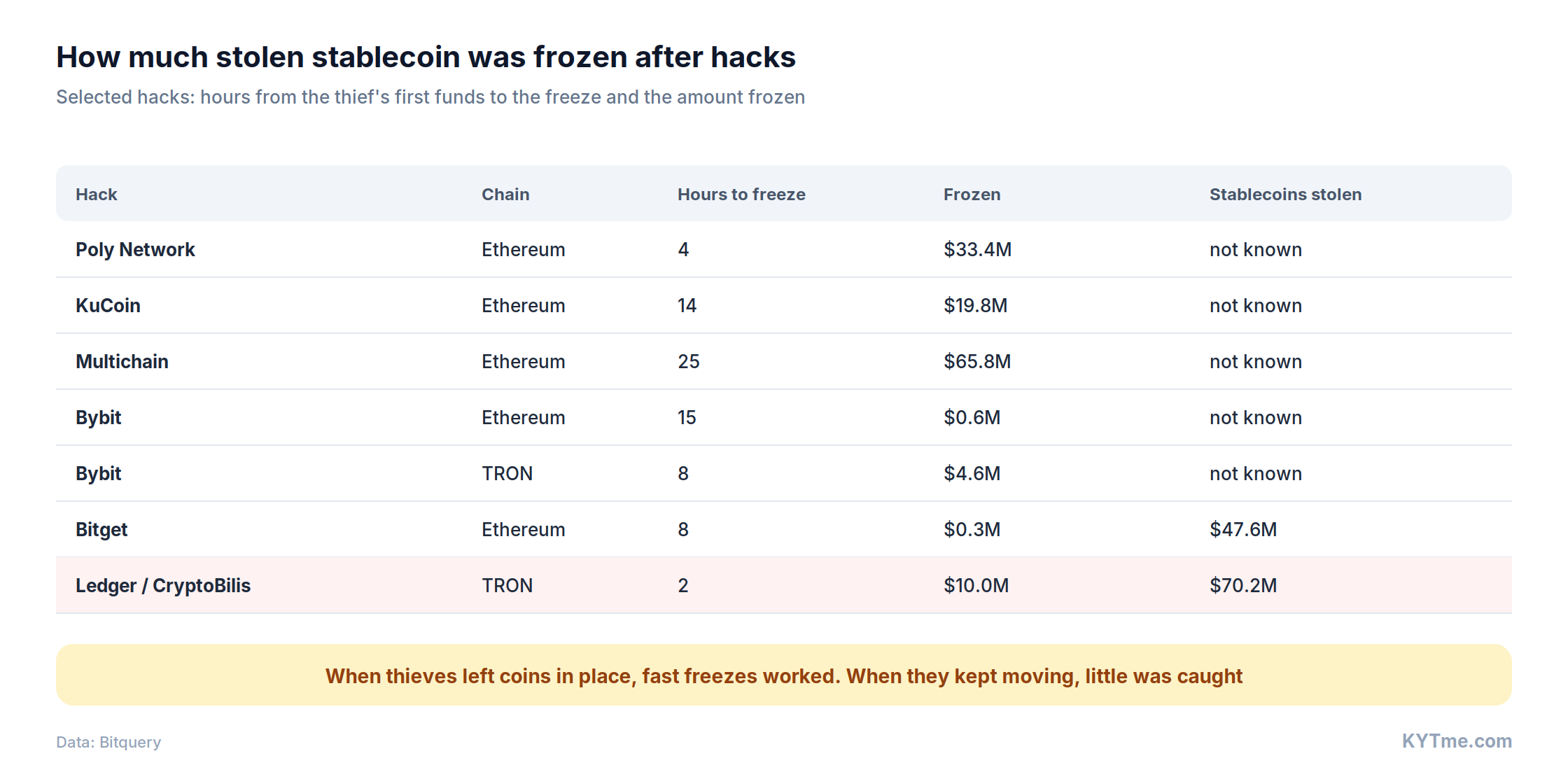
Hacks show both sides. When the thief left the coins in place, a fast freeze worked: Tether and Circle froze a combined $119M from the KuCoin, Poly Network and Multichain thieves, each time within about a day. When the thief kept moving, there was almost nothing to freeze. After the Bitget hack, less than 1% of the $47.6M in stablecoins stolen on Ethereum was frozen. A recent example is the theft from Ledger wallets through the reseller CryptoBilis: Tether started blocking addresses two hours after the first funds arrived and froze $10M of the $70.2M stolen on TRON, or 14%.

What happens to frozen USDT
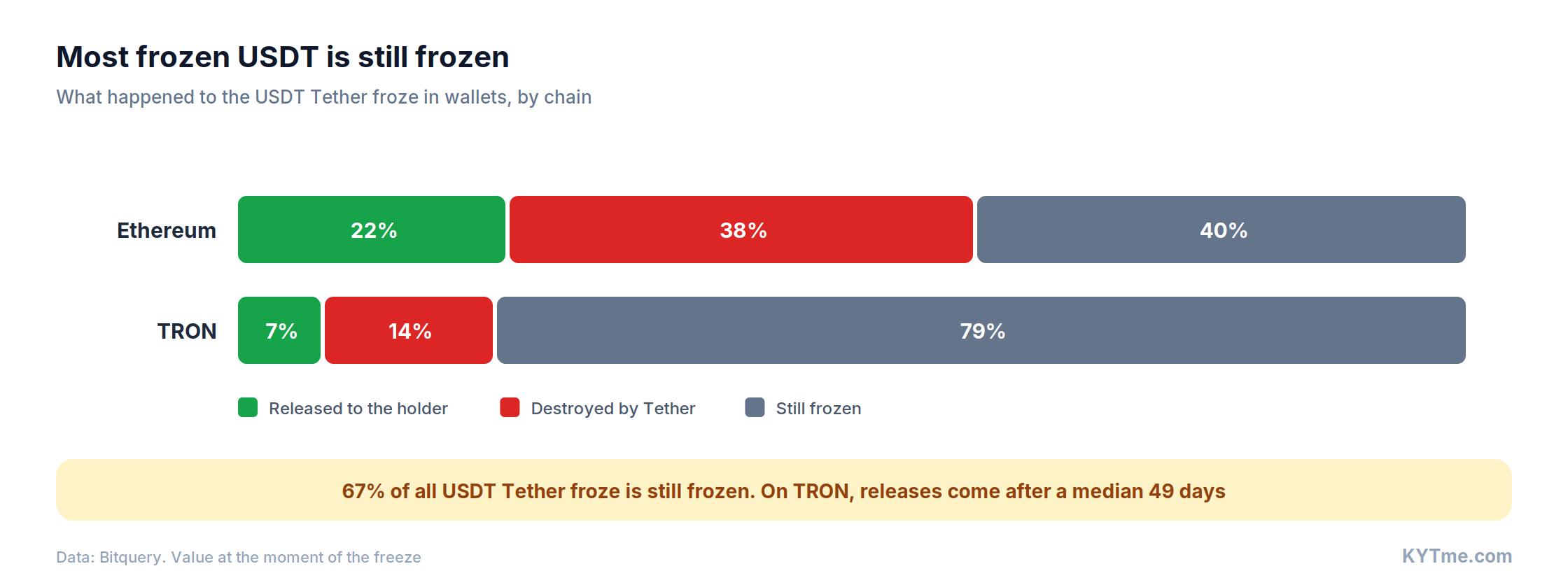
Most frozen USDT stays frozen. Of all the USDT Tether blocked in wallets on Ethereum and TRON, 67% is still frozen, Tether destroyed 22%, and 12% was returned to the holders. On TRON, releases happen much faster, after a median of 49 days. On Ethereum, the median wait is over a year.
There is also a less obvious detail. A frozen wallet cannot send USDT, but it keeps receiving it. After their freeze, another $330M arrived in such wallets, and more than half of that is stuck too. This follows directly from how the contract works: the blacklist blocks sending, not receiving. Anyone who sends USDT to a blacklisted address simply loses that money.
The most interesting part begins when Tether destroys a frozen balance. Bitquery matched these destroys with payouts from the Tether Treasury and found that for 83% of the destroyed amount, the Treasury issued exactly the same sum, down to a millionth of a USDT, a median of five minutes later. In 94% of cases, this money went to addresses that pass it straight to the Bitfinex exchange. From there, the trail on-chain ends: from the outside, you cannot see whose account was credited.
Bitquery links the largest such match to a US Secret Service seizure made public in June 2025. It involves seven Ethereum wallets that Tether had frozen 19 months earlier. Tether destroyed the coins in six of them, and 27 minutes later the Treasury paid out the sum of all seven – about $225M – to a single address. Twelve seconds later, the money went to a Bitfinex hot wallet. Tether destroyed the coins in the seventh wallet three hours after the payout. Bitquery itself stresses that a match in amount and timing is strong evidence, but not an on-chain record that directly links the two operations.
What about blockchains
Compared with issuers, blockchains themselves step in rarely and almost always after major hacks. The largest case is BNB Chain in 2022: after a bridge hack, validators halted the network and blocked the hacker's wallet, trapping $289M in BNB. In 2025, Sui validators froze $162M stolen from the decentralized exchange Cetus and later returned it by vote. In April 2026, the Arbitrum Security Council moved $71.6M in ETH out of the wallet of the attacker who hacked Kelp DAO. In August, the Cronos network rolled back its blockchain to undo the attack on Tectonic – a story we covered in detail in our article on the Cronos rollback. Of the $755M stopped by networks, $207M went back to victims and another $121M partly did.
A separate question is censorship at the block level, which leaves no freeze behind. Ethereum is the easiest place to test it: most blocks are assembled by specialized builders, and some of them leave out transactions linked to sanctioned wallets. For almost two years, such builders produced about half of all Ethereum blocks, and 64% at the peak. Since the US lifted its sanctions on Tornado Cash, so few such transactions remain that the test no longer gives a clear answer. On Bitcoin there is almost nothing to test: since late 2018, only about one block in 590 has contained a payment involving an address on the OFAC list. Bitquery's conclusion: Bitcoin is largely censorship-resistant – a payment cannot be frozen, and if one pool leaves it out, the next one will include it.
How far these numbers can be trusted
The study's main conclusion holds up under stress tests. Bitquery recalculated the total five more ways, changing the counting rules, and the issuers' share stayed between 84% and 95% each time. It drops lower in only one scenario – to 76% – if you count at face value the aUSD stablecoin that a bug minted on the Acala network. Bitquery itself treats those tokens as worthless.
What this means for anyone holding USDT
Bitquery sums up the study's main conclusion simply: blockchains almost never stop anyone, while the issuers of the stablecoins that run on top of them freeze thousands of wallets a year and usually do not explain why. If you hold USDT or USDC, the decision on whether your coins can move is made by the issuing company.
For ordinary users, this has very practical consequences. A frozen wallet keeps accepting USDT, so before sending, it is worth checking that the recipient's address is not blacklisted. And since most frozen wallets carry no labels and freezes often come late, coins with a problematic history have time to spread down the chain before they are stopped. That is why, before accepting USDT from an unknown sender, it is worth checking their address: a freeze can come after the coins are already yours.
