
In the third quarter of 2026, total stablecoin supply grew by less than 1%, but the largest holders were actively reallocating funds. RLUSD supply rose by 59%. Crypto exchanges cut their USDT holdings by billions of dollars and increased their positions in other stablecoins. Many of these alternatives offer rewards for holding funds or come with revenue-sharing arrangements.
How much did stablecoin supply grow in Q3 2026?
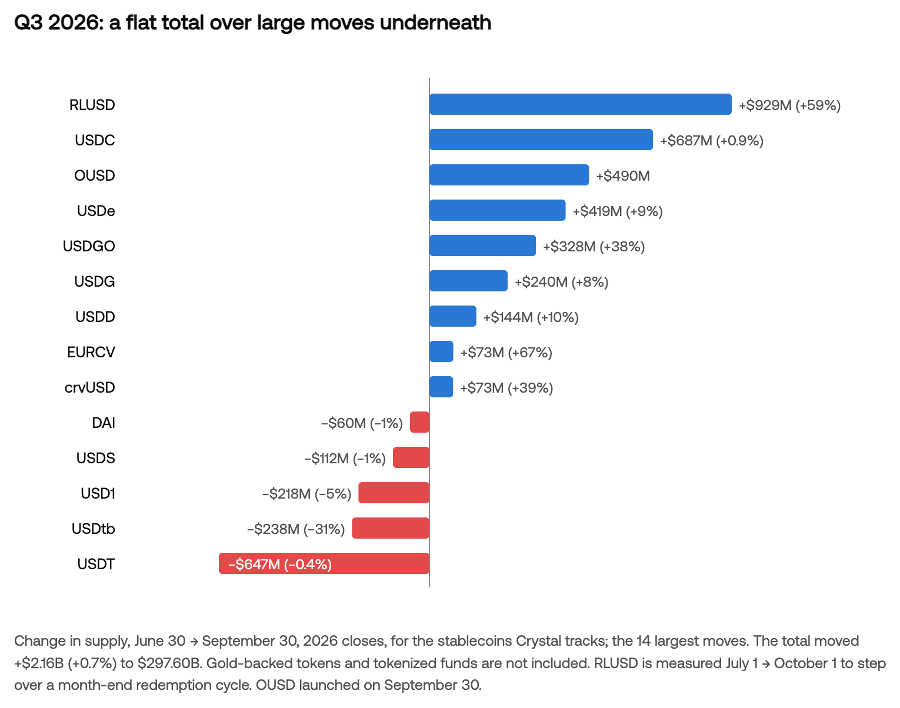
The supply of the stablecoins covered rose from $295.4 billion on June 30 to $297.6 billion on September 30, an increase of $2.2 billion. RLUSD led the way, growing by $929M (+59%). It was followed by USDC (+$687M), USDe (+$419M), USDGO (+$328M) and USDG (+$240M). The Open USD (OUSD) stablecoin, launched on September 30, ended its first day with $490M in supply.
USDT supply fell by $647M, just 0.4% of its starting base of $184 billion. USDtb supply shrank by almost a third, or $238M, and USD1 fell by $218M. The previous quarterly review covers market changes in the second quarter.
The almost unchanged headline figure hides the scale of movement between holders. The largest stablecoin holders made transactions totaling about $32 billion when all movements are counted without netting offsetting changes. Most of these transactions, however, cancelled each other out. The key indicator is not the total volume of funds moved, but who exactly moved them and into which stablecoins.
Five behavior patterns of the largest holders
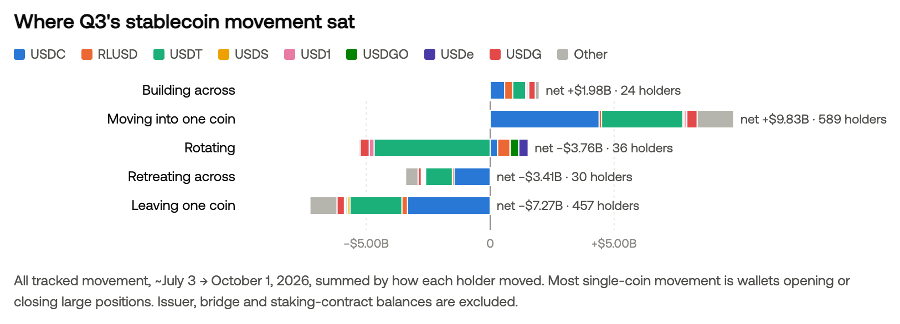
Each major holder was assigned to one of five categories depending on how its balances in the stablecoins covered changed:
- Building positions in several assets: the holder increased its holdings in several stablecoins and cut almost nothing.
- Moving into one asset: the holder significantly increased its holdings in one stablecoin while leaving its positions in the others almost unchanged.
- Reallocating between assets: the holder increased its holdings in some stablecoins and reduced them in others.
- Reducing positions in several assets at once: the holder cut its holdings in several stablecoins while adding almost nothing.
- Exiting one asset: the holder significantly cut its holdings in one stablecoin while leaving its positions in the others almost unchanged.
The largest volumes fell into the two single-asset categories: moves into one stablecoin totaled +$9.8 billion, and exits from one asset −$7.3 billion. To a large extent, this reflects wallets opening and closing large positions. Such transactions include, for example, the creation of new custody wallets, off-exchange settlements and withdrawals of assets to wallets that owners control themselves.
The categories in which holders changed positions in several stablecoins at once cover smaller amounts but say more about market preferences. They show which assets the holders themselves chose. Almost all participants in these groups are identified exchanges, lending platforms and protocols.
Because issuer, bridge and staking contract wallets are excluded from the analysis, and the data covers only the largest holders of each asset, the five categories net out at about −$2.6 billion, even though total stablecoin supply grew by $2.2 billion.
The charts show only the changes in the third quarter.
Lending vaults and trading platforms built positions in several stablecoins at once
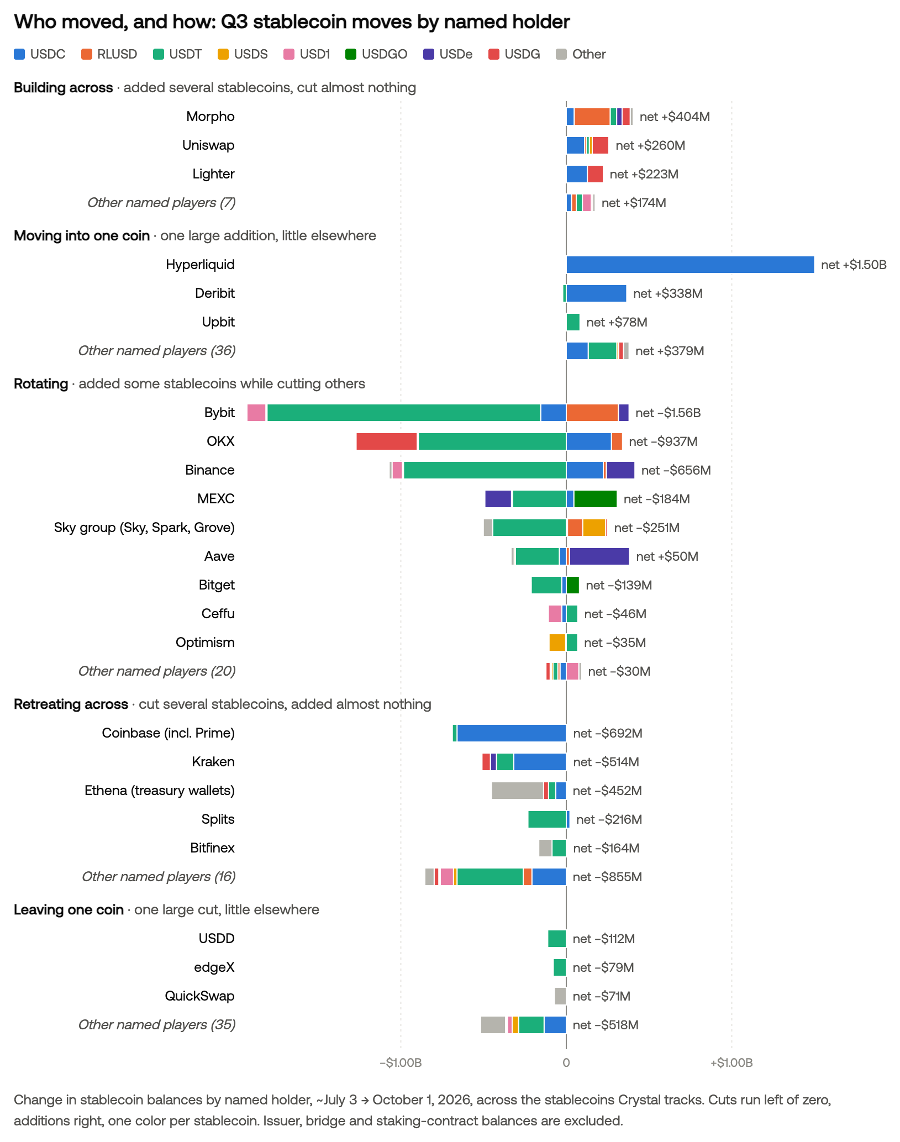
Three platforms increased their holdings of several stablecoins at the same time while cutting almost nothing. The assets of Morpho, a lending protocol, rose by $404M across six stablecoins. RLUSD made the largest contribution (+$218M). In addition, $49M in USDG was added on Robinhood Chain.
Uniswap, a decentralized exchange whose trading pool liquidity grows when liquidity providers deposit more tokens, added $260M. Most of the increase came from USDC (+$111M) and USDG (+$101M).
Lighter, a perpetual futures exchange, increased its stablecoin balances by $223M. On its main trading venue, it uses USDC as base collateral, and the volume of this asset there rose by $127M. The newer version of Lighter on Robinhood Chain uses USDG for dollar settlement and added $96M in this stablecoin.
Morpho's growth was made up of individual arrangements. About $247M of the increase came from a single deposit: Spark placed its own RLUSD, up to a $250M cap, in the new Sentora x Spark vault. This allocation was approved as part of Spark's governance update of September 10.
Other Morpho vaults working with RLUSD shrank by about $29M over the same period. So the net RLUSD increase on Morpho was $218M. By the end of the quarter, almost the entire Spark deposit was still waiting for borrowers, meaning the funds had been placed in the lending vault but not yet lent out.
Growth in other Morpho vaults was also linked to partnership arrangements. The main Sentora vault for RLUSD offers a nominal yield of about 5.4%, with roughly half of that rate paid as weekly RLUSD rewards. Steakhouse's EURCV vault offers a fixed 3% rate set by its curator, the entity that manages the vault's parameters. Most of the funds deposited there, however, remain unlent. Part of Morpho's growth is also linked to borrower demand: additional USDe is used as collateral for borrowing RLUSD.
In Morpho's case, the partners behind the vaults played the key role in increasing balances. Most of the quarterly growth came from a sponsor, a curator or a rewards budget.
Why did USDC grow on derivatives exchanges?
The largest single increase of the quarter came in one stablecoin. Trader deposits on Hyperliquid, a perpetual futures platform, rose by $1.5 billion to about $7.2 billion. All of the increase was in USDC. On Deribit, USDC holdings rose by another $365M. Both platforms earn income linked to the use of USDC.
Hyperliquid
On August 26, Hyperliquid adopted new rules for handling USDC. The reserve backing traders' USDC is held by Coinbase. The company passes most of the income from investing the reserve assets on to the protocol. According to reports, these funds are used to buy back the HYPE token, that is, for the project itself to buy tokens on the market.
The growth was also concentrated among a small group of participants. About three quarters of the quarter's net increase came from a single cluster of wallets that moved USDC through a blockchain bridge and deposited it on Hyperliquid. This is most likely a single trading firm. Across all deposits, transfers of $100K or more made up about 2% of the total number of transactions but accounted for 80% of the total value.
Deribit
Coinbase owns Deribit and funds USDC rewards for holding funds on the platform. On August 1, the company extended the rewards program to about 70 more countries. Deribit also launched more than 100 USDC-settled contracts.
On October 1, the last day of the period covered by the study, Coinbase International's perpetual futures were moved to Deribit. This change will therefore show up only in the fourth-quarter data.
So USDC growth on derivatives platforms is explained not only by traders' preferences but also by the economic incentives the trading platforms themselves receive. In August, Circle and Coinbase renewed their revenue-sharing agreement on the same terms. Coinbase notes that the agreement can be renewed on an ongoing basis. Part of the income Coinbase receives is passed on to the platforms where USDC is held.
End-of-quarter balances show a more mixed picture. On the tracked on-chain perpetual futures platforms, almost all stablecoins are USDC. The main exception is Aster, where USDT and USD1 dominate. However, most derivatives trading still takes place on large centralized exchanges, and their stablecoin holdings consist mainly of USDT.
Why did exchanges cut their USDT holdings in Q3 2026?
Market participants' decisions are most visible in the group that reallocated between stablecoins. Among the identified participants, 19 exchanges and lending platforms ended the quarter with lower balances and together cut USDT by $4.6 billion.
At the same time, they added about $1.9 billion in other stablecoins. The largest increases were in USDC ($569M), RLUSD ($493M), USDGO ($341M), USDe ($236M) and USDS ($139M). These are gross amounts of assets added. In Figure 2, each stablecoin's changes within the group offset one another, so the net growth figures look smaller.
| Holder | USDT change | Assets added | Assets also reduced |
|---|---|---|---|
| Bybit | −$1.66 billion | RLUSD +$315M, USDe +$64M | USDC −$155M, USD1 −$118M |
| Binance | −$987M | USDC +$223M, USDe +$172M | USD1 −$63M |
| OKX | −$899M | USDC +$273M, RLUSD +$67M | USDG −$375M |
| Sky group (Sky, Spark, Grove) | −$444M | USDS +$139M, RLUSD +$92M | USDS +$139M, RLUSD +$92M |
| MEXC | −$326M | USDGO +$262M, USDC +$46M | USDe −$161M |
| Aave* | −$266M | USDe +$363M | USDC −$42M |
| Bitget | −$189M | USDGO +$79M | USDC −$28M |
*Aave is listed because of the reallocation of assets in its lending pools. Its total stablecoin holdings grew over the quarter, so Aave is not among the 19 participants that ended the quarter with lower balances.
Some exchanges increased their holdings of stablecoins for which they run reward programs. The RLUSD increase on Bybit followed the launch on July 20 of the RLUSD Hold & Earn campaign together with Ripple. The USDGO increase on Bitget coincided with holding rewards programs and asset conversion campaigns that ran from March to July. The Sky group cut USDT and increased its holdings of USDS, the stablecoin Sky issues itself.
Lending platforms also changed the structure of their reserves. Aave's pools held $266M less USDT and $363M more USDe. This reflects demand from borrowers who use USDe as collateral. OKX moved in both directions: in addition to cutting USDT, it reduced its USDG holdings by $375M.
Even so, total USDG supply grew by $240M. This happened because Lighter, Uniswap and Morpho together added about $246M of this stablecoin on Robinhood Chain.
Regulatory changes may also have influenced market participants' decisions. The transition period under the EU's MiCA regulation for crypto-asset service providers ended on July 1, and USDT did not receive authorization under this regime. The reallocation is consistent with the assumption that some platforms were reducing their dependence on USDT while increasing their holdings of stablecoins that offer holding rewards.
However, not all the USDT withdrawn from exchange balances moved into other stablecoins. Wallets that could not be linked to specific identified holders increased their USDT holdings by about $1.5 billion over the quarter. Some of these funds may have belonged to exchange customers withdrawing crypto to their own wallets. So part of the USDT that disappeared from exchange balances may have moved into self-custody rather than being converted into another stablecoin.
Who reduced stablecoin balances in Q3 2026?
Participants in the groups that reduced positions in several assets cut their stablecoin holdings. The combined balances of Coinbase and Coinbase Prime fell by $692M, almost all of it in USDC. Some of the funds may have moved within the Coinbase group, since Deribit increased its USDC holdings by $365M over the same period.
Kraken cut its balances by $514M. Most of the decline was in USDC (−$317M) and USDT (−$105M). Galaxy Digital, Gate and Crypto.com each reduced their holdings by between $95M and $116M, with changes affecting at least two stablecoins at each company.
Taken together with the moves of participants that built positions in several assets and of derivatives exchanges, these reductions reveal a common direction of flows: balances grew on platforms actively engaged in lending, derivatives trading or offering rewards through partnership programs. Coinbase is the exception: the company offers rewards for holding USDC, yet its own stablecoin balances declined.
What time zones the users of the largest stablecoins live inAug 19, 2026Read more
Ethena cut its USDtb reserves as USDe spread to other platforms
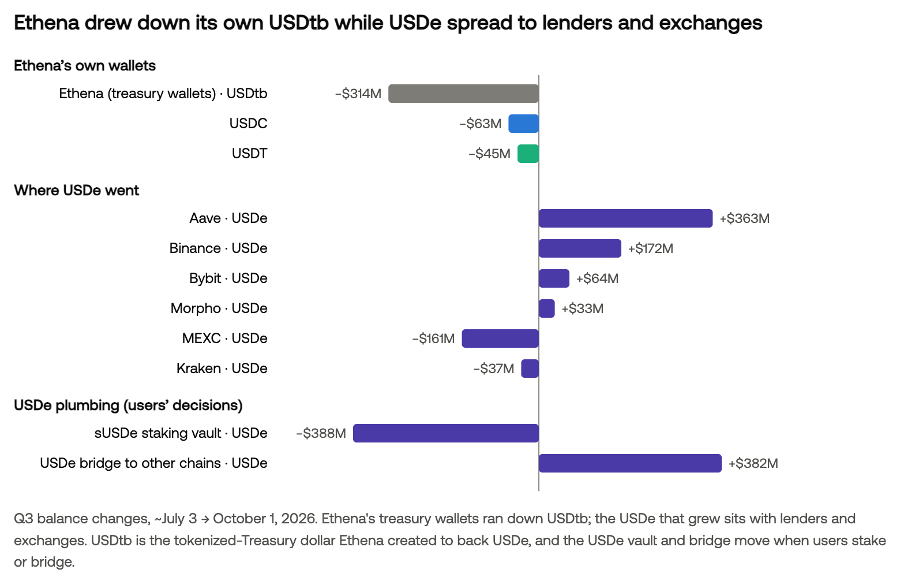
Ethena's treasury wallets cut their USDtb holdings by $314M. This stablecoin is backed by treasury assets and was created by Ethena to help back USDe. Total USDtb supply, however, fell by only $238M. This means other holders together added about $76M.
USDe supply rose by $419M over the quarter. The new volumes of this asset went mainly to Aave (+$363M), Binance (+$172M) and Bybit (+$64M), where USDe is used as collateral and margin for trading.
On September 11, USDe became available on the Tron network via Stargate. A significant share of the quarter's new USDe moved to other blockchains in a few large transfers. Identifying the parties behind these transfers requires further research.
Who pays for stablecoin distribution?
This kind of reallocation does not come cheap, and stablecoin issuers, the organizations that issue these assets, bear a large share of the costs.
Coinbase alone received $325M under revenue-sharing agreements with Circle, according to Circle's quarterly Form 10-Q for the second quarter of 2026, the report in which the company discloses its financial results and other material information.
Tether reported net operating profit of $1.5 billion for the second quarter in a press release. The company's reserve buffer, the difference between the value of its assets and the amount of USDT in circulation, roughly halved over the quarter to $4.1 billion. This follows from the reserves report reviewed by the audit firm BDO.
PayPal also funds such incentives. USD.AI, which lends to companies and other borrowers to buy computing hardware, holds PYUSD as the reserve backing its own USDai token. The two projects offer a 4.5% reward on deposits of up to $1 billion. In the third quarter, USD.AI's PYUSD reserve grew by $51M as new USDai tokens were issued.
New market entrants are also competing for partnerships with trading platforms. Open USD was launched on September 30. It is issued by Bridge, part of Stripe, with partners including Coinbase, Visa and Mastercard. By design, most of the income from this stablecoin's reserve assets is to be returned to partners.
At the end of the quarter, the budgets for such arrangements grew. On September 16, the US Federal Reserve raised its target interest rate range by 25 basis points from the previous level to 3.75–4.00%.
As a result, issuers of reserve-backed stablecoins now earn higher income from their investments in US Treasury securities. The effect of this change should show up in fourth-quarter figures.
What to watch in Q4 2026
In the fourth quarter, three questions are worth following:
- 1. Will the funds stay on the platforms after the reward programs end? The current phase of Bybit's RLUSD Hold & Earn program ends on October 18.
- 2. Will revenue sharing keep attracting USDC deposits to derivatives exchanges, or will competing issuers offer comparable terms?
- 3. Will new stablecoins that share reserve income, such as Open USD, be able to win market share from established players?
