
If your bank froze your account after you sold USDT on P2P, the buyer almost certainly paid you with someone else's money, stolen from a fraud victim. The victim filed a complaint, the bank transfers were traced along the chain, and your account turned out to be one of its links. In most cases the situation can be resolved. First, find out from the bank in writing who imposed the restriction and on what grounds, then collect proof of the trade and send an explanation to whoever froze the account. Below are the mechanics, the general steps and a breakdown of eight countries: India, Nigeria, Turkey, Brazil, Spanish-speaking Latin America, Kenya, Pakistan and the United Kingdom.
Why banks freeze an honest seller's account
The scheme behind it is called a triangle, or triangulation. It has three participants, and only one of them knows what is going on.
- 1. A scammer deceives a victim: offers a fake investment, sells a non-existent product, poses as a relative or a bank employee. The victim sends money to the account details provided.
- 2. At the same time, the scammer opens a P2P order to buy USDT from an ordinary seller and uses the victim's money as payment. Sometimes the victim is told directly to send the amount to the seller's details – «this is our partner».
- 3. The seller sees the payment arrive, releases the USDT, and the crypto goes to the scammer.
- 4. The victim realizes they have been deceived and files a complaint with the police or the bank.
- 5. The victim's bank and the police trace the transfer and find the account the money went to. That is your account.
- 6. The bank freezes either the disputed amount or the entire account until the case is sorted out.
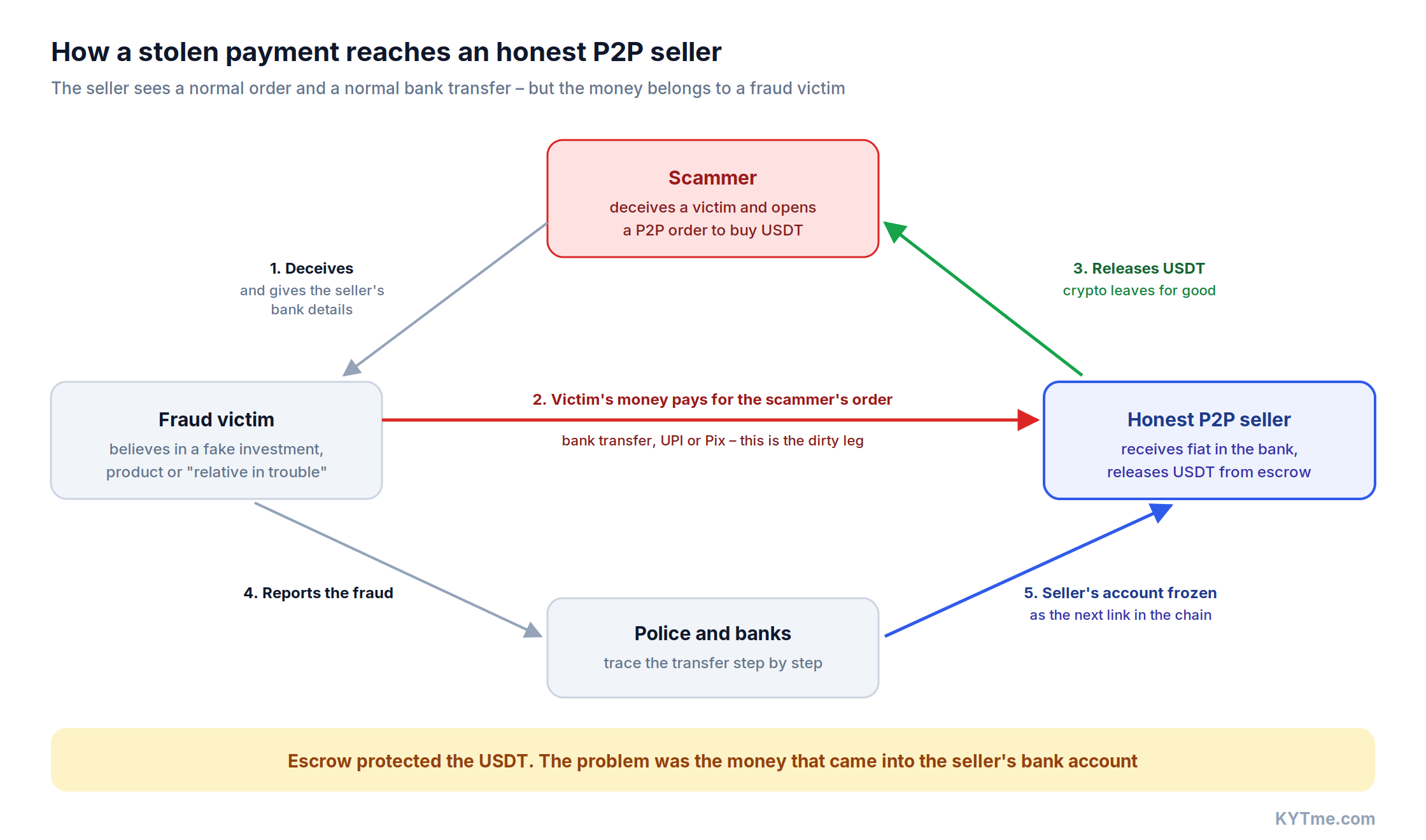
To the police, you look the same in this chain as a money mule who accepts transfers into their account for a fee. The only way to tell one from the other is through documents, so how quickly the restriction is lifted depends on how complete your evidence package is.
Exchange escrow does not help here, and this is the most important thing to understand. Escrow holds the crypto until the buyer pays. But in a triangle the crypto is clean, and the dirty part is the fiat side of the trade – the money that landed in your bank account. The exchange does not see or check it. Binance describes this scenario directly in its help page on how to avoid having your bank account frozen in P2P trades: it advises asking the buyer for additional verification, keeping a separate account and not allowing any mention of crypto in the payment reference.
Where dirty crypto comes from and how it reaches ordinary people22 sept. 2026En savoir plus
Bank, exchange or Tether: which freeze is yours
Three different events are often called by the same word, «frozen», even though the steps to take in each are different.
- The bank froze your account. You cannot withdraw or transfer fiat money, and the bank refers to a complaint, a police request or a review. This is your case, read on.
- The exchange held a deposit or restricted your account. The crypto has been credited, but you cannot withdraw it, and the exchange asks you to confirm the source of funds. The reason is usually the history of the sender's address.
- Tether blocked the address. The USDT is visible in the wallet but cannot be sent through any interface. This is a restriction in the token's smart contract itself, and neither the bank nor the exchange has anything to do with it.
We explained why exchanges hold deposits from addresses with a bad history using the example of OKX's new rule on checking deposits from high-risk addresses.
What to do in the first 72 hours after a freeze
These steps are the same for any country. Everything else depends on how well you handle them.
- 1. Ask the bank for a written answer.Not by phone or in a support chat, but by letter or through an official complaint form. Five questions: who imposed the restriction (the bank itself, the police, the financial intelligence unit, a court); the number of the request, complaint or case; the date; the legal basis; and whether a specific amount or the entire account has been frozen.
- 2. Collect the evidence package for the trade.The list is in the table below. Do it right away: chats and order details on exchanges are not stored forever.
- 3. Write to whoever froze the account.If the restriction was imposed at the request of the police, the police decide on unblocking, not the bank. In that case, writing only to the bank will change nothing.
- 4. Keep a log.Dates of contact, ticket numbers, names of staff, replies. If the case goes to a regulator complaint or to court, this log will become part of the evidence.
| Document | Where to get it | Why you need it |
|---|---|---|
| Document Where to get it Why you need it P2P order number and a screenshot with the buyer's name | order history on the exchange | confirms it was a trade, not a transfer «for a service» |
| Order receipt (P2P Order Receipt) | from Binance on request to support, from other exchanges as an order export | official confirmation from the exchange |
| Transaction hash of the release (TxID) | withdrawal history on the exchange or a blockchain explorer | proves you handed over the crypto |
| Chat with the buyer in the order chat | the order chat on the exchange, screenshots or export | shows normal trade terms |
| Bank statement with the transfer reference | your bank | links the payment to a specific order |
| Your ID documents and proof of verification on the exchange | you and the exchange | shows you traded openly under your own name |
| A dated AML report on the counterparty's address | an address screening service, if you checked before the trade | confirms you checked the buyer in advance |
India: lien and debit freeze after a P2P trade
In India, accounts are frozen not by the bank on its own initiative but by the cyber police. The victim files a complaint on the cybercrime.gov.in portal (NCRP) or via the 1930 helpline. The complaint enters the CFCFRMS system, and the police trace the money layer by layer: the first layer is the scammer's account, the second and third are the accounts of those the scammer paid. A P2P seller usually ends up in the second layer. The police send a request to the bank, and the bank imposes a restriction.
The legal basis is the Bharatiya Nagarik Suraksha Sanhita (BNSS) 2023: section 106 allows the police to seize property, and section 107 allows its attachment only by order of a magistrate.
In recent years, state High Courts have repeatedly limited the practice of blanket freezes. You can refer to these rulings in written requests.
Steps to take:
- 1. At the bank, find out which cyber police imposed the restriction (state and station), who the investigating officer is, the NCRP complaint number, whether it is a lien or a debit freeze, and for what amount.
- 2. Find the complaint on the NCRP portal. If the buyer deceived you too, you can file your own complaint as a victim.
- 3. Send the investigating officer a written request by email and by registered post. Attach the evidence package, refer to the court rulings and ask to limit the hold to the disputed amount and lift the debit freeze from the rest of the account.
- 4. Obtain an NOC – a no-objection letter – from the cyber police. With it, the bank lifts the restriction, usually within a few working days.
- 5. If the officer does not respond, apply to a magistrate under section 503 of the BNSS or file a writ petition in the state High Court. At this stage you need a lawyer.
Here is how it looks in practice. A seller from Gujarat had a lien of ₹50,000 placed on his account at the request of the Uttar Pradesh cyber police, even though he had never been to that state. Lawyers on the Kaanoon portal, answering his question, noted that the police have no right to demand that a seller compensate the victim, and that documents must be sent to every state the request came from. According to CryptoTimes, accounts were frozen even over trades worth ₹600–1,700. The author of a column who went through such a freeze described it like this:
The money stayed in plain sight, but I could not withdraw it, transfer it or pay through UPI for everyday purchases, – said the CryptoTimes columnist.
The scale of the problem is clear from the statistics. In 2025, India recorded 28.15 lakh cyber incidents with losses of ₹22,495 crore, and banks reported 24.67 lakh mule accounts (according to India's Ministry of Home Affairs).
Nigeria: PND and PND-C on a bank account
A PND can be imposed by the bank itself on suspicion or under its terms, by a court, and at the request of the EFCC, the NFIU financial intelligence unit or the police. A Nigerian peculiarity is mass freezes: under an order of the Federal High Court, the EFCC froze 1,146 accounts for 90 days. In another case, the court froze 22 accounts of Bybit and KuCoin users holding ₦548.6M (case FHC/ABJ/CS/543/2024). In such cases the reason is not a specific trade but a general investigation into P2P trading.
Steps to take:
- 1. Ask the bank in writing whether it is a PND or a PND-C, at whose request, and whether there is a letter number or a court order.
- 2. If the restriction was imposed at the EFCC's request, go there with a lawyer and a full evidence package. Submit your explanation in writing.
- 3. If there is a court order, your lawyer files a motion to vacate in the same court.
To be honest about timelines: there is no published EFCC procedure for lifting a PND. User accounts suggest it takes anywhere from a few weeks to several months.
Turkey: bloke, MASAK and CMK 128/A
In Turkey a freeze can come from three sources, and the first thing to find out is which one is yours.
- The MASAK financial intelligence unit. Under article 19/A of Law 5549, MASAK can suspend transactions on an account for seven working days. In practice, according to lawyers, the restriction lasts 15 to 60 days.
- The prosecutor's office. Under article 128 of the Code of Criminal Procedure (CMK), the account is seized for the entire duration of the investigation.
- The bank itself under CMK 128/A. This provision came into force on December 25, 2025 and applies to fraud and theft through information systems. A bank, payment service or crypto platform with reasonable suspicion suspends the account for up to 48 hours on its own and notifies the prosecutor. During this time a judge, or the prosecutor in urgent cases, decides whether to order a seizure. A prosecutor's order is sent to the judge within 24 hours, and the judge must rule within 48 hours. If there is no decision, the restriction is lifted automatically.
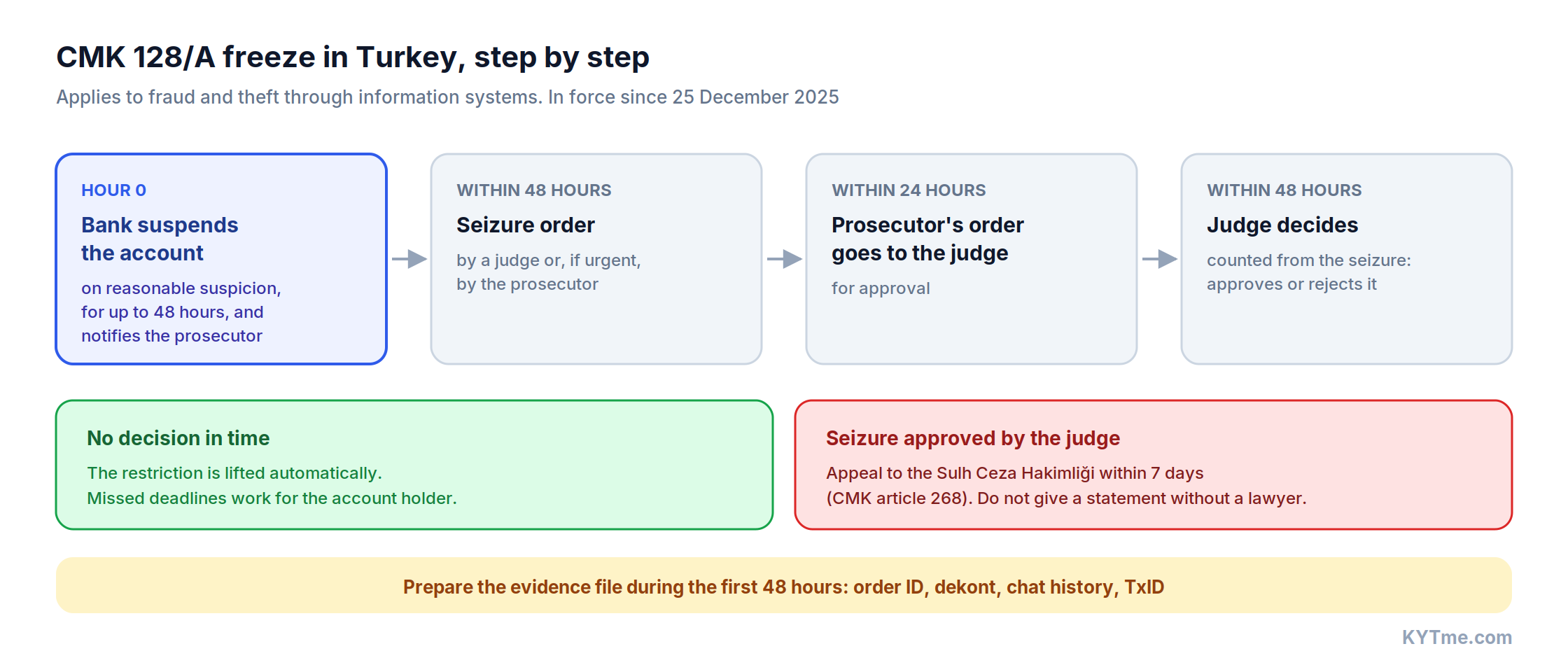
Steps to take:
- 1. Find out the type of restriction: an internal bank block, a MASAK suspension, or a seizure under CMK 128 or 128/A.
- 2. Submit a written explanation (izahat dilekçesi) to the bank's compliance team with the order number, the bank receipt (dekont), the chat history and the TxID.
- 3. If the seizure was ordered by a judge, appeal it to the criminal court of peace (Sulh Ceza Hakimliği) within seven days under article 268 of the CMK.
- 4. Do not give a statement without a lawyer. The right to a lawyer during questioning is set out in article 147 of the CMK, and your first statement often determines whether you become a witness or a suspect.
The risks here are higher than in other countries: fraud using banking systems (article 158/1-f of the Criminal Code) is punishable by 4 to 10 years in prison, and money laundering (article 282) by 3 to 7 years. That is why Turkish lawyers include not only bank documents but also an on-chain report on the trade in the defense file.
A typical story. A student sold 2,754 USDT for 100,980 TL on OKX P2P. Some time later the bank closed his account, and a few months after that he was summoned for questioning: the sender had obtained the money illegally.
I do not know this person, I only sold crypto through the OKX P2P platform, – wrote the seller in a complaint on Şikayetvar.
Lawyer Ahmet Karaca puts the essence of the problem this way: the crime lies not in the sale itself but in the source of the money that arrived in your account.
Brazil: MED and Pix contestado
In Brazil, an account is blocked almost automatically through MED (Mecanismo Especial de Devolução), the system for returning Pix payments in cases of fraud.
How it works:
- 1. The victim disputes the Pix with their bank. They have 80 days from the transfer date.
- 2. The victim's bank sends a fraud notification, and the recipient's bank immediately blocks the amount in the account up to the available balance.
- 3. The banks have seven days to review the case.
- 4. If fraud is confirmed, the money is returned to the victim.
Since February 2, 2026, MED 2.0 (Resolução BCB 493) has been in effect. Money is now traced along the entire chain, not just to the first account: the bank blocks intermediate accounts, can hold new incoming payments, and the recipient receives a fraud mark in DICT, the Pix key directory. With this mark it is difficult to register keys and use Pix fully even after the dispute is over.
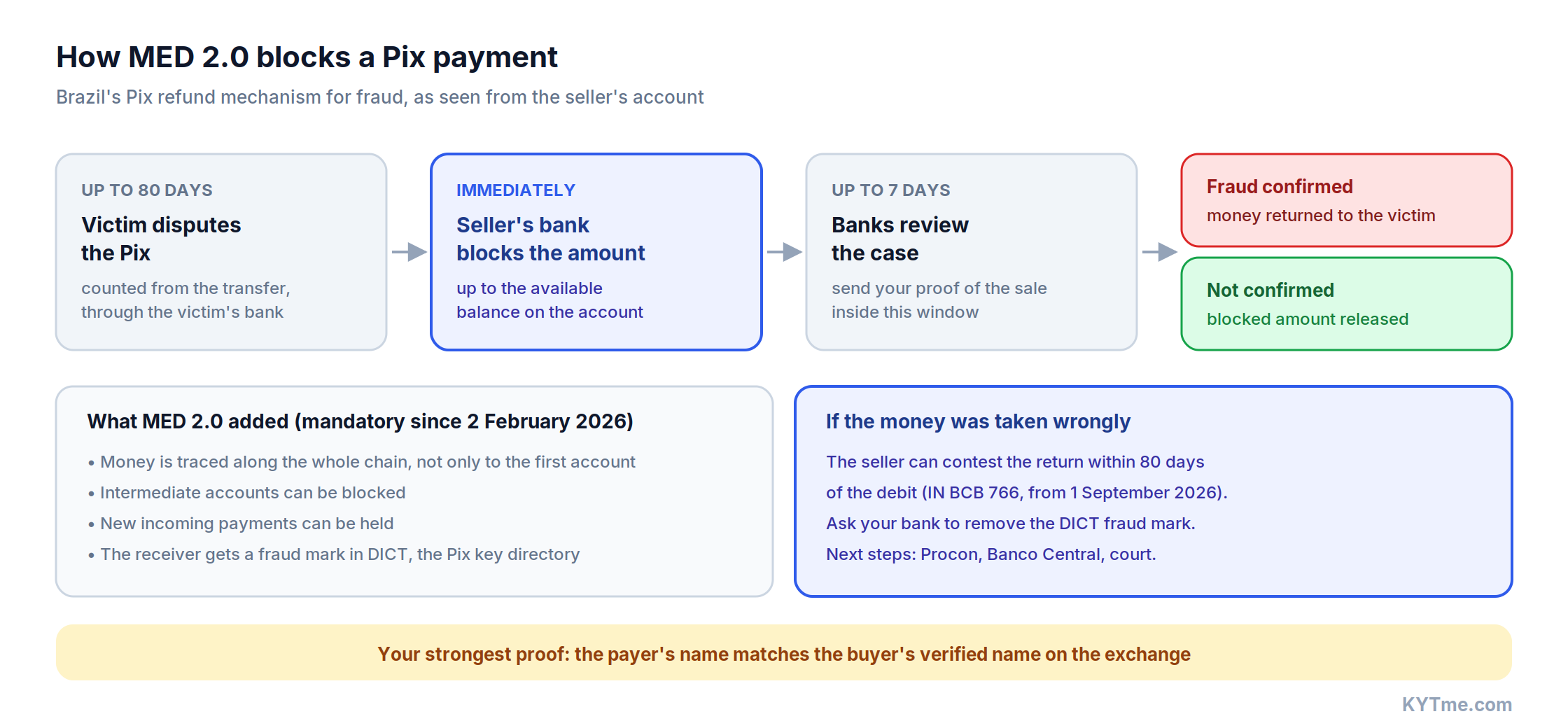
A new rule matters for sellers. Since September 1, 2026, under Instrução Normativa BCB 766, a recipient whose money was debited based on a fraudulent dispute can contest the return within 80 days of the debit. Previously the limit was 30 days.
Steps to take:
- 1. Find out from the bank whether it is MED or an internal block, and when the payment was disputed.
- 2. Within the seven-day review window, give the bank proof of the sale: the order, the TxID, the chat and confirmation that the payer's name matches the buyer's name on the exchange.
- 3. If the money was debited anyway, contest the return within 80 days.
- 4. Demand that your bank remove the fraud mark in DICT. If it refuses, file a complaint with Procon and the Central Bank, then go to court.
Courts can side with the seller. A bitcoin seller on the Hodl Hodl P2P platform sold coins for R$15,000, and after the trade the buyer disputed the payment. Banco do Brasil debited the money and blocked the account without a review. A court in the state of Goiás ordered the bank to return R$15,000 and pay R$3,000 in moral damages: the bank failed to prove that it had followed the rules for reviewing disputes.
Spanish-speaking Latin America: cuenta congelada after P2P
Argentina, Colombia and Venezuela have no dedicated mechanism like Brazil's MED: banks block accounts under internal anti-money laundering rules and ask the holder to justify the origin of the money.
- Argentina. Banks and Mercado Pago block an account until justificación de fondos, confirmation of the source of funds. The steps are: record the block with screenshots, file an official claim and get a ticket number, attach documents on your income and on the specific sale, and if there is no response, complain to the Central Bank (BCRA) and the consumer protection service, citing Law 24.240.
- Colombia. Banks operate under the SARLAFT system and may ask about the origin of funds when payments are frequent or large. Prepare statements, income documents and your DIAN tax return.
- Venezuela. Banks are especially sensitive to any mention of crypto in the payment reference. Do not accept payments with such notes, and open an appeal on the exchange immediately if the buyer added one.
Many sellers do not understand why the bank looks at the sender at all if the money arrived. The Spanish finance blog marketclave describes it as a typical question: if the money arrived, what does it matter who sent it. For the bank, that is exactly what matters: if the payer does not match the buyer on the exchange, explaining the origin of the money becomes much harder.
Kenya and Pakistan: restrictions at the request of the DCI and FIA
Kenya. Here, exchange accounts are frozen more often than bank accounts. The Directorate of Criminal Investigations (DCI) obtained freezes on Kenyan traders' Binance accounts. According to TechCabal, the restrictions lasted more than two months with no charges, no court order and no stated deadline. Ask the exchange and the bank for the written grounds and the request number.
Pakistan. As far back as 2018, the central bank prohibited banks from servicing crypto transactions, so accounts are blocked both on suspicion of P2P trading and over fraud complaints investigated by the FIA. The mechanics are the same: the victim's money reaches the seller through a mule. A bank may close the account if it learns about regular P2P trading, so it is better to deal with the bank and the FIA through a lawyer.
United Kingdom: SAR and Account Freezing Order
In the UK, a freeze usually happens in two stages, and at the first one the bank explains almost nothing.
Stage 1. The bank files a SAR. If a transaction looks suspicious, the bank files a suspicious activity report (SAR) with the National Crime Agency (NCA) and stops the transaction or the entire account until it hears back. Under section 335 of POCA, the agency has seven working days to respond, and if it objects, a 31-day moratorium applies. A court can extend it.
The bank will not tell you that it filed a SAR. It is not allowed to warn the customer about the review: doing so is a criminal offence. So silence from the bank or general phrases about a «security review» are normal and not a sign that you personally are suspected of anything.
Stage 2. Account Freezing Order. If questions remain, the police, the NCA or another authority obtains an account freezing order (AFO) from a magistrates' court. It is granted if the account holds £1,000 or more, for up to two years and without any charge: the civil standard of proof is enough. The authority can then seek forfeiture of the funds (Account Forfeiture Order). Since 2024, the same logic applies to freezing orders on crypto wallets, including those on exchanges.
Steps to take:
- 1. Submit a written complaint to the bank and ask it to explain the restriction and the timeline. Even if the bank does not disclose the reason, the complaint records the date you contacted it.
- 2. If the bank has not resolved the issue within eight weeks or closed the account without explanation, go to the Financial Ombudsman Service.
- 3. If you have been served with an AFO, see a lawyer. The order can be challenged or varied in the same court by proving the lawful origin of the money: this is where your full set of P2P trade documents comes in.
Cheat sheet: who freezes accounts in eight countries
| Country | Local term | Who freezes | Legal basis | Amount or whole account | How long it lasts |
|---|---|---|---|---|---|
| India | lien, debit freeze | cyber police via the bank | BNSS s. 106/107 | court rulings say only the disputed amount, in practice often the whole account | weeks to months |
| Nigeria | PND, PND-C | bank, EFCC, court | EFCC Act, court orders | usually the whole account | weeks to months, 90 days or longer under court orders |
| Turkey | bloke, askıya alma | MASAK, prosecutor, bank | Law 5549 art. 19/A, CMK 128, CMK 128/A | depends on the decision | MASAK 7 working days, 15–60 in practice; CMK 128 for the whole investigation |
| Brazil | MED, Pix contestado, marcação DICT | the recipient's bank, automatically | MED rules, Resolução BCB 493 | the disputed amount, plus possible hold on new incoming payments | 7 days of review, the DICT mark lasts longer |
| Argentina | cuenta congelada | bank, Mercado Pago | UIF and BCRA rules | usually the whole account | until the source of funds is confirmed |
| Kenya | account restriction | DCI, ARA | POCAMLA | the whole account | more than two months in known cases |
| Pakistan | account freeze | bank, FIA | SBP circular of 2018 | usually the whole account | no set timeframe |
| United Kingdom | SAR, AFO | bank, then police via a court | POCA 2002 | a transaction or the whole account | 7 + 31 days for a SAR, up to 2 years for an AFO |
How to lower the risk of a freeze on your next P2P trade
You cannot rule out a freeze completely: you cannot see where the buyer's money comes from. But most cases start with the same mistakes.
If you sell often, it is convenient to check a buyer's address right in your messenger with the KYTme Telegram bot.
What checking the buyer's address can and cannot do
So why check the address you are releasing USDT to? For two reasons.
First, a check shows whether the buyer's wallet is linked to fraud, scam platforms, sanctioned addresses or mixers. If the wallet the buyer asks you to send USDT to has already received funds from such sources, it is a strong signal that you are not dealing with an ordinary buyer. Walking away from the trade at this point is cheaper than spending months unfreezing your account later.
Second, a dated report is proof of good faith. It shows that you checked the counterparty before the trade. Turkish and Indian lawyers include such on-chain reports in the documents for the police and the court. A report does not replace an NOC and is not an official document, but it strengthens your position.
A real check needs only a public wallet address or a transaction hash. It never asks you to connect a wallet, sign anything or enter a seed phrase. Services that ask for this are scams.
KYTme shows the scores of three providers in one report – Crystal Intelligence, BitOK and VALEGA Chain Analytics. The first check is free.
Check a buyer's address for free
Visiter le site
No, if you sold the crypto honestly and were not part of the scheme. The police can hold the disputed amount during the investigation, but they have no right to demand that you compensate the victim without a court decision. Respond to offers like «return the money to the victim and the account will be unfrozen» only in writing and after consulting a lawyer.
